
Let’s be real for a second: most home gym equipment is either a glorified clothes hanger or a bulky monstrosity that makes your spare bedroom look like a scrap metal yard. You want to build serious, functional, "I-can-climb-a-mountain-and-rip-a-door-off-its-hinges" strength, but the standard squat rack/bench combo isn't cutting it anymore. It’s static. It’s heavy. And honestly? It’s boring.
If you’re a Ninja Warrior, a gymnast, a CrossFit fanatic, or an MMA fighter, you know that real-world strength isn't built in a straight line. It’s built in the transitions. It’s built from weird angles. It’s built when your body is forced to stabilize against resistance that doesn’t just come from "up and down."
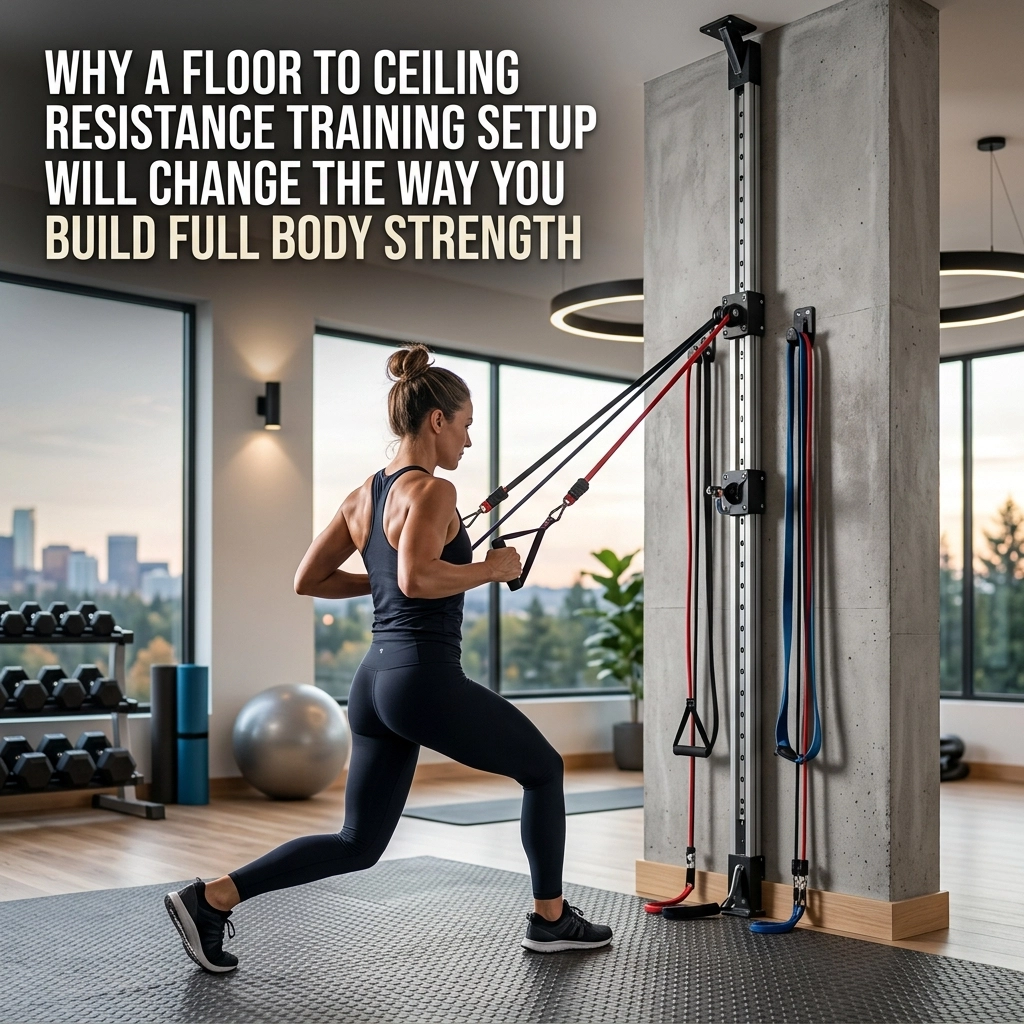
That is where the floor to ceiling gym concept changes everything. Specifically, the Resistance Rail from Bold Body Fitness. We’re talking about a vertical evolution in training that turns your dead wall space into a high-performance training hub.
In this deep dive, we’re going to break down exactly why moving your resistance training to a vertical, floor-to-ceiling setup is the single best move you can make for your home gym in 2026.
The Problem with the "Standard" Home Gym
Most people start their home fitness journey with a set of dumbbells and maybe a shaky door-frame pull-up bar. If they’re serious, they upgrade to a power rack. Don't get me wrong: power racks are great for moving heavy iron: but they have massive limitations for the modern athlete.
- Fixed Points of Contact: Traditional racks offer a handful of fixed positions. If you want to do a high cable pull, you’re stuck with whatever the machine gives you.
- Footprint: They eat space. In an apartment or a small garage, a full rack is a death sentence for your floor plan.
- Wall Damage: Most high-end calisthenics equipment for home requires bolting things into studs. If you’re a renter or just don't want to drill twenty holes into your drywall, you're out of luck.
This is why we developed a no wall damage workout system. We wanted something that provided the stability of a commercial gym with the footprint of a floor lamp.

Why Verticality Matters: The Science of Infinite Angles
Traditional resistance training often ignores the vertical axis. Think about it: when you lift a dumbbell, the resistance is always gravity, pulling straight down. To change the angle, you have to change your body position: lie on a bench, sit at an incline, etc.
A floor to ceiling resistance training setup flips the script. Instead of you moving around the weight, the anchor point moves around you.
Infinite Anchor Points
With a system like the Resistance Rail, you have a continuous track from the floor to the ceiling. This isn't just about "high, medium, and low." This is about micro-adjustments.
- Want to simulate the exact angle of a grappling takedown? Set the rail at hip height.
- Need to work on your Ninja Warrior grip transitions? Slide the anchor to the very top.
- Working on explosive sprint starts? Anchor at the floor.
By having infinite anchor points, you recruit stabilizer muscles that usually stay dormant during standard lifts. This is how you develop "functional" strength: the kind that translates to the mats, the course, or the ring.
The Ultimate Pull Up Bar Alternative
Let’s talk about pull-ups. For most of us, they are the gold standard of bodyweight training at home. But let’s be honest: standard bars are limited. You’re either doing a pull-up or you’re not. There’s no easy way to scale the movement or change the grip width without buying three different pieces of gear.
The Resistance Rail acts as the ultimate pull up bar alternative. Because it spans from floor to ceiling and uses high-tension resistance, you can perform assisted pull-ups that actually mimic the mechanics of the real movement. Even better, for the gymnasts and calisthenics pros, the rail allows for "active" hang variations and dynamic rows that you just can't do on a static bar.
Tailored for the Elite: Who Needs a Floor to Ceiling System?
At Bold Body Fitness, we don’t build gear for the "casual walker." We build gear for people who want to push their limits.
1. The Ninja Warrior & OCR Athlete
Ninja Warriors need grip strength and the ability to generate force from awkward positions. A floor-to-ceiling setup allows you to attach various grips (nunchucks, cannonballs, rings) at any height. You can simulate the "cliffhanger" or "pegboard" movements by utilizing the vertical rail as a support and resistance anchor.
2. The MMA Fighter & Grappler
Grappling is all about tension. In a fight, the "weight" isn't just sitting there; it’s pulling, pushing, and twisting. By using a floor to ceiling gym with heavy-duty resistance bands, you can simulate a clinches or a single-leg takedown defense. The constant tension of the bands mimics the "live" feel of an opponent much better than a static barbell ever could.
3. The CrossFit Athlete
CrossFit is about versatility. You need to go from high-intensity pulling to overhead pressing in seconds. The speed of adjustment on a vertical rail system means your "Work Capacity" stays high because you aren't fumbling with pins and plates. It’s the ultimate crossfit home gym addition for those who need to get their WOD done in a 10x10 spare room.
4. The Gymnast & Calisthenics Practitioner
For those focused on calisthenics equipment for home, the Resistance Rail provides a stable, vertical plane to practice levers, flags, and planches. The ability to add "light" resistance to these advanced moves allows you to bridge the gap between "I can't do this" and "I just mastered it."

Building Your Full Body Workout at Home
What does a workout actually look like on a floor-to-ceiling system? It’s more than just curls and rows. It’s a total-body onslaught. Here is a sample "Bold Power" circuit you can run using the Resistance Rail:
The Bold Power Circuit
- Vertical Rail Squat to Press: Anchor at the floor. Hold the handles at your shoulders. Squat deep and explode upward, pressing the resistance toward the ceiling. (Targets: Quads, Glutes, Shoulders).
- The "Grappler" Woodchopper: Set the anchor at chest height. Stand perpendicular to the rail. Rotate your core with maximum velocity, pulling the resistance across your body. (Targets: Obliques, Core Stability).
- High-to-Low Face Pulls: Set the anchor at the ceiling. Pull toward your face, focusing on the rear delts and upper back. (Targets: Posture, Shoulder Health).
- Resisted Mountain Climbers: Anchor at the floor. Loop the straps around your ankles. Get in a plank and run. (Targets: Hip Flexors, Lower Abs).
- The Assisted Pistol Squat: Use the rail as a stability point while performing one-legged squats. The vertical nature of the rail allows you to "walk" your hand up and down for the perfect amount of support.
Check out more routines at Bold Body Fitness Workouts.
No Wall Damage: The Renter's Dream
One of the biggest hurdles to building a versatile home gym is the "landlord factor." Most high-quality home gym equipment requires you to turn your wall into Swiss cheese.
The Resistance Rail uses a high-tension, floor-to-ceiling pressure mounting system. It’s like a heavy-duty cargo bar for your house. You get the stability to pull hundreds of pounds of tension without a single screw entering your wall.
This makes it the premier no wall damage workout system on the market. Whether you live in a luxury high-rise or a suburban basement, you can have a professional-grade training station that leaves zero trace when you move out.

Maximizing Space and Efficiency
Let’s talk aesthetics. A cluttered house leads to a cluttered mind. If your living room is full of cast iron plates and rubber mats, you’re never going to feel relaxed.
The beauty of the floor to ceiling gym is its footprint. It occupies about 4 square inches of floor space. That’s it. Because the resistance comes from the vertical rail and high-grade bands/cables, you don’t need a rack of 50lb weights taking up space.
When you're done, the handles and bands can be tucked away or left neatly on the rail. It looks like a piece of modern architecture, not a basement gym from 1984.
How to Get Started with Vertical Training
If you're ready to stop playing around with subpar gear and start building elite strength, you need to head over to our Shop Page.
We offer different configurations depending on your ceiling height and your training goals. Whether you’re looking for a basic setup for resistance training or a full-blown Ninja Warrior rig, we’ve got you covered.
Don't forget to join the conversation in our Community Forums. You’ll find MMA fighters, CrossFitters, and calisthenics experts sharing their rail setups and workout tips.

The Bold Body Fitness Philosophy
At Bold Body Fitness, we believe that your environment shouldn't limit your potential. You shouldn't have to choose between a nice home and a hardcore workout.
The Resistance Rail wasn't just built to be another piece of home gym equipment. It was built to be a catalyst. It’s for the person who gets up at 5:00 AM to train before the kids wake up. It’s for the athlete who needs to squeeze in a session between meetings. It’s for anyone who refuses to settle for "average."
Why a Floor to Ceiling Setup is the Future:
- Adaptability: It grows with you. As you get stronger, you just add more resistance or change the angle.
- Safety: No heavy plates to drop on your toes or your floor.
- Speed: Transition from a chest press to a seated row in under three seconds.
- Total Body: From your calves to your traps, there isn't a muscle group the rail can't hit.
Final Thoughts: Level Up Your Strength
The transition to a floor to ceiling resistance training setup is more than just a gear upgrade; it’s a mindset shift. It’s about moving away from the "up-and-down" world of traditional lifting and into a 360-degree world of functional power.
Whether you're looking for a pull up bar alternative, a no wall damage workout system, or the ultimate calisthenics equipment for home, the Resistance Rail is the answer.
Stop letting your space define your strength. Take control of your training, maximize your vertical space, and build the kind of body that’s ready for anything.
Ready to transform your home? Click here to see the Resistance Rail in action and grab yours today.

Want more tips on building the ultimate home gym? Check out our tags on Bodybuilding and Flexibility to see how we’re redefining fitness in 2026.
