
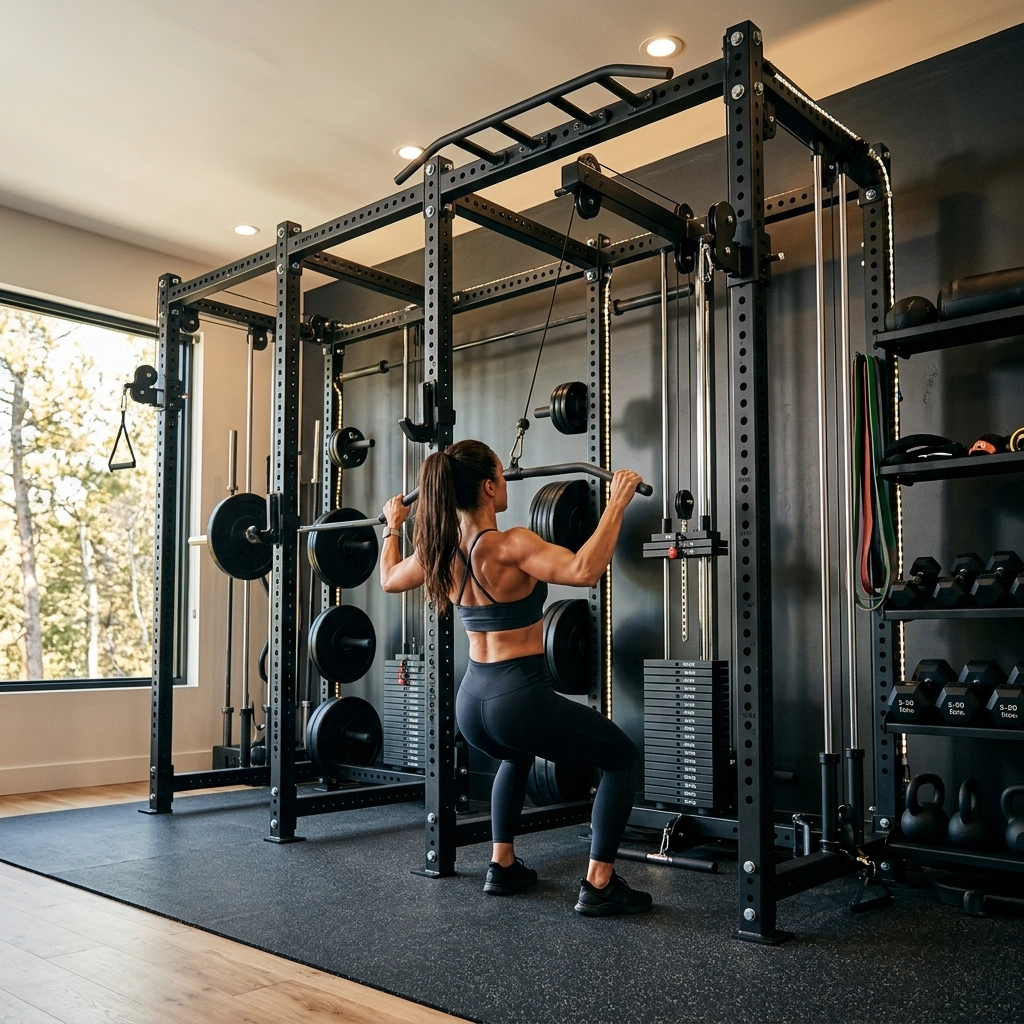
Let’s be real for a second: most home gym equipment is a compromise. You’re either drilling holes into your studs, losing half your garage to a massive power rack, or worse, using one of those flimsy doorway pull-up bars that feels like it’s going to snap your neck every time you attempt a muscle-up.
If you’re a serious athlete: a ninja warrior, a gymnast, a CrossFit fanatic, or an MMA fighter: "good enough" isn't in your vocabulary. You need gear that matches your intensity. You need a system that doesn't just sit in the corner collecting dust but actually expands what’s possible in your training.
Enter the floor to ceiling gym.
At Bold Body Fitness, we didn't want to build just another piece of equipment. We wanted to build a revolution. That’s why we created the Resistance Rail. It’s not just a pull up bar alternative; it’s a high-performance, vertical training axis that turns any room into an elite-level facility without a single drill bit touching your walls.
In this deep dive, we’re going to break down why a floor-to-ceiling system is the ultimate versatile home gym and why it will fundamentally change the way you look at resistance training and bodyweight training at home.
1. The Engineering of Infinite Stability
Most people think they need a 400-pound steel cage to feel safe during a workout. They’re wrong. The secret to stability isn't mass; it’s tension.
A true floor-to-ceiling system, like our Resistance Rail, uses industrial-grade high-tension compression. We’re talking about thousands of pounds of force holding a vertical rail between your floor and your ceiling. This isn't a "tension rod" for a shower curtain. This is a structural powerhouse.
For the CrossFit home gym enthusiast or the calisthenics equipment for home seeker, stability is everything. When you’re performing explosive pull-ups or weighted dips, you cannot have the equipment shifting. By utilizing the structural integrity of your home’s floor and ceiling joists, the Resistance Rail creates a rock-solid anchor point that stays put.
And the best part? It’s a no wall damage workout system. If you’re a renter or just someone who respects their drywall, this is a game-changer. You get the stability of a bolted-down rack with the flexibility of a portable system.

2. Unlocking the Third Dimension: The Power of Verticality
Most traditional home gym equipment limits you to moving in two dimensions: forward/backward and side-to-side. But elite human movement happens on a vertical axis.
When you train with a floor-to-ceiling rail, you’re unlocking "The Third Dimension." Think about it: most racks have holes spaced every 2 to 4 inches. If you want to set your resistance band at the perfect height for a chest fly or a face pull, you’re often stuck with "close enough."
The Resistance Rail offers infinite anchor points. Because it’s a continuous track, you can slide your attachments to the exact millimeter that fits your biomechanics. This is crucial for resistance training. Changing the angle of a band by just three inches can completely shift the muscle recruitment from your upper pecs to your mid-back.
For gymnasts and ninja warriors, this verticality allows for:
- Progressive height adjustments for ring work.
- Variable grip heights for vertical climbing drills.
- Ceiling-to-floor transitions that simulate real-world obstacles.
3. The Ultimate Pull Up Bar Alternative
We’ve all seen the doorway bars. They limit your range of motion, they’re narrow, and they’re frankly dangerous for high-level calisthenics.
A floor-to-ceiling gym is the superior pull up bar alternative. Because the rail stands away from the wall, you have 360 degrees of space. Want to do 360-degree pull-ups? Go for it. Want to practice your back levers or front levers without kicking the drywall? You finally have the room.
If you’re serious about calisthenics equipment for home, you know that "space" is your most valuable asset. The Resistance Rail gives you that space by utilizing the "dead air" in the middle of your room or against a wall without being intrusive.

4. Why MMA Fighters and CrossFit Athletes are Switching
If you’re in the fight game or the CrossFit world, your training is high-intensity and high-variety. You don't have time to spend ten minutes adjusting pins and plates.
The versatility of a floor-to-ceiling system allows for rapid-fire transitions. You can go from high-tension band work (simulating a clinch or a takedown) to explosive pull-ups in seconds.
For MMA:
- Clinch Resistance: Attach heavy bands to the mid-point of the rail to work on your neck strength and pummeling drills.
- Rotational Power: Use the infinite anchor points to set bands at hip height for explosive punching and kicking drills.
- Isometric Holds: Use the stability of the rail for isometric pushing and pulling, mimicking the grind of a grappling match.
For CrossFit:
- Efficiency: The small footprint means you can place the rail right next to your rower or bike for seamless EMOMs or AMRAPs.
- Versatility: It acts as a mounting point for rings, TRX systems, and heavy-duty resistance bands, making it a true full body workout at home hub.
5. Space Efficiency: The "Floor Lamp" Footprint
One of the biggest hurdles to building a versatile home gym is space. Not everyone has a 3-car garage to turn into a "Pain Cave."
A floor-to-ceiling gym takes up roughly the same square footage as a floor lamp. By going vertical, you reclaim your floor space. This is why it’s the gold standard for urban dwellers and apartment athletes. You can have a professional-grade training station in the corner of your living room that looks sleek, modern, and: dare we say: Bold.
Check out our shop to see how the slim profile of the Resistance Rail fits into any aesthetic without screaming "clunky gym gear."
6. A Deep Dive into Resistance Training Biomechanics
Why does the "infinite adjustment" of a floor-to-ceiling rail matter so much for resistance training? It comes down to the resistance curve.
When you use traditional weights, gravity is the only force. It always pulls down. When you use resistance bands attached to a vertical rail, you control the direction of the force.
If you’re rehabbing an injury or looking to target a specific "sticking point" in your bench press or squat, you need the band to be at a very specific height to provide the right tension at the right moment of the lift. Standard racks fail here. The Resistance Rail excels.
By being able to slide your anchor point to any height, you can ensure that the band is always perpendicular to your limb at the point of maximum contraction. That is how you maximize hypertrophy and strength gains.

7. The "No Wall Damage" Guarantee
Let’s talk about the "no wall damage" factor again. Most high-end home gym equipment requires you to find a stud, drill massive holes, and hope you don't hit a wire or a pipe. When you move, you’re left with a mess to patch and paint.
The Resistance Rail uses industrial-grade, non-marking pads on both the floor and the ceiling. The compression mechanism is so powerful it creates a structural bond that feels like it’s part of the building, yet it can be removed in minutes without leaving a trace.
This makes it the only viable full body workout at home solution for people who value their security deposit or their home’s resale value. You can find more details on our technical specs in our sitemap or product pages.
8. Calisthenics: From Beginner to Human Flag
If you’re into bodyweight training at home, you know that the "Human Flag" is one of the ultimate tests of strength. But how do you train for it? You need a vertical pole that won't budge.
Most home setups don't offer a vertical grip option. They only offer horizontal bars. A floor-to-ceiling rail provides that vertical axis. You can practice your grip transitions, your vertical pulls, and your core stabilization in ways that a standard pull-up bar simply won't allow.
Calisthenics equipment for home should be about removing limits, not creating them. With the Resistance Rail, you can attach:
- Gymnastic Rings for dips and muscle-up progressions.
- Parallel Handles for neutral grip pull-ups.
- Resistance Bands for assisted movements (perfect for mastering your first pull-up or muscle-up).

9. Building a Full Body Workout at Home
You don't need a dozen machines. You need one solid anchor. Here is how you can perform a full body workout at home using only a floor-to-ceiling rail and a few attachments:
Upper Body:
- Pull-Ups/Chin-Ups: Utilize the top anchor for traditional pulls.
- Incline/Decline Push-Ups: Use a mid-level attachment for handles or rings to vary the angle of your presses.
- Band-Resisted Rows: Set the anchor at chest height for heavy horizontal pulling.
Lower Body:
- Assisted Pistol Squats: Hold onto the rail or a mid-level handle for balance as you master the single-leg squat.
- Band-Resisted Deadlifts/Squats: Anchor the bands at the very bottom of the rail to add accommodating resistance to your lower body movements.
- Hamstring Curls: Use a low anchor with bands to isolate the hamstrings.
Core:
- Hanging Leg Raises: Use the top bar for maximum core recruitment.
- Pallof Presses: Set the anchor at shoulder height for the ultimate anti-rotational core workout.
- Woodchoppers: Move the anchor from high to low to hit your obliques from every angle.
10. The Bold Body Fitness Philosophy
At Bold Body Fitness, we believe that your environment shouldn't dictate your results. Whether you’re training in a high-end garage or a studio apartment, you deserve equipment that is over-engineered and built for the long haul.
The Resistance Rail Standard is the culmination of years of testing. We didn't just want something that worked; we wanted something that felt like a piece of professional athletic equipment.
When you step up to a Resistance Rail, you feel the tension. You feel the quality of the steel. You feel the stability that only a floor-to-ceiling system can provide. It’s an invitation to train harder, push further, and be bolder.

11. Comparing the Alternatives: Why Floor-to-Ceiling Wins
Let's look at the scoreboard.
| Feature | Power Rack | Doorway Bar | Floor-to-Ceiling Rail |
|---|---|---|---|
| Footprint | Massive (4'x4' minimum) | Small | Tiny (4"x4" at base) |
| Stability | High (if bolted) | Low (Dangerous) | Extremely High |
| Wall Damage | High (Bolts) | Medium (Frame crushing) | Zero |
| Adjustability | Fixed Holes | None | Infinite |
| Versatility | High | Low | Highest |
| Price | $500 - $2000+ | $30 - $100 | Mid-range / High Value |
The choice is clear. If you want the performance of a power rack without the bulk and the "no-drill" convenience of a doorway bar without the risk, the floor-to-ceiling gym is the only logical conclusion.
12. Conclusion: Stop Waiting, Start Training
The "perfect time" to build your home gym is now. Stop letting space constraints or rental agreements hold back your progress. Whether you’re looking for calisthenics equipment for home, a CrossFit home gym solution, or just the best pull up bar alternative on the market, the Resistance Rail is the answer.
You’re an athlete. You’re a warrior. You deserve a setup that can keep up with you.
Visit the Bold Body Fitness homepage to learn more about our mission, or head straight to our shop to grab your own Resistance Rail. It’s time to stop training in two dimensions and start dominating the third.
Be Bold. Train Hard. Leave no marks.
Want to dive deeper into the technical side of our gear?
Check out our workout entries for specific training routines or browse our product tags to find the perfect attachments for your specific sport. We’re constantly updating our resources to help you get the most out of your floor to ceiling gym.
