
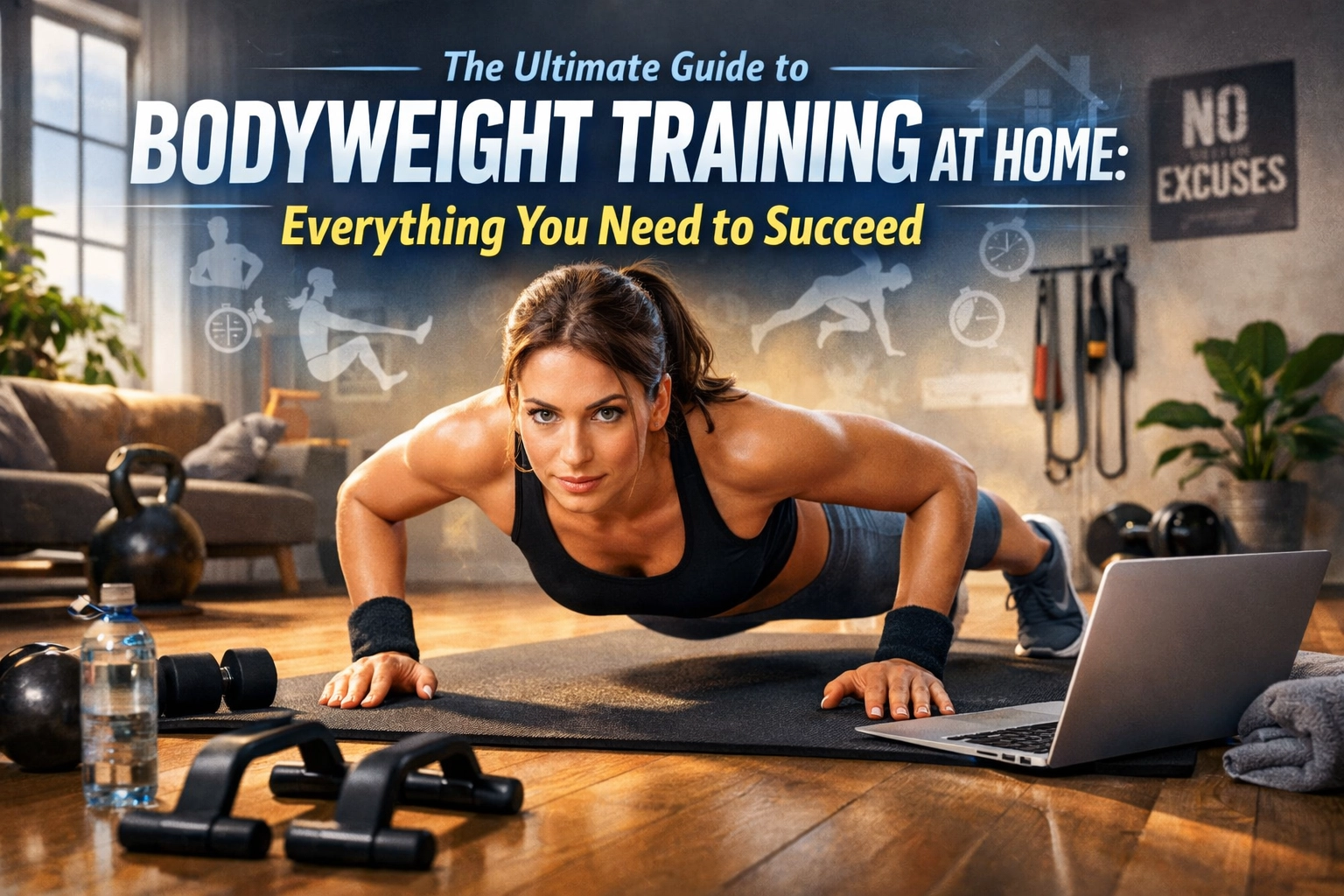
Look, I'm going to be straight with you: you don't need a fancy gym membership or thousands of dollars in equipment to build an incredible physique. Bodyweight training at home is one of the most effective, straightforward ways to develop real-world strength, explosive power, and the kind of functional fitness that translates to actual performance.
Whether you're a ninja warrior crushing obstacles, a CrossFit athlete looking to dominate your next WOD, an MMA fighter building fight-ready conditioning, or a calisthenics practitioner chasing that first muscle-up: this guide will give you everything you need to succeed with bodyweight training.
Why Bodyweight Training Actually Works
Bodyweight training isn't just "beginner stuff." It's how gymnasts build some of the most impressive physiques in sports. It's how special forces operators stay combat-ready. It's how movement specialists develop incredible body control.
The beauty of bodyweight training at home is its simplicity and effectiveness. You're moving your body through space, developing coordination, balance, and proprioception while building muscle and strength. Plus, you can train anywhere, anytime: no excuses.
When you master your own bodyweight, you develop functional strength that carries over to everything else you do. Can you bang out 20 perfect push-ups? Great. Now try 10 deficit push-ups with your hands elevated and your chest dropping below hand level. Still think bodyweight training is easy?
The Four Pillars: Foundational Movements You Can't Ignore
Every effective bodyweight program is built on four fundamental movement patterns. Master these, and you've got the foundation for a full body workout at home that rivals anything you'd do in a commercial gym.
1. Push-Ups: The Ultimate Upper Body Builder
Push-ups train your chest, shoulders, triceps, and abs all at once. But here's where most people go wrong: they rush through reps with terrible form, wondering why they're not seeing results.
Progression pathway:
- Incline push-ups: Hands elevated on a bench or table, making the movement easier
- Standard push-ups: The classic variation everyone should master
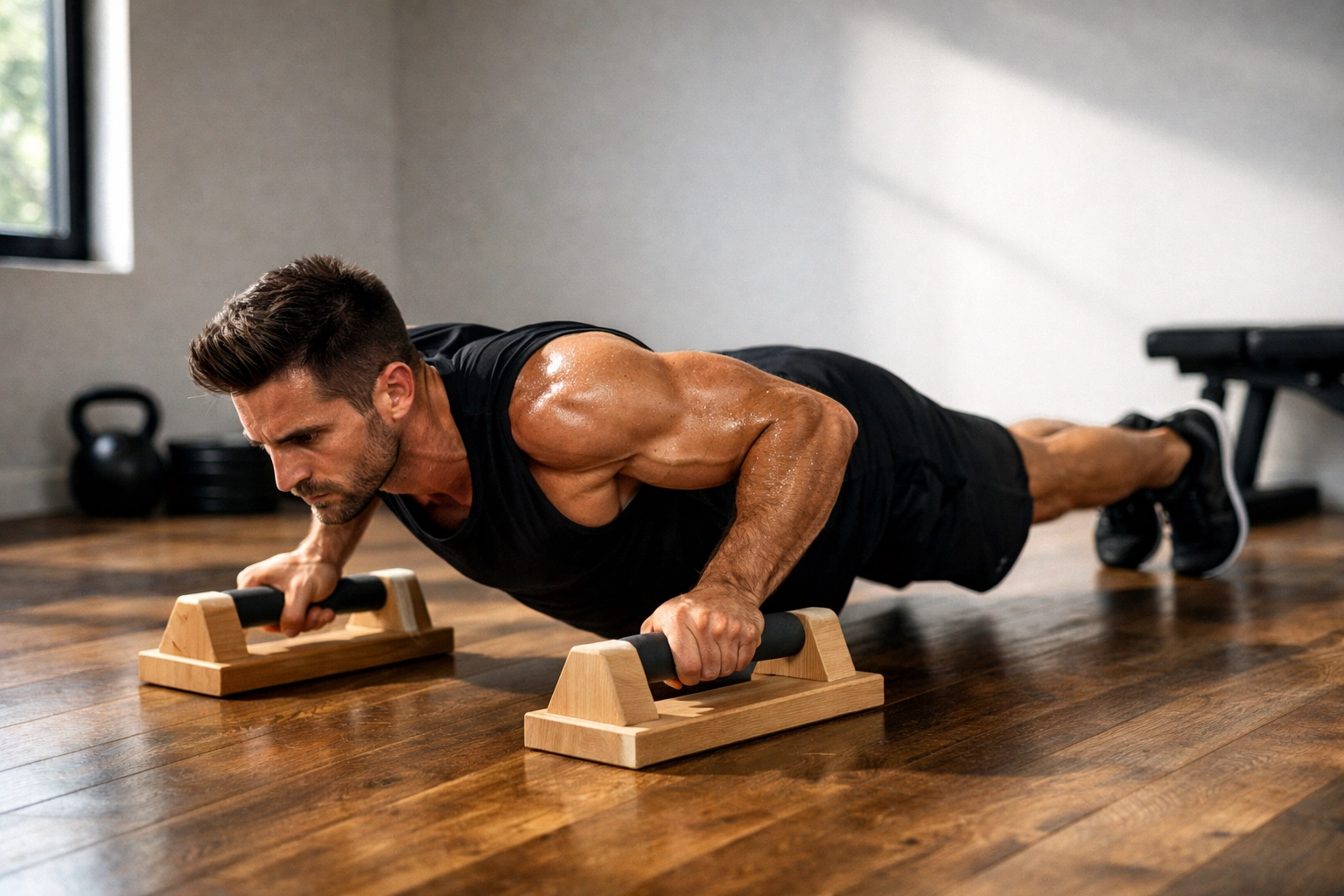
- Deficit push-ups: Hands on elevated surfaces (like parallettes or books), allowing your chest to drop deeper for increased range of motion
- Explosive push-ups: Add a clap or push yourself off the ground
- Pseudo planche push-ups: Lean forward with hands positioned lower, engaging shoulders heavily
2. Squats: Building Bulletproof Legs
Your legs contain the largest muscle groups in your body. Neglect them at your own peril.
Progression pathway:
- Air squats: Master 20+ perfect reps
- Jump squats: Add explosive power
- Bulgarian split squats: Single-leg variation that crushes your quads and glutes
- Pistol squats: The king of bodyweight leg exercises: full single-leg squat to the floor
Want to make pistols easier? Start by holding onto a door frame or pole for balance. As you get stronger, use less assistance until you're flying solo.
3. Pull-Ups/Chin-Ups: The Pull Movement You Need
This is where most home trainers hit a wall, literally. How do you do pull-ups without a pull-up bar drilled into your doorframe or wall?
That's where innovative equipment comes into play. A pull up bar alternative like the Resistance Rail from Bold Body Fitness gives you a floor to ceiling gym setup that requires zero wall damage and provides multiple grip positions for varied training.
Progression pathway:
- Negative chin-ups: Jump to the top position, lower yourself slowly over 5-10 seconds
- Band-assisted pull-ups: Use resistance bands for assistance
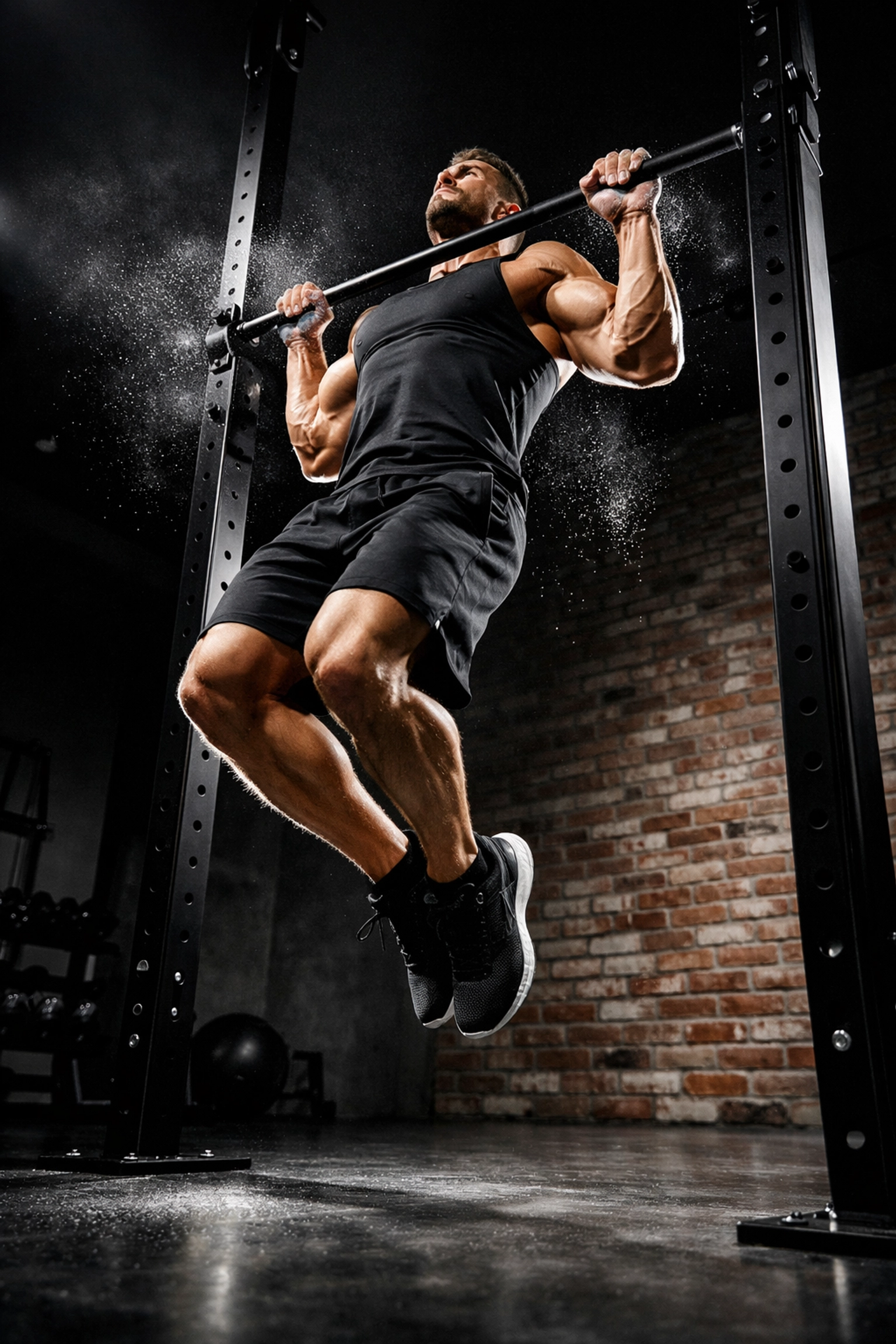
- Standard pull-ups/chin-ups: Full dead hang to chin over bar
- Weighted pull-ups: Add a weight vest or hold a dumbbell between your feet
- Muscle-ups: The ultimate pulling exercise combining a pull-up and dip
4. Posterior Chain Work: Building Your Backside
Your hamstrings, glutes, and lower back need attention too. Without a barbell, you'll need to get creative.
Options include:
- Single-leg Romanian deadlifts: Balance on one leg while hinging at the hip
- Nordic curls: Anchor your feet and lower yourself forward (brutal on hamstrings)
- Glute bridges and hip thrusts: Lie on your back and drive through your heels
- Towel deadlifts: Stand on a towel and pull upward, creating isometric tension
Structuring Your Bodyweight Training Program
Here's the reality: random workouts create random results. You need a system.
Week 1-2: Foundation Building
- 2-3 full-body workouts per week
- 2 sets of each foundational movement
- Focus on perfect form and full range of motion
- Rest 2-3 minutes between sets
Week 3-4: Volume Increase
- 3-4 full-body workouts per week
- 3 sets of each movement
- Begin adding accessory exercises (dips, leg raises, etc.)
- Rest 90-120 seconds between sets
Week 5+: Progressive Overload
- 4-5 workouts per week (can split upper/lower or push/pull)
- 3-4 sets of each movement
- Progress to harder variations
- Add circuits, supersets, or EMOM (every minute on the minute) formats

Taking Your Training to the Next Level with Smart Equipment
While you can absolutely make gains with pure bodyweight training, strategic equipment amplifies your results. I'm not talking about buying a garage full of machines: I'm talking about versatile home gym solutions that multiply your exercise options.
The Resistance Rail is a game-changer for serious home trainers. It's a no wall damage workout system that installs between your floor and ceiling (no drilling, no anchors, no permanent modifications). Think of it as your personal calisthenics equipment for home that opens up dozens of new movement possibilities:
- Pull-up and chin-up variations with multiple grip widths
- Muscle-up training with adjustable height options
- Ring work for gymnastic strength building
- Suspension training when you add TRX or rings
- Resistance band training with multiple anchor points
- Core exercises like hanging leg raises and L-sits
For CrossFit athletes building a crossfit home gym, ninja warriors practicing obstacle transitions, or calisthenics practitioners chasing advanced skills: this kind of versatile setup is invaluable. Check out more options in the Bold Body Fitness shop.
Sample Workouts That Deliver Results
The Strength Builder (45 minutes)
Block 1: Push
- Push-ups: 4 sets to near failure
- Pike push-ups: 3 sets of 8-12
- Tricep dips: 3 sets of 10-15
Block 2: Pull
- Pull-ups/chin-ups: 4 sets to near failure
- Australian rows: 3 sets of 12-15
- Scapular pull-ups: 3 sets of 10
Block 3: Legs
- Bulgarian split squats: 3 sets of 10 each leg
- Jump squats: 3 sets of 15
- Single-leg glute bridges: 3 sets of 12 each leg
Block 4: Core
- Hanging leg raises: 3 sets of 10-15
- Plank holds: 3 sets of 45-60 seconds
The Conditioning Circuit (20 minutes)
Perform 4 rounds with minimal rest:
- 10 burpees
- 15 push-ups
- 20 air squats
- 10 pull-ups (or rows)
- 15 mountain climbers each side
- 20-second L-sit or plank hold
Rest 60-90 seconds between rounds.
The Skill Development Session (30 minutes)
Focus on one advanced skill per session:
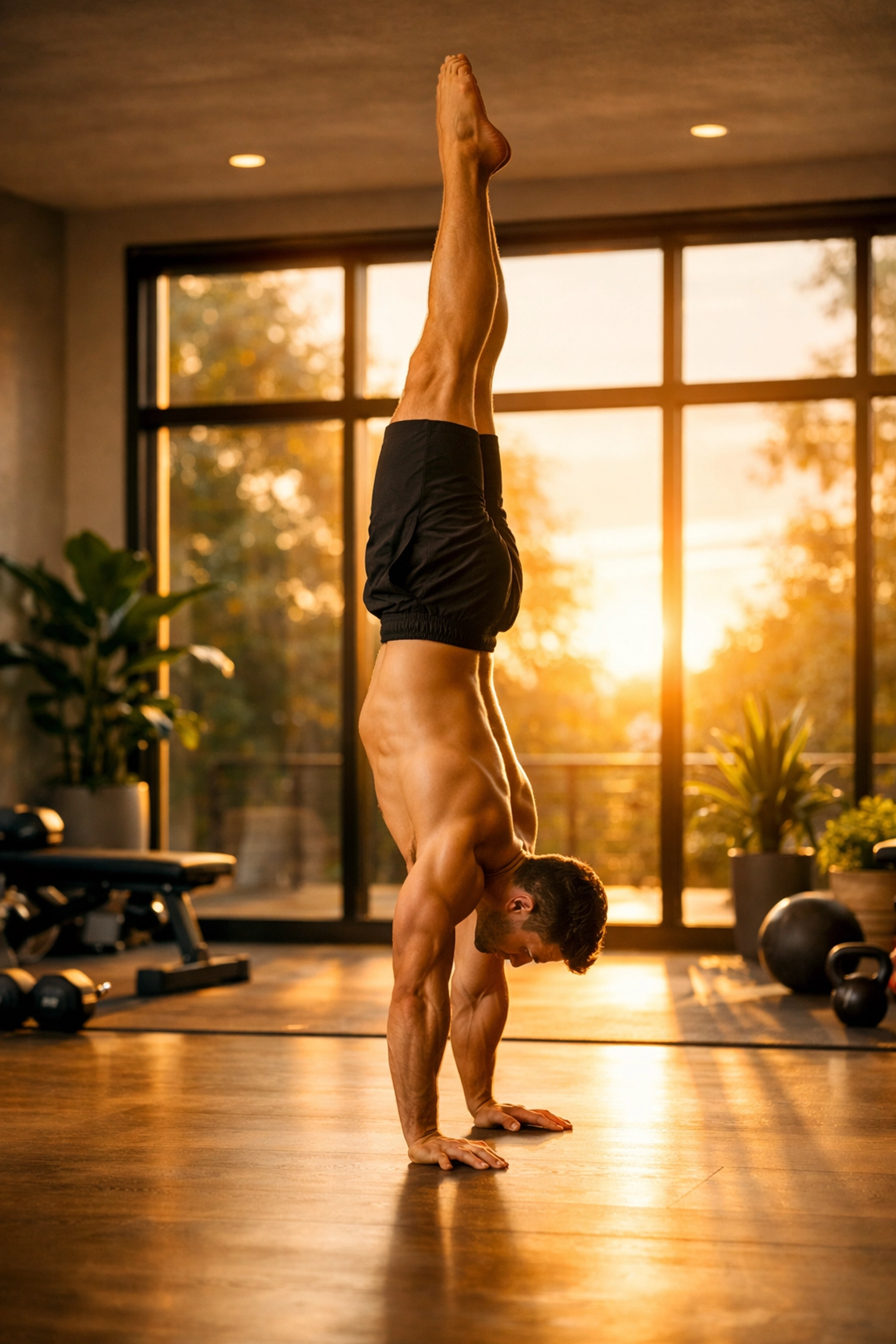
- Handstand practice: 10 minutes of wall handstands, shoulder taps, and holds
- Pistol squat progressions: 15 minutes working through the progression
- Muscle-up transitions: 5 minutes practicing the explosive pull and dip transition
Advanced Progression Strategies
Once you've built a solid foundation, these tactics will keep you progressing:
1. Tempo Training: Slow down your reps. Try a 3-1-3-1 tempo (3 seconds down, 1 second pause, 3 seconds up, 1 second pause). You'll build serious time under tension.
2. Isometric Holds: Add 10-30 second holds at the hardest point of each exercise. Bottom of a pistol squat? Hold it. Top of a pull-up? Hold it.
3. One-and-a-Half Reps: Complete a full rep, come halfway back up, go back down, then complete the rep. That's one rep. Your muscles will hate you.
4. Cluster Sets: Do 3 reps, rest 15 seconds, do 3 more reps, rest 15 seconds, do 3 more reps. That's one cluster set. This lets you accumulate high-quality volume.
5. Skill Work: Dedicate 10-15 minutes before or after your workout to practicing advanced movements like handstands, levers, or flags.
Common Mistakes That Kill Progress
Mistake #1: Skipping progressions. You can't go from regular push-ups to one-arm push-ups overnight. Respect the progressions.
Mistake #2: Training to absolute failure every set. Leave 1-2 reps in the tank on most sets. This allows better recovery and more consistent training.
Mistake #3: Ignoring mobility and flexibility. If you can't get into proper positions, you can't perform exercises effectively. Spend 10 minutes daily on mobility work.
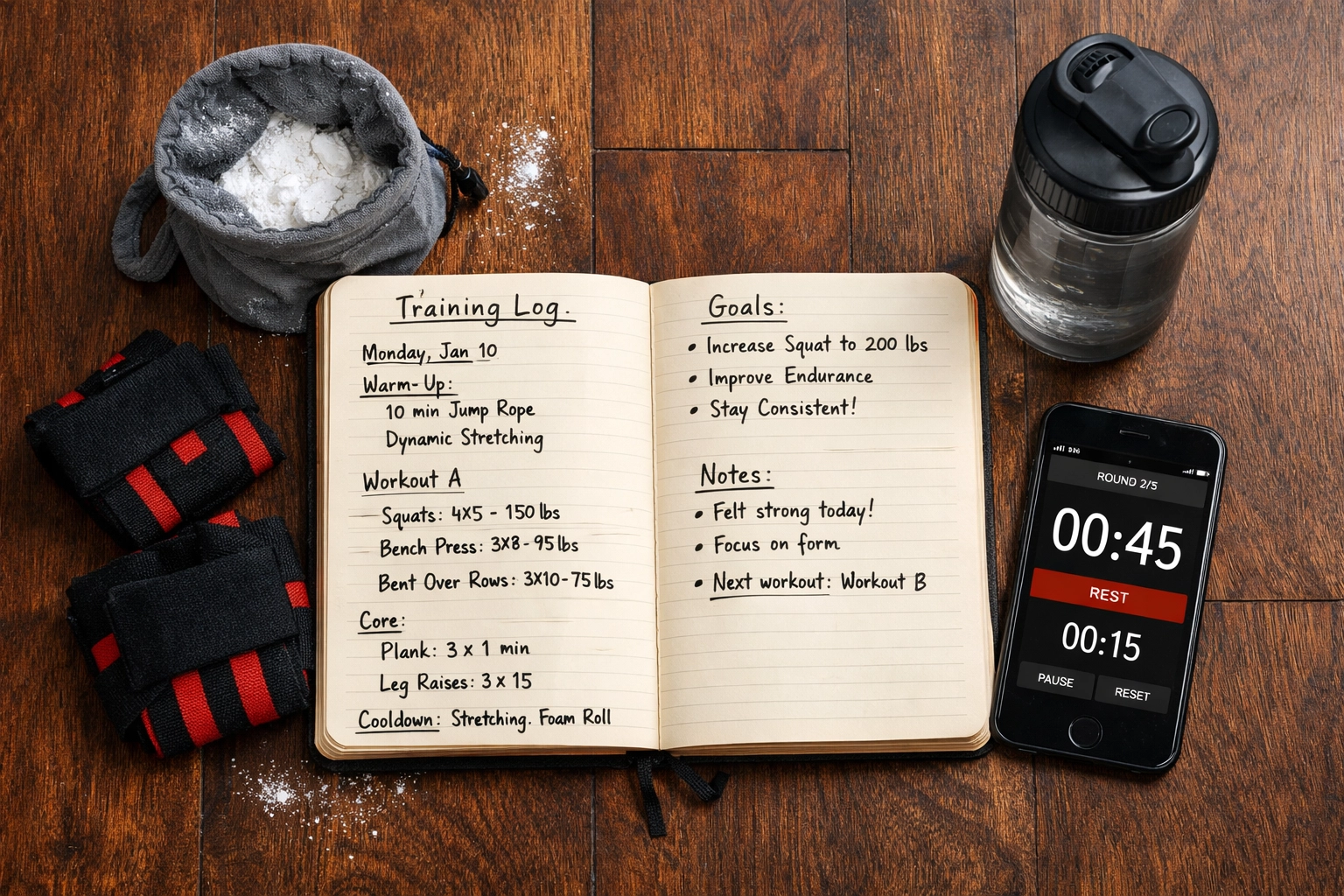
Mistake #4: Not tracking your workouts. Write down your reps, sets, and which progressions you're using. What gets measured gets improved.
Mistake #5: Neglecting recovery. Your muscles grow during rest, not during training. Get 7-9 hours of sleep, eat adequate protein, and take rest days seriously.
Your Bodyweight Training Blueprint
Here's your action plan:
Phase 1 (Weeks 1-4): Build the Foundation
Master the basic progressions of all four foundational movements. Train 3-4 times per week. Focus on form above all else.
Phase 2 (Weeks 5-8): Increase Volume
Add more sets, more exercises, and start incorporating harder variations. Train 4-5 times per week.
Phase 3 (Weeks 9-12): Specialize and Progress
Choose 2-3 advanced skills or movements to focus on. Continue building strength in your basics while dedicating extra time to your specialty skills.
Phase 4 (Weeks 13+): Master Your Domain
You're now an intermediate-to-advanced trainee. Program your own workouts, experiment with different training styles, and continue pushing toward elite-level movements.
The Bottom Line
Bodyweight training at home isn't a compromise: it's a choice made by some of the strongest, most athletic people on the planet. With the right progressions, consistent effort, and strategic equipment choices, you can build an incredible physique and jaw-dropping strength without ever stepping foot in a commercial gym.
The key is showing up consistently, progressing intelligently, and being honest with yourself about your effort level. Your body doesn't know if you're in a fancy gym or your living room: it only knows tension, time under load, and progressive overload.
Start with the basics, respect the progressions, and don't be afraid to invest in quality equipment that expands your training options. Whether you're training for obstacle course racing, martial arts, gymnastics, or just want to look and feel incredible: bodyweight training delivers.
Ready to take your home training to the next level? Explore the full range of versatile home gym equipment at Bold Body Fitness and build the setup that matches your ambitions.
Now stop reading and go train.
