
Let's cut through the noise.
You're not here because you're looking for another "beginner-friendly" workout routine. You're here because you're serious about your training. Maybe you're a calisthenics practitioner chasing that muscle-up. A CrossFit athlete who needs to train on off days. A ninja warrior building grip strength for competition. Or an MMA fighter who refuses to let location determine fitness level.
Whatever your discipline, you've hit the same wall everyone hits eventually: your full body workout at home has plateaued, and you're wondering how to break through without dropping hundreds monthly on a gym membership.
Good news. You're about to learn exactly how to level up your home training, faster than you thought possible.
Why Most Home Workouts Stop Working
Here's the brutal truth about bodyweight training at home: it stops being effective the moment you stop challenging yourself.
Your body is an adaptation machine. Do the same push-ups, the same squats, the same planks week after week, and your muscles get comfortable. They stop growing. Your strength gains flatline. And suddenly, that home workout that used to leave you gassed barely breaks a sweat.
The problem isn't home training itself. The problem is that most people don't know how to progressively overload without a rack full of weights at their disposal.
The Three Pillars of Home Workout Progression
Before we talk equipment, let's talk strategy. Because even the best calisthenics equipment for home won't help if you don't understand the fundamentals of progression.
1. Progressive Overload (Without Adding Weight)
Progressive overload doesn't require dumbbells. It requires creativity.
Think about it: a regular push-up becomes a decline push-up becomes an archer push-up becomes a one-arm push-up progression. Each variation increases the load on your muscles without adding a single pound of external weight.
The same principle applies across every movement pattern:
- Squats → Pistol squat progressions
- Rows → Front lever progressions
- Dips → Weighted or ring dip variations
- Pull-ups → Muscle-up progressions
The key is treating each workout as an opportunity to do slightly more than last time. More reps. Harder variation. Longer hold. Something has to change.
2. Time Under Tension
Want to make a bodyweight exercise brutally effective? Slow it down.
Instead of banging out 20 quick push-ups, try 10 with a 3-second descent and a 2-second pause at the bottom. Your muscles don't count reps, they respond to time under load.
This technique transforms basic movements into muscle-building monsters. A 30-second wall sit becomes a 60-second wall sit with a pause at the deepest point. A standard pull-up becomes a controlled 5-second negative.
Time under tension is how you squeeze maximum results from minimum equipment.
3. Training Close to Failure
Here's where most home trainers leave gains on the table.
If you finish your set and could easily do five more reps, you didn't train hard enough. Period. Real muscle growth happens in those final, grinding repetitions where your body is screaming to stop.
Every working set should end with only 1-3 reps left in the tank. That's the sweet spot for hypertrophy and strength gains.
The Equipment Gap: Why Bodyweight Alone Has Limits
Now let's address the elephant in the room.
Pure bodyweight training is powerful. But it has limitations, especially when it comes to building a truly versatile home gym that supports full body workout at home programming.
Think about pull movements. Without something to hang from, you're limited to floor-based exercises that don't fully engage your lats, biceps, and grip. Think about resistance training that challenges your muscles through every plane of motion. Think about the explosive movements that CrossFit athletes and ninja warriors need to practice.
You need anchor points. You need something to pull against, hang from, and push off of.
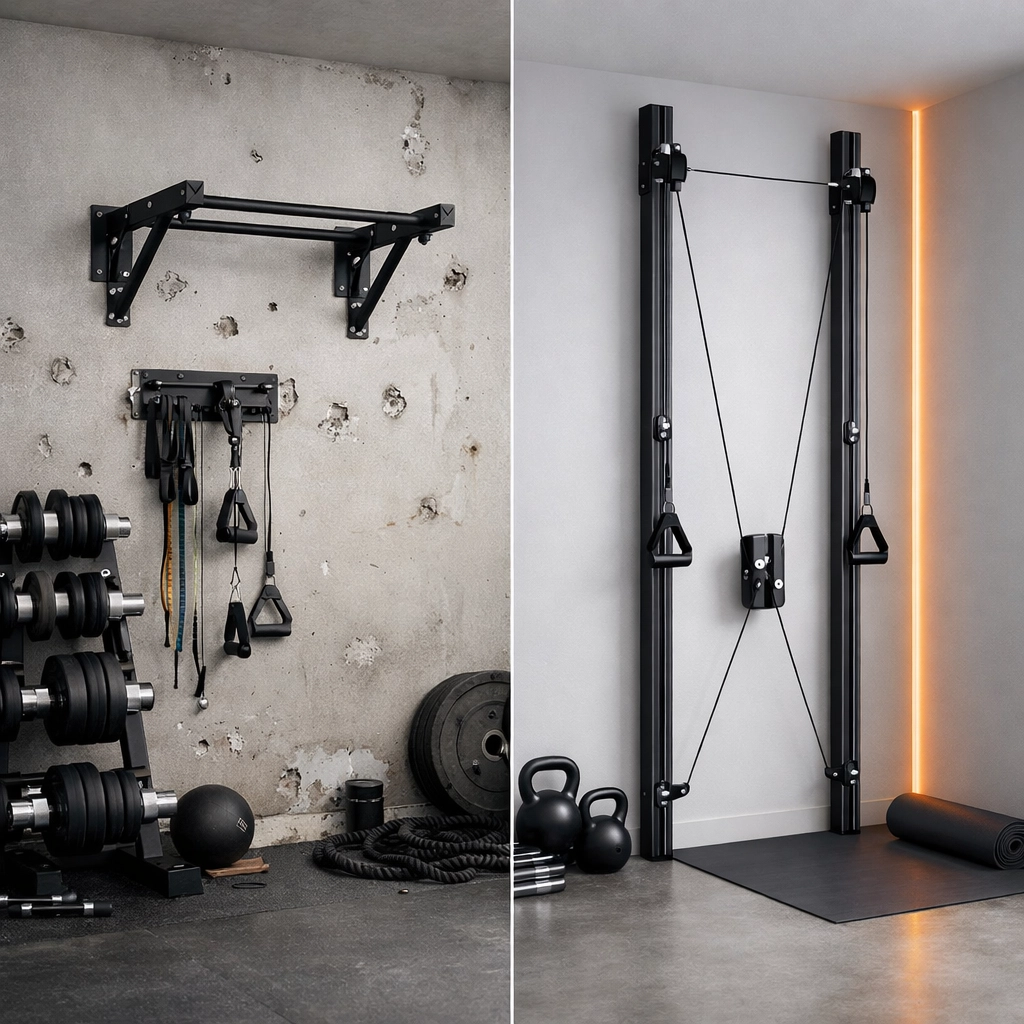
This is where most home gym setups fall short. Traditional pull up bar alternatives either:
- Require wall damage (hello, security deposit)
- Don't support dynamic movements
- Take up too much floor space
- Look like industrial equipment in your living room
Enter the Floor to Ceiling Gym Concept
Here's the game-changer that serious athletes are discovering: the floor to ceiling gym setup.
Unlike wall-mounted equipment or doorway bars that limit your exercise selection, a floor-to-ceiling system creates anchor points at multiple heights. This means you can train:
- Pull movements (rows, pull-ups, muscle-up progressions)
- Push movements (dips, incline push-ups, decline push-ups)
- Core work (hanging leg raises, ab rollouts)
- Resistance band training (banded squats, face pulls, rotational movements)
- Suspension training (TRX-style exercises)
- Grip work (dead hangs, towel hangs, farmer carries)
The beauty of a no wall damage workout system? You get commercial gym functionality without destroying your rental, apartment, or home.
At Bold Body Fitness, we built the Resistance Rail specifically for athletes who refuse to compromise. It's a floor-to-ceiling tension system that creates multiple attachment points for bands, straps, rings, and more: without a single screw in your wall.
Building Your Versatile Home Gym Setup
Let's get practical. Here's how to build a crossfit home gym or calisthenics setup that actually delivers results.
Essential Equipment Tier
Start here:
- Floor to ceiling anchor system (like the Resistance Rail)
- Resistance bands (multiple tensions)
- Gymnastic rings or suspension straps
- Ab wheel
This minimal setup enables hundreds of exercises and supports progressive overload for years.
Advanced Equipment Tier
Level up with:
- Weighted vest (for added resistance on bodyweight movements)
- Parallettes (for L-sits, handstand work, and planche progressions)
- Kettlebell or two (for ballistic movements)
The goal isn't to recreate a commercial gym. It's to build a training space that supports your specific goals without clutter or compromise.

Full Body Workout Programming That Actually Works
Equipment means nothing without smart programming. Here's how to structure your full body workout at home for maximum results.
The Compound Movement Foundation
Every session should prioritize compound movements: exercises that engage multiple muscle groups simultaneously. These movements build functional strength, burn more calories, and deliver better results than isolation exercises.
Your compound movement menu:
- Squat variations (goblet, pistol progressions, jump squats)
- Hinge movements (Romanian deadlifts, kettlebell swings, good mornings)
- Horizontal push (push-up variations, ring push-ups, dips)
- Horizontal pull (rows, ring rows, band pulls)
- Vertical push (pike push-ups, handstand push-up progressions)
- Vertical pull (pull-ups, chin-ups, muscle-up progressions)
- Carry movements (farmer carries, overhead carries)
Sample Full Body Session
Here's a workout template that hits every major movement pattern:
Warm-Up (5-10 minutes)
- Jump rope or jumping jacks: 2 minutes
- World's greatest stretch: 5 reps per side
- Band pull-aparts: 15 reps
- Bodyweight squats: 10 reps
Strength Circuit (3-4 rounds)
- Pull-ups or ring rows: 8-12 reps
- Bulgarian split squats: 10 reps per leg
- Ring dips or push-up variation: 10-15 reps
- Single-leg Romanian deadlift: 8 reps per leg
- Hanging leg raises: 10-15 reps
Rest 60-90 seconds between rounds.
Finisher
- Plank hold: Max time
- Dead hang: Max time
This session hits your entire body, emphasizes compound movements, and can be scaled from beginner to advanced by adjusting exercise variations.
Sport-Specific Training at Home
Different athletes need different approaches. Here's how to customize your home gym equipment setup for specific disciplines.
For Ninja Warriors
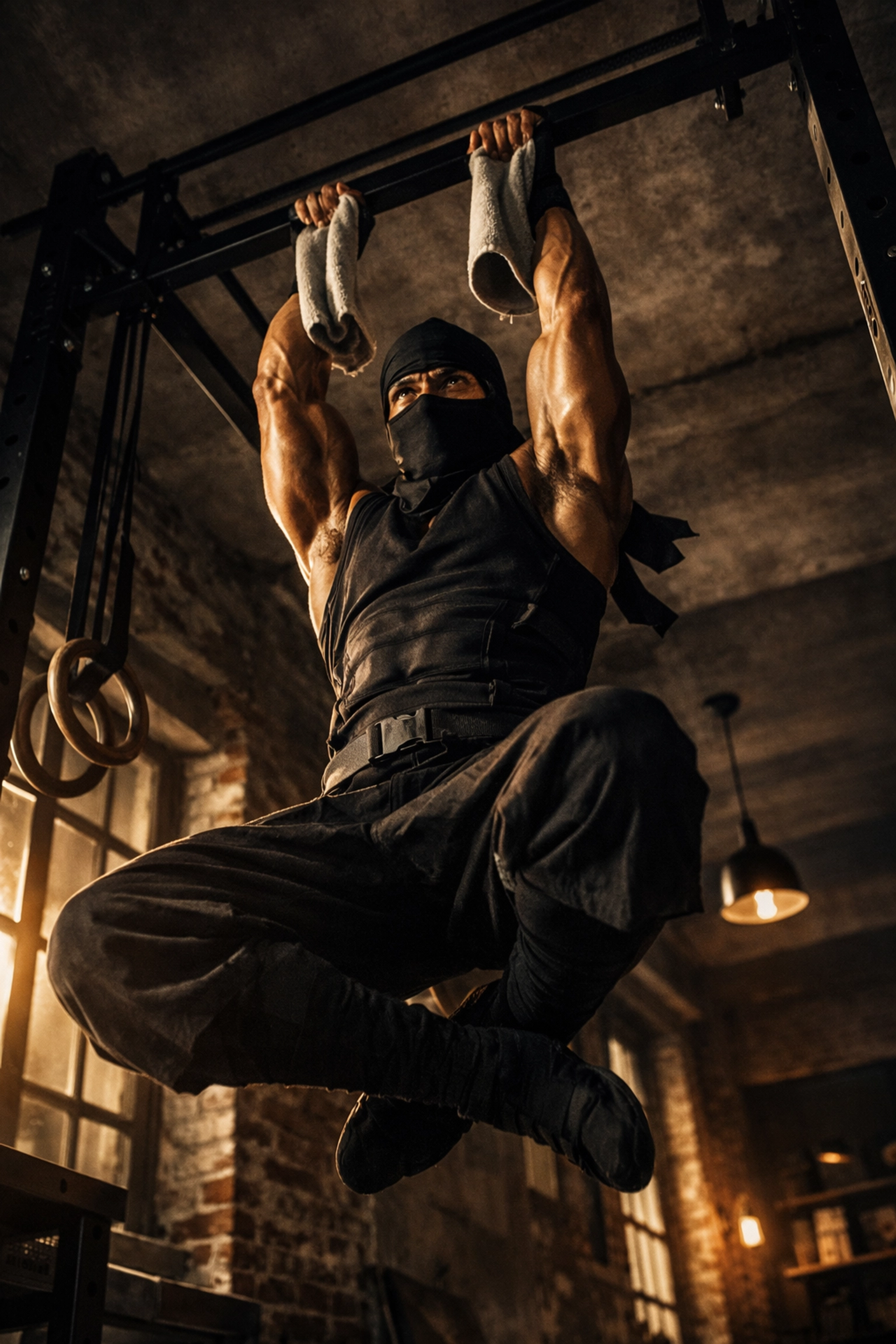
Focus on grip strength, pulling power, and explosive movements. The Resistance Rail Deluxe setup allows you to practice dead hangs, towel hangs, and lache movements. Add grip trainers and hangboard work for competition-ready forearms.
For CrossFit Athletes
Your home training should complement box workouts. Focus on skill work (muscle-up progressions, handstand practice) and conditioning (EMOM workouts, AMRAPs using resistance bands and bodyweight). A versatile home gym lets you train movements that need extra practice without waiting for equipment at a crowded box.
For Calisthenics Practitioners
Progressive calisthenics requires stable anchor points for front lever, planche, and muscle-up progressions. Invest in quality gymnastic rings and a floor to ceiling system that won't wobble during dynamic movements. Check out our guide on building a beast-mode home gym without destroying your walls for detailed setup tips.
For MMA Fighters
Combat athletes need rotational power, core stability, and full-body conditioning. Resistance bands attached to a stable anchor point enable rotational exercises, sprawl drills, and explosive pulling movements that translate directly to grappling and striking.
The Consistency Factor
Here's the unsexy truth that nobody wants to hear: the best workout program is the one you actually do.
Having a versatile home gym removes the biggest barrier to consistency: access. No commute. No waiting for equipment. No monthly fees eating into your budget.
When your bodyweight training at home setup is 30 seconds away, excuses disappear. That's when real transformation happens.
Add full-body workouts 1-2 times per week to your existing training, or build an entire program around home-based sessions. Either way, consistency beats intensity every single time.
Your Next Move
Stop accepting mediocre home workouts. Stop pretending you can build real strength with just a yoga mat and good intentions.
Serious athletes need serious equipment: but that doesn't mean drilling into walls or converting your garage into a CrossFit box.
A floor to ceiling gym setup like the Resistance Rail gives you pull up bar alternative functionality, resistance band anchor points, and suspension training capabilities in a single system that installs in minutes and damages nothing.
Ready to build the versatile home gym you actually deserve? Explore our full range and start training like the athlete you are.
No excuses. No limitations. Just results.
Bold training. Bold results. That's the Bold Body Fitness way.
