

Let's cut the BS. You're tired of waiting for equipment at your box. You're done with monthly membership fees that could buy you a solid power rack. And you're absolutely over adjusting your training schedule around someone else's hours.
Building a CrossFit home gym isn't just about convenience: it's about taking complete ownership of your training, your progress, and your warrior mindset. Whether you're grinding through AMRAPs at 5 AM or hitting a heavy lifting session at midnight, your home gym answers to nobody but you.
This guide gives you everything you need to build a legit CrossFit training space that'll make your garage the envy of every athlete in your neighborhood. No fluff, no compromises: just the straight truth about what works.
Know Your Space, Plan Your Battle Station
Before you drop a single dollar on equipment, you need to assess your training ground like a general surveying a battlefield. Your space dictates everything: from the equipment you can use to the movements you can perform.
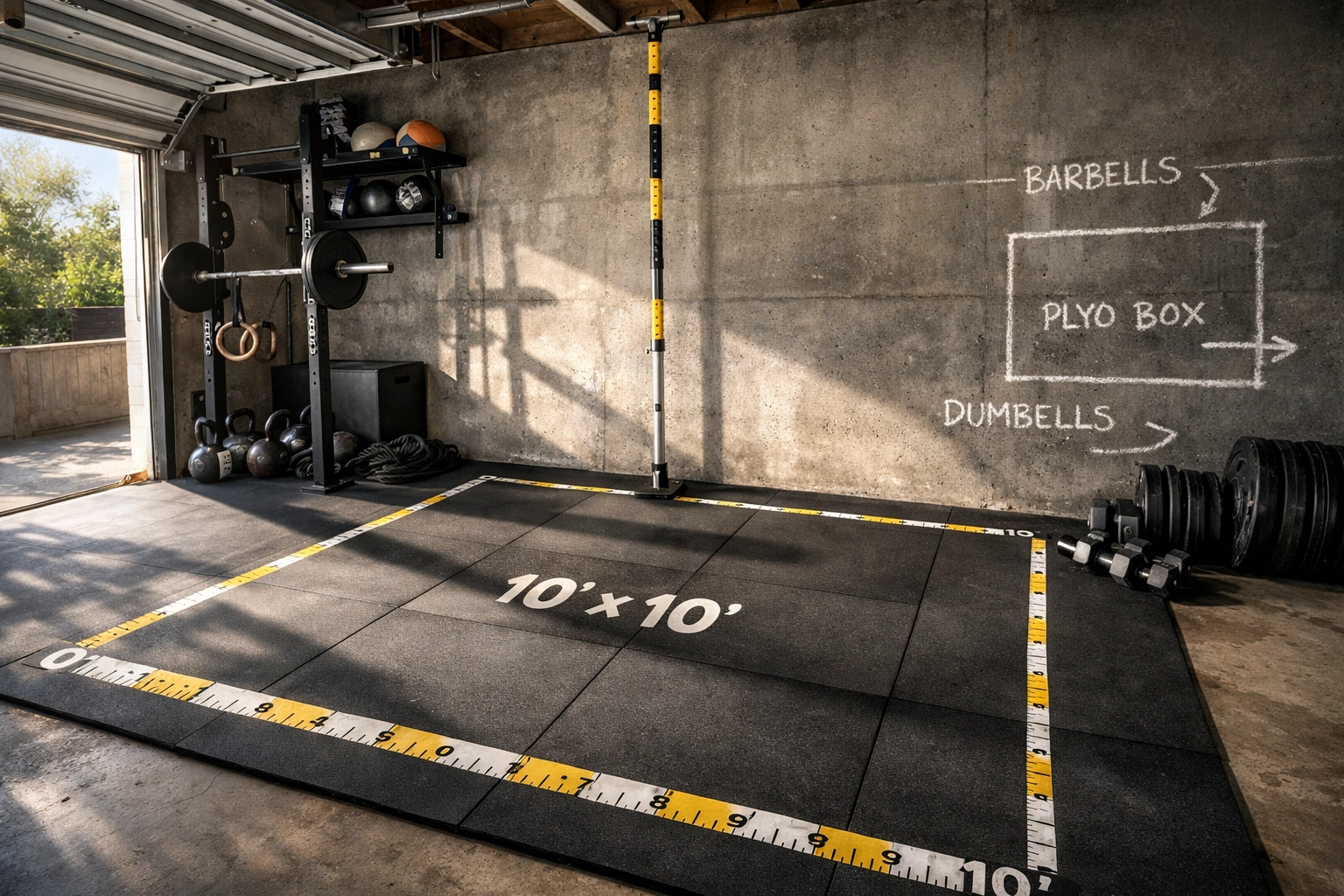
Minimum space requirements: You need at least 10 feet by 10 feet of dedicated training area. That's non-negotiable for any functional CrossFit setup. But here's the reality: if you want to perform Olympic lifts, run through burpee box jumps, and swing a kettlebell without putting a hole in your wall, you'll want 12x12 feet minimum.
Ceiling height matters more than you think. Can you do wall balls without denting the ceiling? Will your pull-up bar clear your head when you kip? Measure twice, mount once. Eight-foot ceilings are the bare minimum; nine to ten feet gives you the clearance you actually need.
Floor considerations: That concrete garage floor won't cut it when you're dropping 225 pounds from overhead. You need proper flooring: rubber mats at minimum, ideally with a dedicated lifting platform for barbell work. Horse stall mats are the gold standard: 3/4-inch thick, indestructible, and cheap as hell from your local farm supply store.
The Essential Equipment Arsenal
Let's talk about what actually matters. These are the non-negotiables: the gear that separates a CrossFit home gym from a random collection of weights gathering dust.
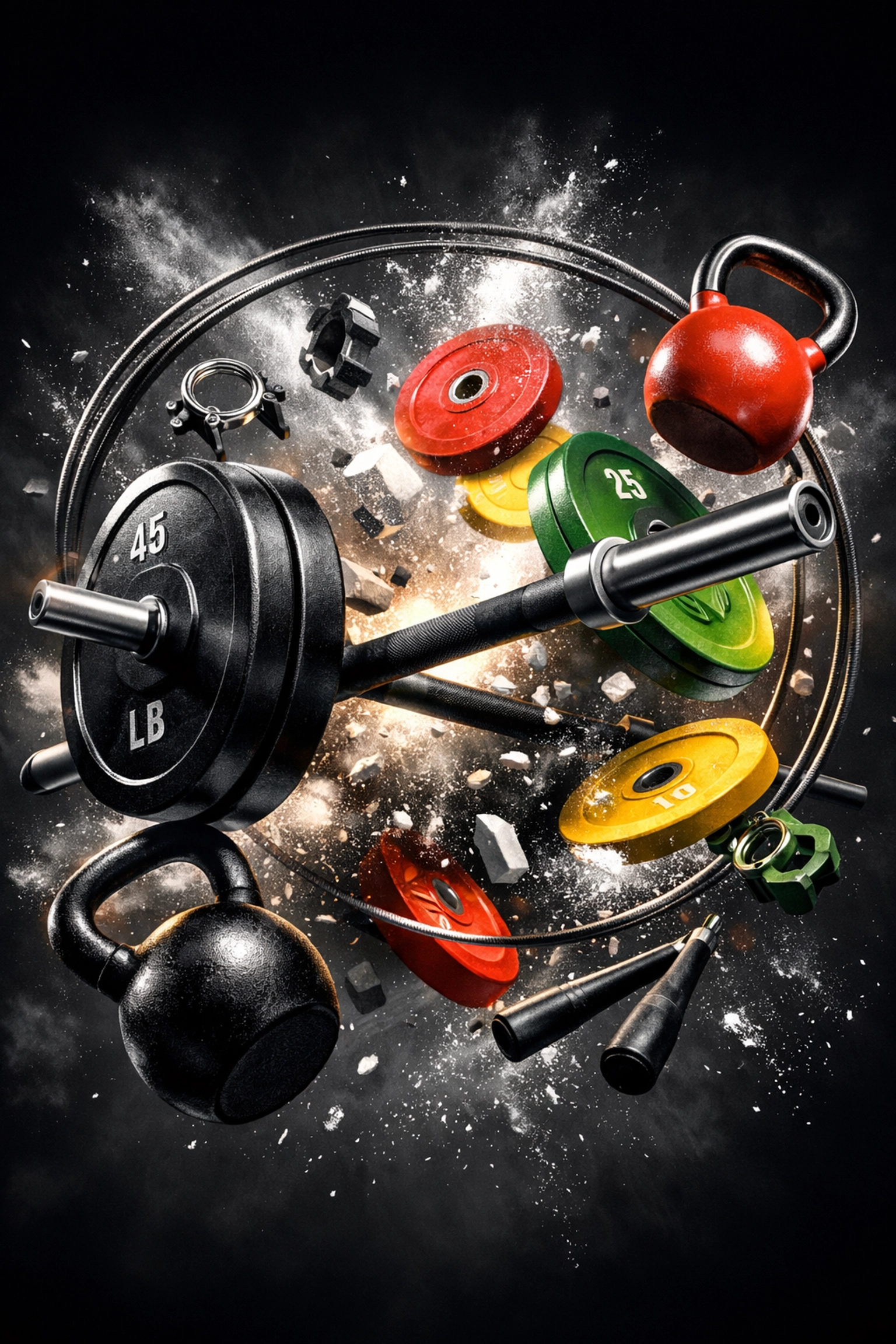
Barbell: Your barbell is your primary weapon. Get a quality 20kg Olympic barbell with proper knurling and bearing rotation. Cheap bars bend, spin poorly, and make Olympic lifts feel like garbage. Rogue, American Barbell, or Fringe Sport all make solid options. Budget $200-400 for something that'll last a lifetime.
Weight Plates: Start with bumper plates that can handle drops. You'll want pairs of 45s, 25s, 15s, and 10s at minimum. Hi-temp bumpers are more affordable than competition plates and work perfectly for home use. Budget $500-800 for a starter set that gets you to 300+ pounds.
Kettlebells: CrossFit loves kettlebells, and so should you. Start with a 35lb and a 53lb (the pood standards), then add a 70-pounder when you're ready. Swings, snatches, goblet squats, Turkish get-ups: kettlebells deliver brutal full-body workouts. Adjustable kettlebells save money if you're on a budget, but traditional cast iron feels better.
Jump Rope: Double-unders are a CrossFit staple. Get a speed rope with replaceable cables, not some $10 piece of garbage from the big box store. RPM, Rogue, or WOD Nation all make solid options under $30.
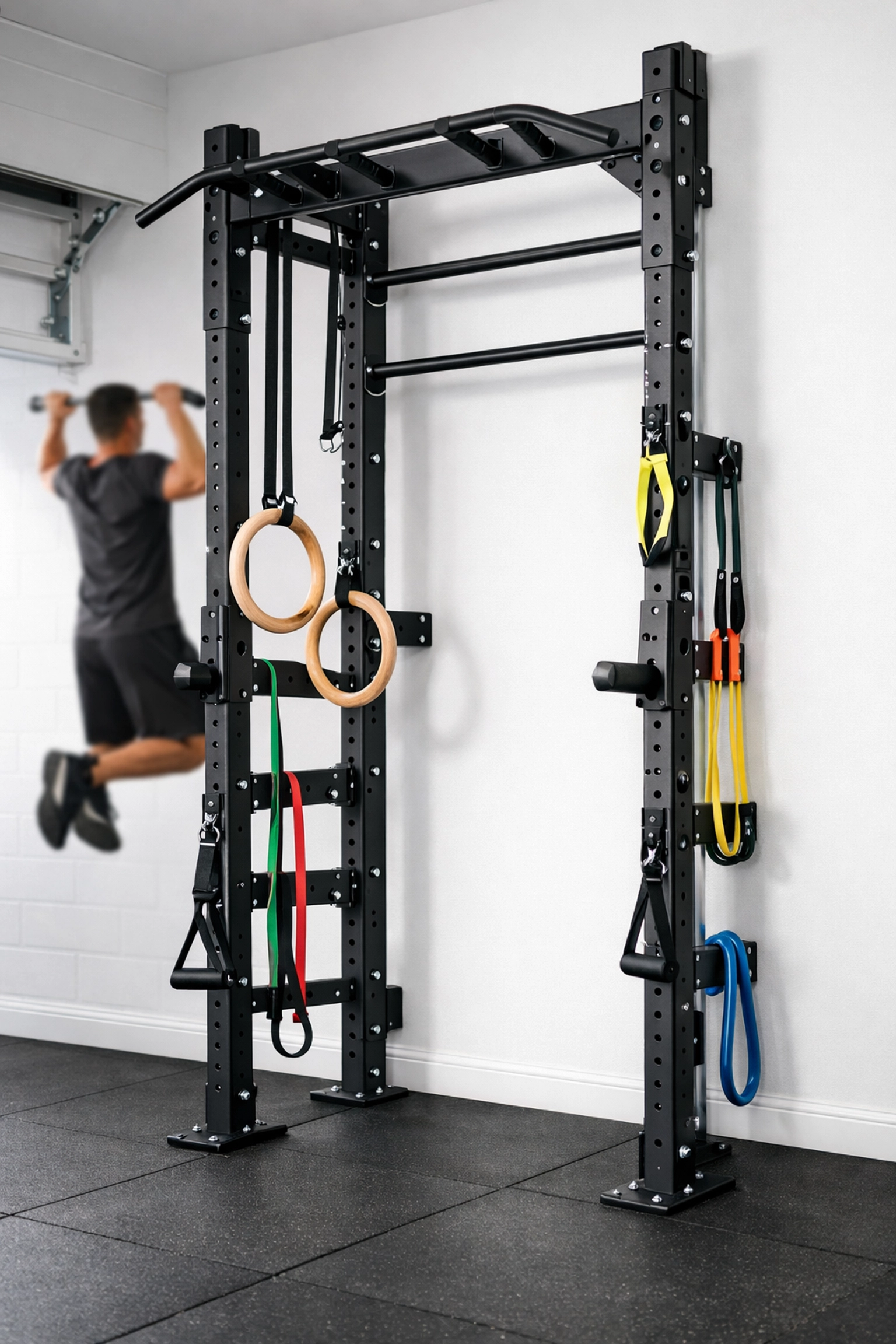
Pull-Up Bar: Here's where things get interesting. Traditional wall-mounted pull-up bars are great: if you own your space and can drill holes in walls. But what if you're renting? What if you want a no-wall-damage workout system that offers more versatility?
That's where innovative solutions like the Resistance Rail from Bold Body Fitness change the game. This floor-to-ceiling gym system gives you pull-up bar functionality plus ring work, muscle-up training, rope climbs, and resistance band setups: all without drilling a single hole in your walls. For CrossFit athletes who want maximum versatility in minimal space, it's a game-changer.
Level Up: Advanced Equipment Worth Having
Once you've nailed the essentials, these additions transform a basic setup into a complete CrossFit training facility.
Power Rack or Squat Stands: You need something to hold that barbell for heavy squats and bench press. A full power rack with safety bars is ideal, but squat stands with spotter arms work if space is tight. Rogue's SML-1 Squat Stand is the budget king at around $400.
Flat Bench: Simple, cheap, essential. You'll use it for bench press, step-ups, box jumps, and a dozen other movements. A basic flat bench costs $100-150.
Plyo Box: Box jumps are CrossFit bread and butter. Get a 20/24/30 three-in-one box or build your own from plywood. Foam plyometric boxes are safer for beginners and won't shred your shins on a miss.
Assault Bike or Rower: Cardio conditioning is part of CrossFit DNA. An Assault Bike delivers soul-crushing workouts; a Concept2 rower is the gold standard for rowing. Both are expensive ($700-900), but both deliver results that make treadmills look like toys.
Rings: Gymnastics rings unlock an entire dimension of bodyweight training. Ring dips, ring rows, muscle-ups, and dozens of advanced movements become possible. Wooden rings feel better than plastic, and you can mount them on your Resistance Rail or rig for maximum versatility.
The Bold Body Fitness Advantage for Small-Space Warriors
Let's address the elephant in the garage: not everyone has a massive space or wants to permanently modify their training area. Maybe you're renting. Maybe you share your garage with actual cars. Maybe you want equipment that adapts to different workouts without a complete reconfiguration every time.
This is where systems like the Resistance Rail absolutely shine for CrossFit athletes.
Traditional CrossFit rigs are incredible: if you have the space, the budget, and the permission to bolt them to walls or floors. But the Resistance Rail offers something different: a versatile home gym that installs floor-to-ceiling with tension, giving you pull-up bars, ring attachment points, resistance band training, and rope climbing capability without drilling holes or spending thousands on a permanent rig.
For calisthenics practitioners, gymnasts, and CrossFit athletes who prioritize bodyweight movements, this approach delivers serious training capacity in a small footprint. You get the functionality of a full CrossFit rig with the flexibility to remove it when needed and the price point that doesn't require a second mortgage.
Budget Strategy: Build Your Arsenal Over Time
Nobody builds Rome in a day, and you don't need to build your complete gym in one shopping spree. Smart CrossFit athletes take a phased approach.
Phase 1 ($800-1200): Barbell, bumper plates (300lbs), pull-up solution, jump rope, kettlebell (53lb), rubber flooring. This gets you 80% of CrossFit workouts covered.
Phase 2 ($400-600): Squat rack or stands, additional weight plates, second kettlebell, plyo box. Now you're running full-spectrum training.
Phase 3 ($700-1000+): Assault bike or rower, rings, specialty bars (trap bar, safety squat bar), additional kettlebells, foam roller and mobility tools.
Buy quality equipment once rather than cheap equipment twice. A $300 barbell will outlast three $100 barbells and feel better every single rep.
Sample CrossFit Workouts to Dominate Your Home Gym
Let's put your new setup to work with brutal workouts that require nothing but the equipment you now own.
"Home Gym Fran" (21-15-9 for time):
- Thrusters (95/65 lbs)
- Pull-ups
Classic CrossFit benchmark that'll smoke your lungs and test your mental toughness. Sub the pull-ups with ring rows if you're building up to strict pull-ups.
"Death by Kettlebell" (EMOM until failure):
- Minute 1: 1 kettlebell snatch (each arm)
- Minute 2: 2 kettlebell snatches (each arm)
- Minute 3: 3 kettlebell snatches (each arm)
- Continue adding one rep per minute until you can't complete the round.
"Garage Games" (4 rounds for time):
- 400m run (or 50 double-unders)
- 15 box jumps
- 12 kettlebell swings (53/35 lbs)
- 9 pull-ups
"Barbell Complex Hell" (5 rounds, not for time):
- 5 deadlifts
- 5 hang power cleans
- 5 front squats
- 5 push press
- 5 back squats
Pick a weight around 60% of your front squat max. Rest 2-3 minutes between rounds. Your entire body will hate you.

Maintenance and Safety: Protect Your Investment
Your equipment is only as good as the care you give it. Here's how warriors maintain their arsenal:
Keep it clean: Wipe down barbells after sweaty sessions. Moisture and salt corrode knurling and damage bearings. A simple rag and some 3-in-1 oil once a month keeps bars spinning smooth.
Check your setup: Before every heavy lifting session, verify that your squat rack pins are properly seated, your Resistance Rail is tight, and your collars are secure. The ten seconds you spend checking could prevent a catastrophic equipment failure.
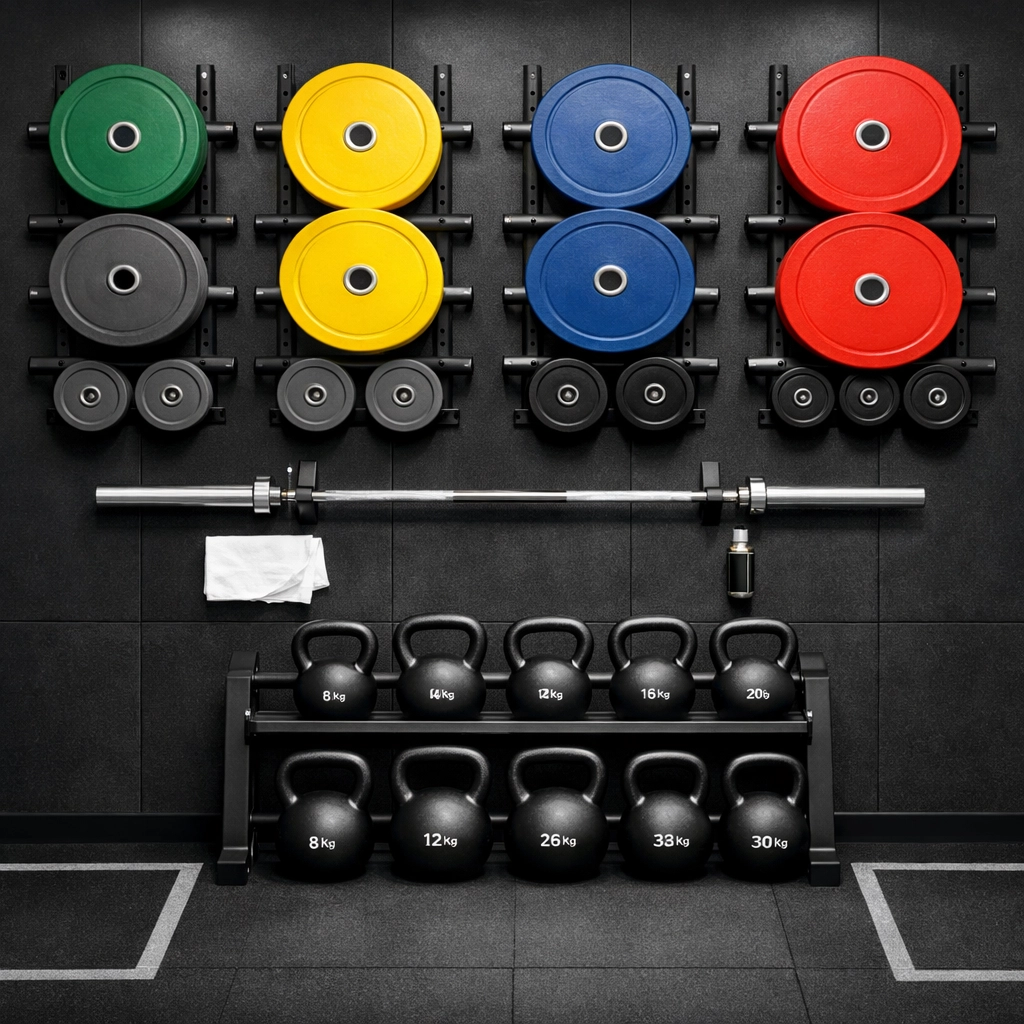
Organize your space: Scattered plates and kettlebells aren't just annoying: they're injury risks. Wall-mounted plate storage, kettlebell racks, and designated zones for different equipment keep your gym functional and safe.
Respect the weight: Just because you're at home doesn't mean physics stops working. Drop weights properly, use safety bars on heavy squats, and train within your capabilities. The ER doesn't care that you were "just working out in your garage."
Build Your Warrior's Den
Building a CrossFit home gym isn't about recreating every feature of your local box. It's about creating a training environment that serves YOUR goals, YOUR schedule, and YOUR warrior mindset.
Start with the essentials. Add equipment as your budget allows and your training demands. Choose quality over quantity every single time. And remember: the best home gym is the one you actually use.
Your garage gym won't have the same community energy as your CrossFit box, but what it does have is something even more valuable: zero excuses. No traffic, no crowds, no waiting, no monthly fees. Just you, your equipment, and the work that needs to be done.
Check out the complete range of versatile home gym equipment at Bold Body Fitness and start building your training sanctuary today. The only question left is: are you ready to train like a warrior?
Now stop reading and start building. Your home gym isn't going to assemble itself.
