
Let’s be real: Most home workouts are mediocre. You’re in your garage or spare bedroom, tossing around a few dusty dumbbells or fighting with a door-anchor band that feels like it’s going to snap and take an eye out at any second. You want the results of a high-end CrossFit box or a professional MMA gym, but your current setup, and your execution, is holding you back.
At Bold Body Fitness, we don't do mediocre. We believe your home gym equipment should empower you to train like an elite athlete, not just "get some movement in." Whether you’re a ninja warrior, a gymnast, or a dedicated calisthenics practitioner, the difference between plateaus and progress often comes down to the details.
If you’re struggling to see the gains you want from your bodyweight training at home, you’re likely falling into one of these seven common traps. Here is how to fix them and turn your space into a high-performance powerhouse.
1. Skipping the Warm-Up (No, Arm Circles Don’t Count)
The biggest mistake you can make happens before the workout even starts. Jumping straight into high-intensity resistance training with cold muscles is a recipe for a torn rotator cuff or a blown-out lower back. Most people view the warm-up as "wasted time" that could be spent lifting. In reality, a proper warm-up primes your central nervous system (CNS) and increases blood flow, allowing you to recruit more muscle fibers during your working sets.
The Fix:
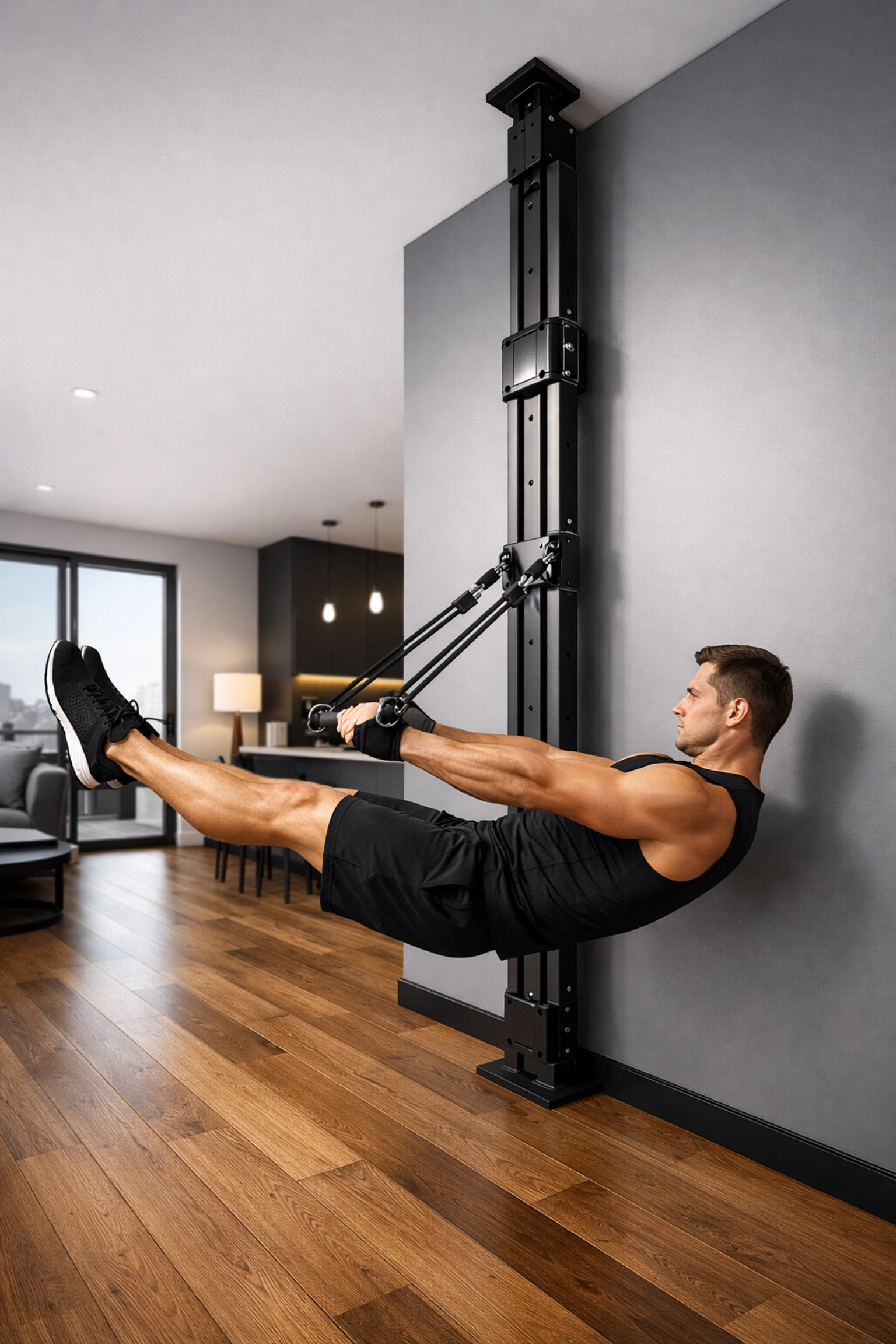
Spend 5–10 minutes on a dynamic warm-up. We’re talking about movements that actually mimic your workout. If you’re using a floor to ceiling gym system like our Resistance Rail, start with low-tension rows and rotations to wake up your scapulae and core. Think thoracic bridges, leg swings, and deep lunges. A dynamic warm-up can boost your performance by up to 20%. Don't leave those gains on the table.

2. Ego Over Technique
We get it. You want to move heavy weight or hit that impressive-looking lever. But when "completing the rep" becomes more important than "how" you completed it, you stop training muscles and start training momentum. Poor form is the primary reason home athletes plateau. If your back is arching during a push-up or your hips are swinging during a pull-up, you aren't getting stronger: you're just getting better at cheating.
The Fix:
Master the mechanics before you increase the load. If you’re looking for a pull up bar alternative that allows for more controlled, scalable movements, the Resistance Rail offers adjustable heights to perfect your form at any angle. Use a mirror or film yourself. If the last two reps of your set look like a struggle bus, drop the resistance and focus on the squeeze.
3. Treating Gravity Like a Friend (The Speed Trap)
If you’re flying through your reps, you’re letting physics do the work for you. Many athletes focus only on the concentric phase (the lifting part) and completely ignore the eccentric phase (the lowering part). When you drop the weight or snap back into position without control, you’re missing out on 50% of the muscle-building potential of that movement.
The Fix:
Slow. It. Down. Execute a 3-second eccentric phase for every single rep. By controlling the descent, you increase Time Under Tension (TUT) and force your muscles to stabilize the load throughout the entire range of motion. This is especially critical for calisthenics equipment for home use, where bodyweight leverage is your primary tool. Slow reps build the kind of "old man strength" that makes MMA fighters and gymnasts so formidable.
4. Incomplete Repetitions (Half Reps = Half Results)
Are you actually locking out your elbows? Are you reaching full extension at the bottom of that row? Partial reps are the hallmark of someone who cares more about the number on the page than the muscle on their frame. While partials have their place in advanced bodybuilding protocols, most home trainees use them because the full range of motion (ROM) is too hard.
The Fix:
Demand a full ROM on every movement. This is where a versatile home gym setup becomes essential. Many door-based systems limit your range of motion because of where they are anchored. Our no wall damage workout system allows you to position your resistance points exactly where you need them to ensure you’re working the muscle from full stretch to peak contraction. If you can't hit the full ROM, reduce the resistance.
5. The "Wet Noodle" Core
Your core isn't just your abs; it’s the bridge that transfers power from your lower body to your upper body. If you aren't bracing your core during resistance training, you’re leaking energy. This leads to unstable lifts and increased pressure on your spine. CrossFit athletes and gymnasts know this better than anyone: stability is the foundation of power.
The Fix:
Practice "bracing" as if someone is about to punch you in the gut. Tighten your midsection, pull your ribs down, and keep your pelvis neutral. Whether you are performing a standing chest press or a single-leg squat, your core should be locked. A full body workout at home should be a core workout by default. If your setup isn't challenging your stability, it’s time to upgrade to a system that requires total-body tension.

6. Training Without a Map (No Tracking System)
If you walk into your garage and "just do some stuff," you aren't training: you're just exercising. There’s a difference. Training is a deliberate, recorded path toward a specific goal. Without tracking your reps, sets, and resistance levels, you have no way of knowing if you are actually applying progressive overload.
The Fix:
Keep a logbook or an app. Write down everything. What was the height setting on your Resistance Rail? Which band did you use? How many reps did you hit before your form broke down? Aim to beat your "past self" by just 1% every session. That could mean one extra rep, five more seconds of a hold, or a slightly higher resistance setting. Data doesn't lie; your memory does.
7. Changing Everything at Once
The "Shiny Object Syndrome" is real in the fitness world. One week you're doing a crossfit home gym WOD, the next you're trying a 30-day yoga challenge, and the week after you're focusing solely on handstands. While variety is good for the soul, it’s terrible for specific strength gains. You can’t adapt to a stimulus if the stimulus is constantly changing.
The Fix:
Pick a program and stick to it for at least 8–12 weeks. Consistency is the only "secret" to elite fitness. Use a versatile home gym system that allows you to perform hundreds of exercises so you don't get bored, but keep your core lifts and movements the same. Master the basics, build the foundation, and then: and only then: layer on the complexity.
Why Your Equipment Might Be the Real Problem
You can have the best intentions in the world, but if your home gym equipment is limiting you, your progress will eventually stall. Most "home solutions" are flimsy, damage your walls, or offer inconsistent resistance that makes tracking progress impossible.
This is why we engineered the Resistance Rail.
We wanted a no wall damage workout system that could withstand the intensity of a pro-athlete’s session while fitting seamlessly into a modern home. No more bulky power racks that take up the whole garage. No more drilling holes into your studs.
The Resistance Rail is a floor to ceiling gym that provides a rock-solid anchor point for bands, TRX, or even boxing bags. It’s the ultimate pull up bar alternative and the foundation for a professional-grade full body workout at home.
The Bold Body Advantage:
- Zero Wall Damage: Perfect for renters or anyone who values their home’s integrity.
- Total Versatility: From MMA-specific drills to calisthenics and traditional strength training.
- Infinite Adjustability: Change your resistance angle in seconds to target muscles you didn't even know you had.
- Pro-Grade Durability: Built for those who train hard and expect their gear to keep up.
Ready to stop making excuses and start making progress? It’s time to stop "working out" and start training with intent.
Browse our full collection of professional home gym gear here.
Stop settling for "good enough." Be bold. Build the body you were meant to have.
