
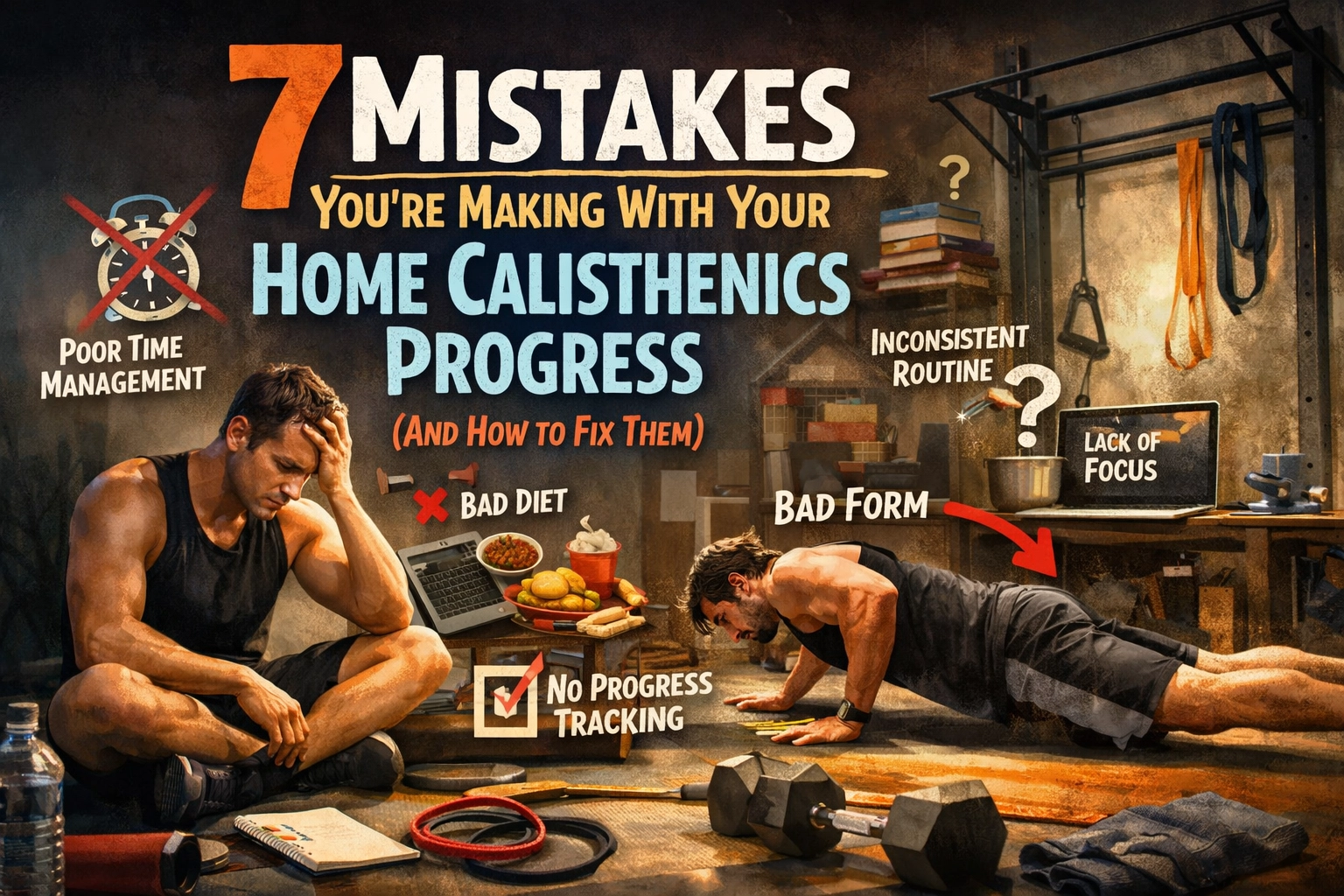
Listen, I’m going to level with you. You started your journey into bodyweight training at home because you wanted freedom. You wanted to escape the crowded commercial gyms, the waiting lines for the power rack, and the monthly fees that lead nowhere. You wanted to master your own body, build a physique that actually does something, and maybe even nail that elusive muscle-up or human flag.
But here’s the reality: most people who transition to a home gym setup for calisthenics hit a plateau within the first three months. They stop seeing gains, their joints start aching, and they end up with a dusty pull up bar alternative tucked in the corner of their bedroom.
I’m Brian Kerr, founder of Bold Body Fitness, and I’ve seen it all. From Ninja Warriors to CrossFit athletes, the mistakes are almost always the same. If you’re serious about your progress, you need to stop making these seven cardinal sins. Here’s how to fix them and turn your living space into a high-performance versatile home gym.
1. Chasing "Cool" Instead of "Effective"
We’ve all seen the Instagram clips. Some guy doing a triple-clap pushup or a one-arm handstand on a railing. It looks incredible. But if you’re spending your entire workout trying to learn a "trick" before you’ve mastered the fundamentals, you’re wasting your time.
The mistake here is using ineffective exercises that prioritize aesthetics over actual strength development. If your goal is a full body workout at home, you need movements that provide a massive stimulus.
The Fix: Master the "Big Five"
Before you try the flashy stuff, you need to own the basics:
- Pull-ups (Vertical Pull)
- Dips (Vertical Push)
- Rows (Horizontal Pull)
- Push-ups (Horizontal Push)
- Squats/Lunges (Lower Body)
If you aren't seeing progress, go back to these. At Bold Body Fitness, we designed our calisthenics equipment for home to facilitate these exact movements with zero compromises. Don't add complexity until you’ve maximized the intensity of the basics.
2. Sacrificing Form for Ego Reps
This is the biggest progress killer in the game. I see it every day in the crossfit home gym community and among beginners: the "half-rep" syndrome. You’re doing 20 pull-ups, but your chin barely clears the bar, and your arms never fully lock out at the bottom.
When you cheat the range of motion (ROM), you’re cheating your muscles. You’re also putting insane amounts of stress on your connective tissue because you’re bouncing off your joints rather than controlling the weight with your muscles.
The Fix: Full ROM or No Rep
Every single rep must be perfect. If you can’t do a full-range dip, don’t just do a shallow one. Use assistance. This is where the Resistance Rail Standard becomes a game-changer. It’s a no wall damage workout system that allows you to set up anchor points at any height. You can use resistance bands to assist your movements, ensuring you hit that full deep stretch and a hard contraction at the top.

3. The "Inconsistency" Virus
The beauty of home gym equipment is that it’s always there. The curse? It’s always there. When your gym is ten feet from your couch, it’s easy to say, "I’ll just do it tomorrow."
Calisthenics is a game of neurological adaptation. Your brain needs to learn how to fire your muscles in specific patterns. If you’re only training once a week, or skipping weeks whenever life gets "busy," your brain never gets the memo.
The Fix: Build a Dedicated "Zone"
Treat your home workout with the same respect you’d treat a session at a pro facility. This is why we advocate for a floor to ceiling gym setup. When you install a professional-grade versatile home gym like the Resistance Rail, it transforms a corner of your room into a sanctuary of sweat. It’s not just a piece of equipment; it’s a mental trigger. When you see it, it’s time to work. No excuses.
4. Forgetting Progressive Overload
In a traditional gym, progressive overload is easy: you just add another 5lb plate to the bar. In bodyweight training at home, people often get stuck doing the same 3 sets of 10 push-ups for six months.
Your body is an adaptation machine. If the stimulus doesn't increase, the muscle won't grow. You can't just do more reps forever: eventually, you're just training endurance, not strength.
The Fix: Add Resistance and Leverage
To keep growing, you have to make the exercises harder. You can do this by:
- Changing the Leverage: Move from regular push-ups to decline push-ups, then to archer push-ups.
- Adding Resistance: This is where resistance training comes in. Use bands or weighted vests to increase the load.
- Decreasing Rest: Shorten your recovery periods to increase metabolic stress.
Check out our Shop for tools that help you bridge the gap between pure bodyweight and heavy resistance.

5. Programming Like a Chaos Monkey
Are you just doing whatever you feel like when you wake up? That might be "fun," but it’s not a plan. If you’re an MMA fighter or a gymnast, you know that performance is built on structure.
Many home athletes suffer from "Program Hopping." They try a calisthenics routine for a week, then switch to a bodybuilding split, then try a yoga challenge. Result? They're mediocre at everything and master of nothing.
The Fix: Stick to the Plan for 12 Weeks
Pick a goal. Is it the Muscle-Up? Is it a 500lb deadlift? Is it overall fat loss? Once you pick it, stick to a structured program for at least 90 days. Your crossfit home gym setup should support a variety of movements, but your focus should be narrow.
A good home program should include:
- A dedicated warm-up.
- Skill work (handstands, holds).
- Primary strength movements (the "Big Five").
- Accessory work for weak points.
6. Neglecting Mobility (The "Tin Man" Effect)
You can have all the strength in the world, but if you can’t get your arms behind your head or touch your toes, your calisthenics progress will hit a brick wall. Most advanced bodyweight moves: like the back lever, the L-sit, or deep squats: require extreme mobility.
The mistake is thinking that "stretching" is something you do for 2 minutes after your workout. For serious practitioners, mobility is training.
The Fix: Integrated Mobility
Don't just sit in a static stretch. Use your home gym equipment to perform loaded mobility. Use the Resistance Rail to perform hanging shoulder openers or assisted deep squats. If you want to move like a ninja warrior, you have to train the end-ranges of your joints.

7. Ignoring the "Check Engine" Light
Overtraining is real, especially when you’re motivated. Calisthenics puts a massive amount of strain on your tendons and ligaments: much more than machines do. If you start feeling a "tweak" in your elbow or a "pinch" in your shoulder, and you try to power through it, you’re asking for a six-month layoff.
The Fix: Listen and Deload
Progress isn't a straight line; it's a staircase. Every 4-6 weeks, you should have a "deload week" where you reduce your volume and intensity by 50%. This gives your central nervous system and your connective tissues time to recover.
Remember, you don't get stronger while you're working out; you get stronger while you're recovering.
Why the Right Equipment Matters
Let's be bold: you can’t build an elite body with cheap, flimsy gear. If you’re using a door-frame pull-up bar that creaks every time you move, you’re subconsciously holding back. You’re afraid the thing is going to rip the trim off your wall or collapse under your weight.
That’s why we built the Resistance Rail. We wanted a no wall damage workout system that could actually handle the intensity of a pro athlete.
The Floor to Ceiling Gym Advantage
Most calisthenics equipment for home is limited. It’s either a bar or a bench. The Resistance Rail is a floor to ceiling gym that utilizes a vertical rail system. This allows you to:
- Adjust your anchor points in seconds.
- Transition from high-intensity resistance training to pure bodyweight moves.
- Perform 100+ exercises in a 2x2 foot space.
- Maintain the integrity of your home (no drilling into studs required).
Whether you’re looking for a pull up bar alternative that offers more versatility or a complete full body workout at home solution, you need gear that matches your ambition.

Your Path to Mastery
If you’ve been making these mistakes, don’t sweat it. We’ve all been there. The difference between the people who stay average and the people who become elite is the willingness to course-correct.
Stop chasing the "cool" moves and master the basics. Lock in your form. Be consistent with your "zone." Apply progressive overload relentlessly. Follow a program. Don't ignore your mobility. And for God's sake, listen to your body when it tells you to rest.
Your home is your stadium. Your body is the machine. It’s time to stop making excuses and start making progress.
Ready to level up your setup? Explore the Bold Body Fitness Shop and see how the Resistance Rail can redefine what’s possible in your home.
Stay bold.
Brian Kerr
Founder, Bold Body Fitness
For more tips on optimizing your home training, check out our sitemap or browse our latest workouts.
