
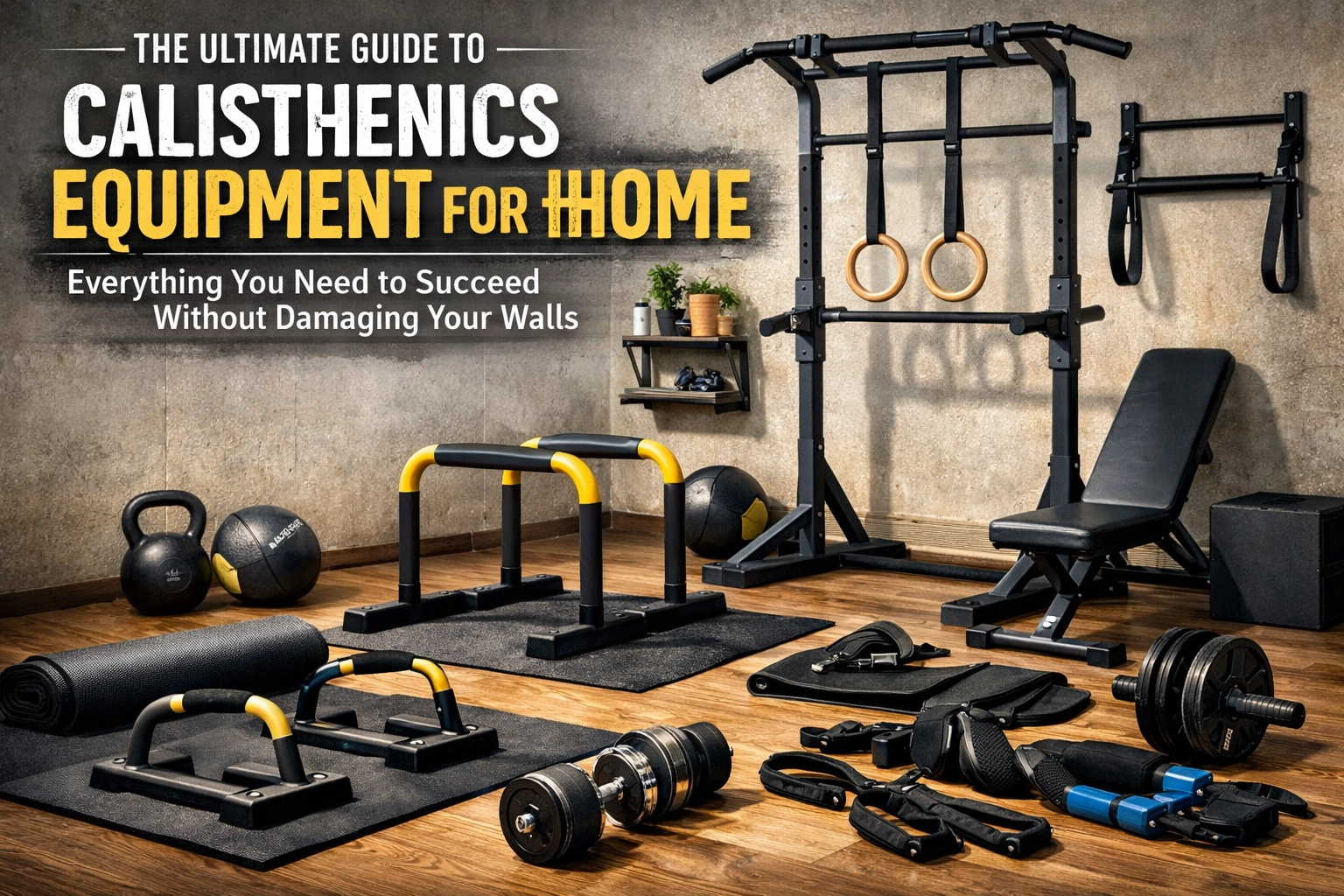
If you’re serious about calisthenics, you already know the truth: bodyweight training at home is only “simple” until you try to do real athlete stuff, muscle-ups, levers, ring strength, ninja-style grip work, and full-send conditioning, inside a normal house.
And that’s where most people hit a wall. Literally.
This guide breaks down the best calisthenics equipment for home that lets you train hard without ripping drywall, wrecking doorframes, or turning your landlord into your arch-nemesis. We’ll cover smart gear picks, safer setup options, and how to build a versatile home gym that supports resistance training, skill work, and a legit full body workout at home, with a big focus on a true no wall damage workout system.
Quick links you’ll actually use:
- Bold Body Fitness homepage: https://www.boldbodyfitness.com/
- Shop (all gear): https://www.boldbodyfitness.com/shop/
- Resistance Rail Standard (featured setup): https://www.boldbodyfitness.com/product/resistance-rail-standard
The “No Wall Damage” Rule: Why Most Home Setups Fail
A lot of “home gym equipment” advice assumes you can drill into studs, mount a bar, hang rings from a beam, or bolt a rack into concrete. Cool… if you own a garage and love renovation projects.
But most athletes train in spaces with:
- standard drywall + 16" stud spacing
- hollow-core doors (aka: don’t trust them)
- unknown ceiling joists
- limited floor space
- neighbors/roommates who don’t want your pull-up routine shaking the building
When you choose equipment, the goal is simple:
High training quality + high stability + low impact on walls/trim/doorframes.
That pushes you toward three categories:
- Floor-to-ceiling systems (stable, expandable, minimal wall damage)
- Freestanding stations (no mounting, more footprint)
- Portable tools (rings, parallettes, bands, small but powerful)
The Core Calisthenics Equipment Stack (In Priority Order)
Here’s the equipment hierarchy I recommend for building a home setup that’s actually useful for calisthenics, gymnastics-style strength, and even crossfit home gym conditioning.
1) A Floor-to-Ceiling Gym System (the “Do Everything” Anchor)
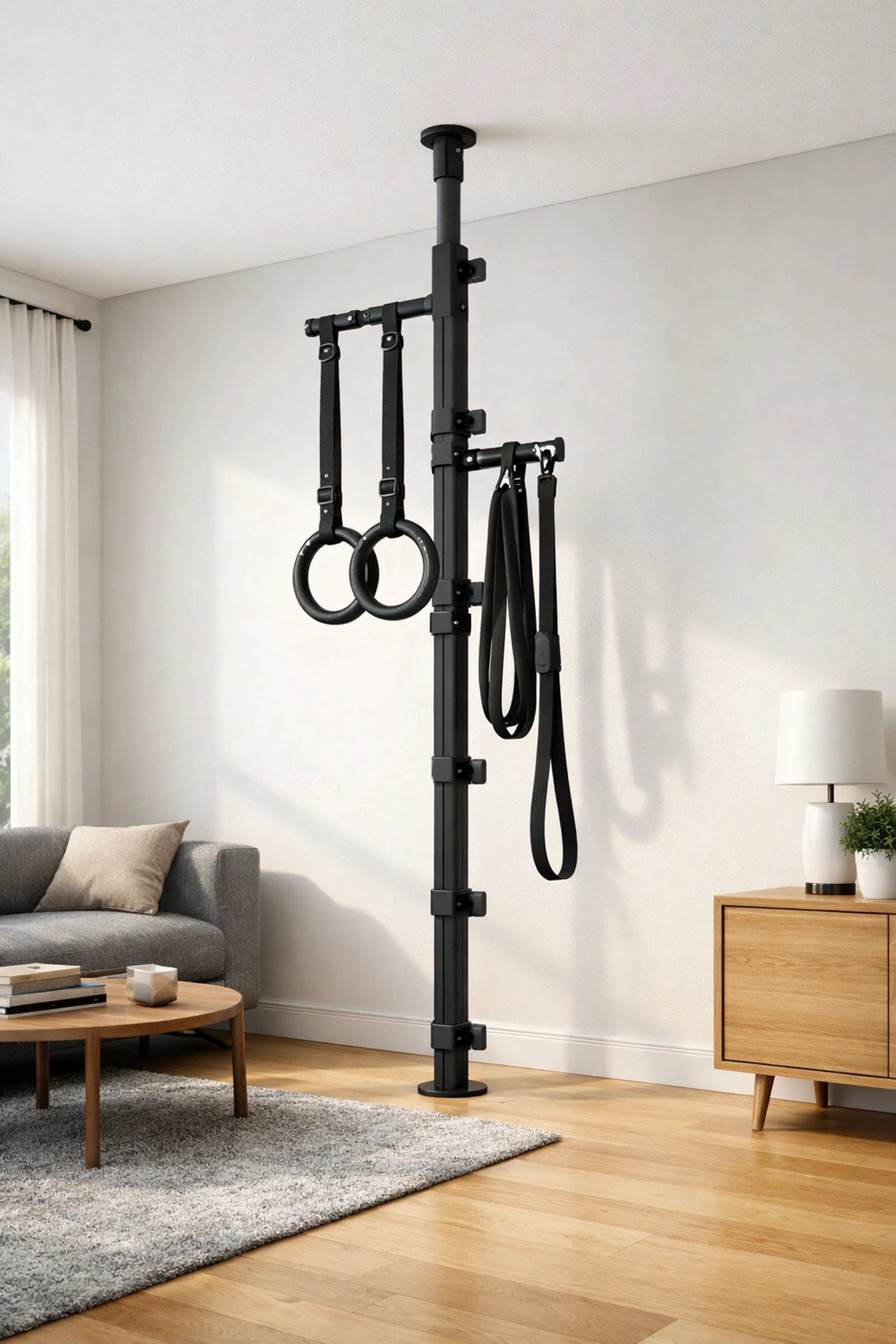
If you want one piece of gear that can become your pull-up hub, anchor point, band station, and progression engine, this is it.
A floor to ceiling gym approach is the sweet spot between “wobbly freestanding tower” and “bolted-to-the-house permanent rack.” It gives you:
- pull variations (pronated, supinated, neutral options depending on attachments)
- band-resisted and band-assisted work
- anchor points for resistance training without drilling into walls
- fast adjustability for different athletes in the same home
This is exactly why we built the Bold Body Fitness Resistance Rail: a stable, home-friendly system designed to deliver a no wall damage workout system vibe while still training like you mean it.
If you’re looking for a pull up bar alternative that doesn’t rely on doorframes or wall mounts, start here:
- Resistance Rail Standard: https://www.boldbodyfitness.com/product/resistance-rail-standard
- Shop all options: https://www.boldbodyfitness.com/shop/
Who this is for: calisthenics athletes, MMA fighters, CrossFitters, ninja warriors, gymnasts, anyone who needs a serious training anchor but doesn’t want holes in their walls.
2) Gymnastic Rings (Maximum Strength, Minimum Space)
Rings are still the best value in calisthenics equipment for home. Period.
They hit:
- pulling strength (rows → pull-ups → high pulls)
- pressing strength (support holds → dips → ring push-ups)
- stability and scap control (the secret sauce for shoulder health)
- core work (L-sits, knee raises, rollouts)
But here’s the key: rings are only as good as their anchor.
Wall-mounting rings is a bad idea in many homes (wrong angle, bad load path, unpredictable studs). A better plan is anchoring to something designed for it, like a floor-to-ceiling rail system, or a properly rated ceiling/beam setup if you know what you’re doing.
Best ring-based movements for full-body training
- Ring rows + ring push-ups (beginner strength base)
- Ring dips + pull-ups (intermediate power)
- False grip hangs + muscle-up transitions (advanced skill)
For CrossFit-style conditioning, rings are also gold: quick transitions, scalable movements, and brutal intensity without machines.
3) Parallettes (Skill Builder + Wrist Saver)
Parallettes are the quiet MVPs of bodyweight training at home. They’re small, store easily, and unlock a ton:
- L-sit progressions
- planche leans and tuck planche holds
- handstand work (more wrist-friendly than floor)
- deeper push-ups for strength and mobility
Mini vs medium parallettes
- Mini: travel-friendly, great for L-sits and push-ups
- Medium: better stability for handstands, more clearance
If your goal includes gymnast-style control, parallettes belong in your starter kit.
4) Resistance Bands (The Most Underrated Home Gym Equipment)
Bands aren’t just rehab tools. For a home athlete, they’re a way to:
- scale hard movements (assisted pull-ups, assisted dips)
- overload others (banded push-ups, banded squats)
- add joint-friendly volume (face pulls, triceps, curls)
They also fit perfectly into a versatile home gym because they’re cheap, portable, and insanely adaptable.
Band staples for calisthenics + MMA/CrossFit athletes
- band-assisted strict pull-ups (volume without ego lifting)
- band face pulls (scap health = better pressing)
- banded RDLs and good mornings (posterior chain without a barbell)
- Pallof press and anti-rotation holds (fight-ready core)
5) A Training Mat (Protect Floors, Save Knees)
If you’re doing:
- kneeling core work
- handstand drills
- mobility flows
- floor-based conditioning
…get a solid mat. It’s not flashy, but it keeps training consistent (and keeps your floors from looking like a battlefield).
Equipment Choices That Sound Good (But Often Wreck Homes)
The Doorframe Pull-Up Bar Trap
Yes, it’s cheap. Yes, it’s popular. And yes, it can also:
- damage trim and doorframes
- slip on certain frames
- limit movement (kipping/fast reps = risky)
- force awkward grip widths
If you’re chasing muscle-ups, chest-to-bar, or ninja grip work, most doorframe bars are a dead end. They’re not a long-term solution for serious athletes.
If you want a safer pull up bar alternative, look for either:
- a stable freestanding station with a real base, or
- a floor-to-ceiling anchored system designed for training load
Wall-Mounted Pull-Up Bars (Only If You’re 100% Sure)
Wall mounts can be great in a garage with exposed studs and proper installation. In a finished room? You’re gambling with:
- unknown framing
- weak anchors
- torque that can crack drywall over time
If “no wall damage” is your rule, skip it.
Build a “One-Station” Full Body Workout at Home (Calisthenics + Strength + Conditioning)
You don’t need ten machines. You need one smart setup and a plan.
Here’s a simple structure that works for calisthenics athletes and CrossFit-style fitness:
Pattern 1: Pull (vertical + horizontal)
- pull-ups or band-assisted pull-ups
- ring rows
- scap pulls + dead hangs for grip
Pattern 2: Push (vertical + horizontal)
- ring push-ups or parallette push-ups
- dips (rings or stable bars)
- pike push-ups / handstand progressions
Pattern 3: Legs (strength + athleticism)
- split squats (add bands for load)
- tempo squats
- hip hinge with bands (RDLs, good mornings)
- jumps (if space allows)
Pattern 4: Core + anti-rotation
- hanging knee raises / toes-to-bar progressions
- L-sits on parallettes
- Pallof press holds with bands
Pattern 5: Conditioning finisher (CrossFit vibes, home-friendly)
Pick a 10–12 minute EMOM:
- Minute 1: 8–12 pull-ups (scale as needed)
- Minute 2: 12–20 push-ups
- Minute 3: 12–20 air squats + 20–40 seconds jump rope
This hits the big promise: a real full body workout at home without needing to drill into your house.
Setup Tips for Stability (So Your “Home Gym Equipment” Doesn’t Feel Like a Toy)
1) Prioritize a solid anchor over fancy accessories
Athletes love buying extras. But if your main station is unstable, everything else is compromised.
A stable base system (like a floor-to-ceiling rail concept) makes rings, bands, and grip work feel locked in instead of sketchy.
2) Train for control, not chaos
If your space is tight or your setup is lightweight:
- keep reps strict
- avoid wild swinging
- build volume gradually
You’ll gain strength faster and reduce wear on your setup (and your home).
3) Think “quiet strength”
If you live in an apartment or have sleeping kids, focus on:
- tempo reps
- isometrics (holds)
- controlled eccentrics
It’s brutal, effective, and doesn’t shake the building.
A Simple Home Calisthenics Equipment Blueprint (3 Levels)
Level 1: The Minimalist (small space, big results)
- rings
- mini parallettes
- bands
- mat
This is the budget-friendly foundation and still supports advanced strength if you train smart.
Level 2: The Serious Athlete (most homes, most goals)
- floor-to-ceiling system (anchor)
- rings
- bands (multiple strengths)
- parallettes
This is where your home becomes a legit training zone without wall damage.
If you want to build this around a purpose-built anchor, start here:
- https://www.boldbodyfitness.com/product/resistance-rail-standard
- or browse the full shop: https://www.boldbodyfitness.com/shop/
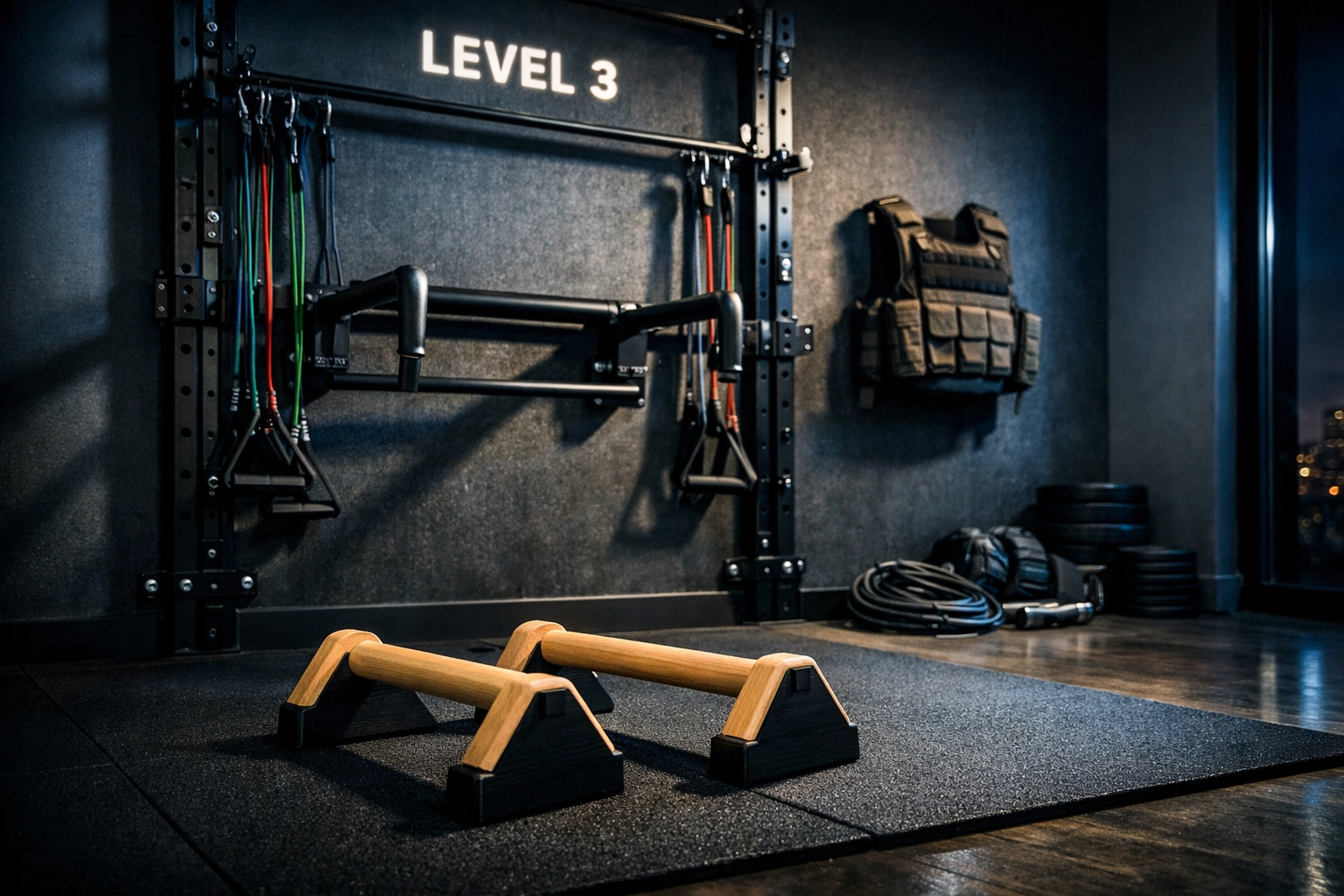
Level 3: The Hybrid Beast (calisthenics + CrossFit home gym)
Everything from Level 2, plus:
- a weighted vest
- dip belt (if your anchor supports it safely)
- jump rope
- kettlebell or adjustable dumbbells (optional)
Now you can combine skills + strength + conditioning in one place.
Training Goals: Match Your Equipment to Your Sport
Ninja Warriors: Grip + dynamic control
Best tools:
- rings (false grip, hangs, transitions)
- bands (elbow-friendly volume)
- a stable anchor system for confidence under load
Key work:
- timed hangs
- scapular endurance
- controlled swings (only if your setup is built for it)
Gymnasts: Positions and perfection
Best tools:
- rings + parallettes
- mat
- bands for prehab
Key work:
- support holds
- hollow/arch control
- strict strength progressions
CrossFit Athletes: Intensity and repeatability
Best tools:
- stable pull station
- rings
- bands
- jump rope
Key work:
- EMOMs and intervals
- strict pulling strength (protect shoulders)
- scalable movements to maintain intensity
MMA Fighters: Durability + usable strength
Best tools:
- rings (joint-friendly pressing/pulling)
- bands (rotational and anti-rotational core)
- a stable anchor you trust
Key work:
- high-rep rows/push-ups
- grip endurance
- trunk stiffness (Pallof press, anti-rotation holds)
The Bold Body Fitness Take: Train Hard, Don’t Remodel Your House
The best home setups don’t rely on luck. They rely on smart design and stable anchors.
If you’re done with shaky doorframe bars, sketchy wall mounts, and “hope this holds” setups, build your home training around equipment that respects your space and your goals.
Start with the essentials, then level up with an anchor system built for serious training:
- Homepage: https://www.boldbodyfitness.com/
- Shop: https://www.boldbodyfitness.com/shop/
- Resistance Rail Standard: https://www.boldbodyfitness.com/product/resistance-rail-standard
Quick Checklist: What to Buy First (and Why)
- Anchor system (floor-to-ceiling gym): the foundation for pull + rings + bands without wall damage
- Rings: unmatched strength-to-space ratio
- Bands: scalable resistance training and prehab
- Parallettes: skill work + wrist-friendly pushing
- Mat: comfort, floor protection, and consistency
If you want a home setup that can handle calisthenics, gymnastics strength, and CrossFit-style conditioning: without wrecking your walls( this stack is the move.)
