
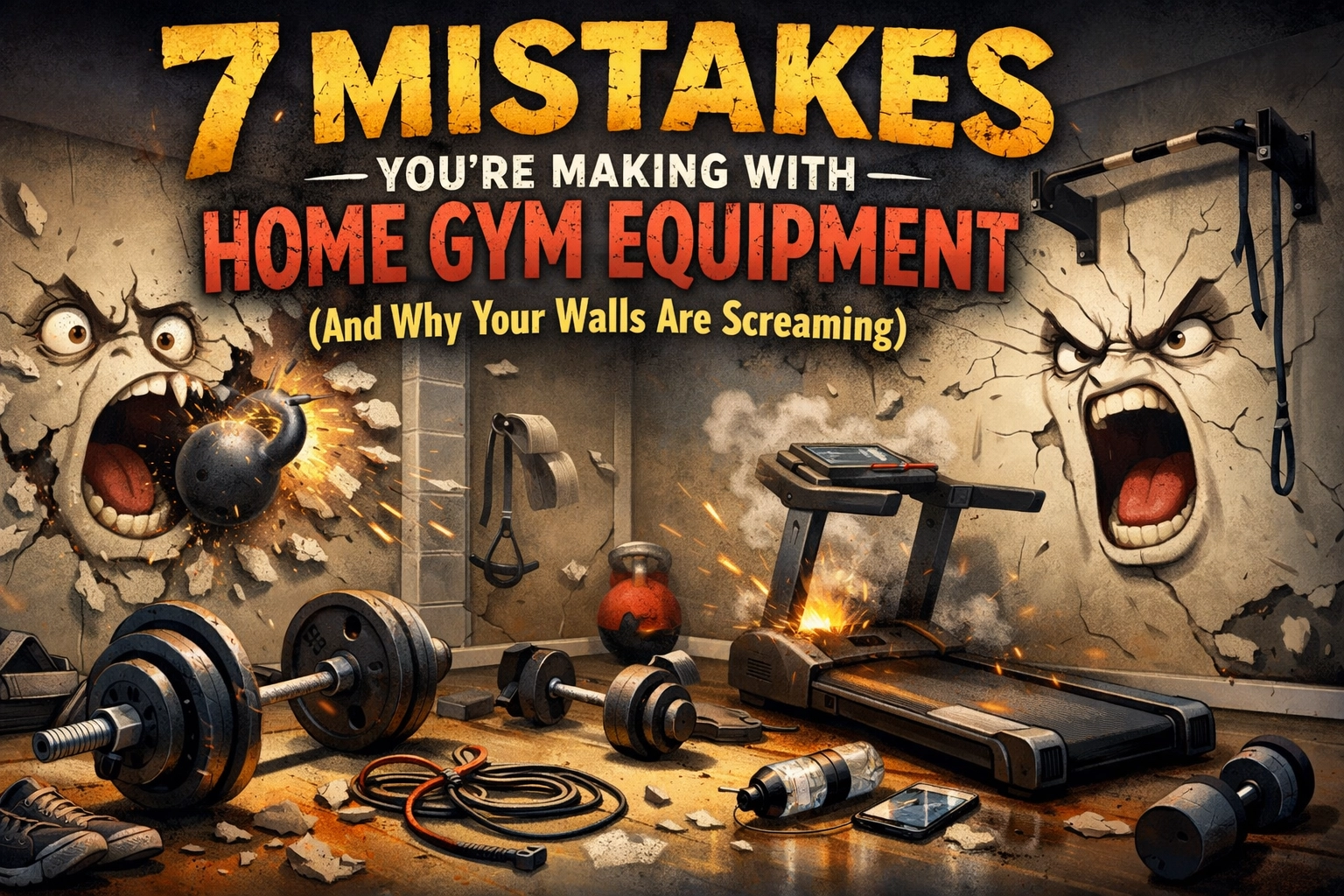
Let’s be real: most home gyms look like a yard sale exploded in a spare bedroom. You started with big dreams of hitting a new PR in your basement, but now you’re tripping over a rusted kettlebell while your drywall looks like it went twelve rounds with Mike Tyson.
If you’re serious about your gains, whether you’re a Ninja Warrior, a CrossFit addict, or a calisthenics pro, your home setup needs to be a temple of performance, not a graveyard for cheap plastic. At Bold Body Fitness, we see the same catastrophic errors day in and day out. People buy the wrong home gym equipment, install it the wrong way, and then wonder why their house is falling apart and their progress has stalled.
Stop the madness. Your walls are screaming for a reason. Here are the seven critical mistakes you’re making with your home gym and exactly how to fix them before you do permanent damage to your home (and your ego).
1. You Forgot to Measure Your "Vertical Limit"
Most people measure the floor space. They check the width, they check the length, and they think, "Yeah, I can fit a power rack here." Then they buy a standard rack, get it home, and realize they can’t do a single pull-up without putting their head through the ceiling.
In basements and garages, ceiling height is the silent killer of gains. If you’re training for resistance training or high-level calisthenics, you need verticality. But you also need to account for the "working height." A pull-up bar isn't just a bar; it’s the space your body occupies above and below it.
The solution is moving toward a floor to ceiling gym concept. This doesn't mean filling the room from top to bottom with junk; it means utilizing vertical space efficiently. If you have low ceilings, you need equipment that scales. Don’t just eyeball it. Remember that high-impact gym flooring adds nearly an inch to your floor height. Measure twice, or prepare to work out in a literal crawl space.

2. Buying "Disposable" Equipment
We get it. The $50 squat rack on that discount site looked like a steal. But in the world of calisthenics equipment for home, you get exactly what you pay for. Cheap gear is made with thin-gauge steel and questionable welds. For an MMA fighter or a gymnast putting massive dynamic loads on a system, "cheap" is synonymous with "dangerous."
When you buy low-quality home gym equipment, it flexes. It wobbles. It eventually snaps. If you’re doing explosive movements or heavy resistance training, that flex translates into instability that ruins your form and kills your joints.
Invest in professional-grade gear. You don't need a hundred machines; you need three or four pieces that are bulletproof. A versatile home gym is built on the foundation of quality. At Bold Body Fitness, we believe your equipment should be able to outlast you. If you’re serious about a CrossFit home gym, you need gear that handles the abuse of a daily WOD without rattling the teeth out of your head.
3. The "Drywall Destroyer": Traditional Pull-Up Bars
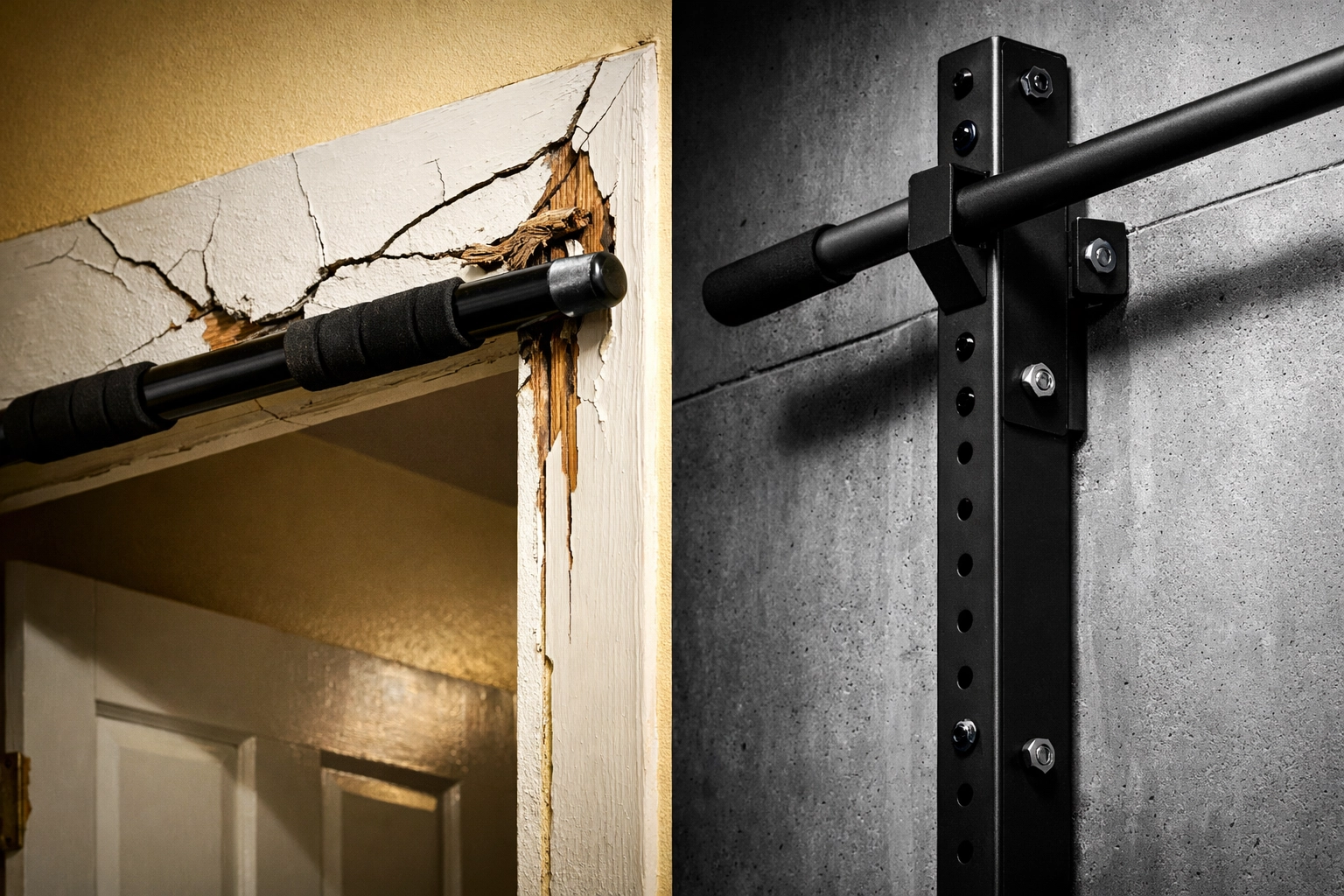
This is the big one. This is why your walls are screaming. Those "no-screw" doorway pull-up bars are a lie. They rely on leverage that puts hundreds of pounds of pressure on your door trim and the thin drywall above it. Over time, that trim cracks, the header shifts, and you’re left with a repair bill that costs more than a year at a luxury gym.
Even worse are the stud-mounted bars installed by someone who "thinks" they found the stud. One heavy set of chin-ups later, and you’ve ripped a chunk of the wall out.
If you want a full body workout at home without turning your house into a construction zone, you need a no wall damage workout system. This is exactly why we developed the Resistance Rail. It’s the ultimate pull up bar alternative because it distributes force differently. It’s designed for athletes who need to train hard: muscle-ups, leg raises, heavy band work: without leaving their landlord (or spouse) a vibrating mess of cracked plaster.
4. Single-Use Machine Syndrome
If your home gym is dominated by a treadmill, a stationary bike, and a leg extension machine, you’ve failed the versatility test. Single-use machines are the fastest way to clutter a room and plateu your progress. They dictate your movement, which is the opposite of what athletes like gymnasts and MMA fighters need.
To achieve a true full body workout at home, you need movement freedom. You need bodyweight training at home combined with variable resistance. Instead of a machine that only does one thing, look for a versatile home gym setup that allows for hundreds of movements.
The Resistance Rail isn't just a bar; it’s a mounting point for everything from suspension trainers to heavy resistance bands. It turns a single wall into a multi-functional training station. Why buy five machines when one rail gives you the ability to do rows, presses, pull-ups, and core work in a 4-foot span? Efficiency is the name of the game.
5. Skipping the Foundation (Flooring)
You’re dropping 225 lbs on bare concrete? Your foundation is crying. Not only does lifting on bare concrete or thin carpet damage your home's subfloor, but it also destroys your equipment. Barbells get bent, plates get cracked, and the noise is enough to wake the neighbors three houses down.
Proper gym flooring isn't a luxury; it’s a requirement for any serious CrossFit home gym. High-density rubber mats absorb the shock, protect your joints during plyometrics, and keep your equipment from sliding around during a heavy set. If you’re doing bodyweight training at home, having a surface with the right grip and give is the difference between a great session and a blown-out wrist.
Don't settle for those cheap foam puzzle pieces from the toy aisle. They’ll compress and slide the moment you try to do a burpee. Get 3/4-inch stall mats or professional rubber flooring. Treat your floor like the piece of equipment it is.

6. The "Cramped Corner" Layout
A common mistake is pushing all your equipment into one corner to "save space." What you end up with is a gym where you can't actually move. If you’re a Ninja Warrior or practicing calisthenics, you need "air space." You need room to swing, room to jump, and room to fail safely.
A versatile home gym should have an open floor plan. This is why wall-mounted or ceiling-integrated systems are so superior to bulky power towers. By using a no wall damage workout system that stays flush or close to the wall, you keep the center of the room open for dynamic movements.
When designing your space, visualize your "working diameter." If you’re doing a lateral lunge or a kettlebell swing, are you going to hit the washing machine? If the answer is yes, your layout is broken. Load your heavy gear along the perimeter and keep the "combat zone" in the middle clear.
7. Ignoring the "Bunker Effect" (Air and Light)
You can have the best calisthenics equipment for home, but if your gym is a dark, stagnant basement corner, you aren't going to use it. Poor ventilation leads to moisture buildup. Moisture leads to rust on your expensive barbells and mold in your drywall.
If you’re training for high-intensity resistance training, you’re going to sweat. That sweat has to go somewhere. Without airflow, your home gym becomes a humid "bunker" that smells like a locker room and degrades your house.
Invest in a high-powered floor fan and a dehumidifier if you’re in a basement. Better yet, ensure your setup is in a place you actually want to be. Lighting matters. If it feels like a dungeon, you’ll train like a prisoner. Brighten the space, clear the air, and make it a "sacred space" dedicated solely to performance.
Why the Resistance Rail is the Game Changer
We’ve talked a lot about the mistakes, but let’s talk about the solution. Most of these problems: space constraints, wall damage, lack of versatility: are solved by the Resistance Rail.
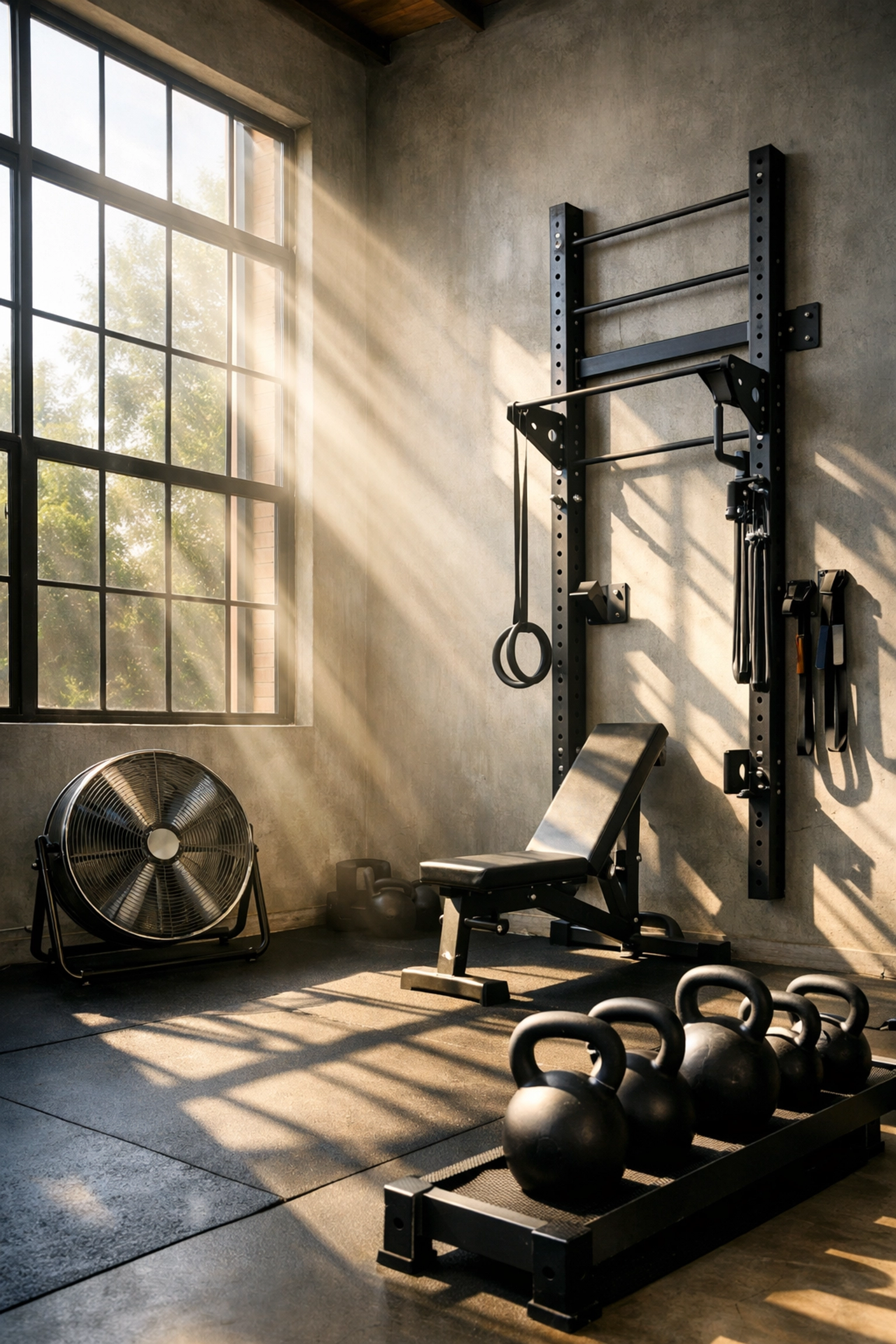
As a pull up bar alternative, it’s in a league of its own. We designed it for people who are tired of the "standard" home gym limitations. It’s a floor to ceiling gym solution that provides a rock-solid mounting point for your entire arsenal.
- No Wall Damage: Our mounting system is engineered to protect your home while supporting elite-level weight.
- Total Versatility: Whether you’re into resistance training, calisthenics, or CrossFit, the Rail adapts to you.
- Space Saving: It takes up virtually zero floor space, keeping your "combat zone" open for movement.
Stop settling for a mediocre home gym. Stop destroying your walls with gear that wasn't meant for serious athletes. It’s time to go Bold.
If you're ready to stop making these mistakes and start building a world-class setup, check out our full range of gear at the Bold Body Fitness Shop. Your walls: and your muscles: will thank you.
Summary of the "Bold" Way:
- Measure High: Don't just look down; look up.
- Quality First: Buy gear that survives your PRs.
- Protect the House: Use a no wall damage workout system.
- Stay Versatile: Avoid single-use machines.
- Floor It: Get real rubber mats.
- Open the Floor: Keep the center clear for movement.
- Breathe: Ensure your gym has air and light.
Building a home gym is an investment in yourself. Don’t let poor planning and cheap equipment turn that investment into a renovation nightmare. Train hard, train smart, and keep it Bold.
