
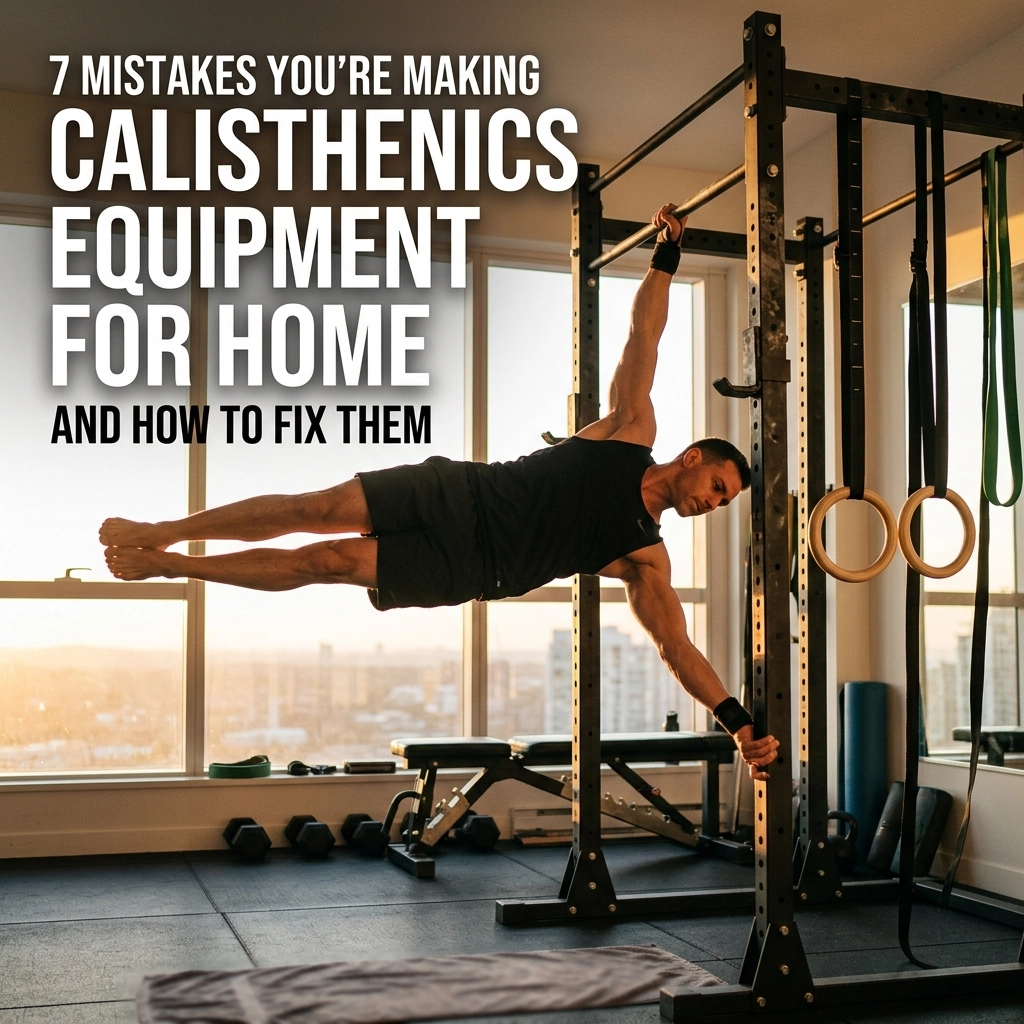
Listen, I get it. You’re ready to level up. You’ve seen the athletes on Instagram pulling off flawless planches and human flags, and you want that elite level of control and strength. So, you go out and buy some basic calisthenics equipment for home, clear a corner of your garage, and start grinding.
But three weeks later, your "heavy-duty" bar is wobbling, your wrists hurt, and you’re staring at a hole in your drywall where your pull-up bar used to be.
At Bold Body Fitness, we don’t do average. We do elite. And as the founder, Brian Kerr, I’ve seen every mistake in the book when it comes to setting up a home gym equipment system. Most people treat their home setup like an afterthought. They buy the cheapest gear, ignore the physics of their own movements, and then wonder why they’re plateauing.
If you’re serious about bodyweight training at home, you need to stop making these seven common mistakes right now. Here is how to fix your setup and finally build that pro-level strength.
1. You’re Ignoring the "Active Volume" of Your Space
The most common rookie move? Measuring your ceiling height and thinking, "Yeah, I can fit a bar there."
You aren't just standing there. You’re performing muscle-ups, explosive pull-ups, and lever progressions. If you have an 8-foot ceiling and you’re 6 feet tall, you’re going to put your head through the rafters the second you try to go chest-to-bar.
The Fix: You need to account for the "Active Volume": the total space required for your body to move through a full range of motion. This is why a floor to ceiling gym is a game-changer. Instead of being stuck with a fixed-height bar that limits your verticality, you need a system that maximizes every inch of your room.
Before you buy, measure your reach and add at least 18 inches for overhead clearance. If your space is tight, look for a versatile home gym solution like the Resistance Rail that allows you to adjust your anchor points on the fly.

2. You’re Choosing "Budget" Over "Performance"
I’m going to be blunt: cheap calisthenics gear is dangerous. When you’re hanging upside down or putting 100% of your body weight into a dynamic movement, the last thing you want is thin-walled tubing and "mystery metal" welds.
Cheap bars flex. Flexing saps your energy. If your equipment isn’t rigid, your nervous system will subconsciously limit your power output because it doesn't feel stable. You’ll never master a front lever on a bar that shakes.
The Fix: Invest in commercial-grade steel. At Bold Body Fitness, we believe your crossfit home gym should feel as solid as the rigs at a pro competition. Look for powder-coated finishes for superior grip and high-gauge steel that doesn't budge. It’s better to buy one pro-grade system than three pieces of junk that end up in a landfill.
Check out our shop for gear that is built to take a beating from MMA fighters and gymnasts alike.
3. Static Equipment is Killing Your Gains
Most people buy a standard pull-up bar and call it a day. But calisthenics is about progression. If your bar is at one fixed height, you’re limited in what you can do. You can’t easily transition from high-bar work to low-bar movements like Australian pull-ups or dips without buying entirely different pieces of equipment.
The Fix: You need a pull up bar alternative that offers adjustability. The beauty of resistance training is the ability to change the angle of the movement to hit different muscle fibers.
A truly versatile home gym should allow you to move your anchor points from the floor to the ceiling in seconds. This allows you to go from heavy rows to overhead pull-ups to deficit push-ups without breaking your flow. This is exactly why we designed the Resistance Rail: to give you an infinite number of heights for every exercise in your arsenal.
4. You’re Buying for the "Instagram Athlete" You Aren’t (Yet)
I see it all the time: guys buying massive, 500lb power racks for their spare bedroom when all they really want to do is master the handstand push-up and muscle-up. They end up with a cluttered room and no space to actually move.
The Fix: Audit your goals. If your focus is full body workout at home using calisthenics, you don't need a cage. You need a streamlined system that prioritizes movement over mass.
If you're a Ninja Warrior or a gymnast, you need open space and high-quality anchor points for rings and bands. Stop buying "all-in-one" machines that do ten things poorly and start buying professional tools that do one thing: provide a rock-solid foundation for your bodyweight: perfectly.

5. You’re Destroying Your Walls (and Your Security Deposit)
Most pro-level bars require you to bolt them into the studs. If you’re a renter or you just spent five figures on a home renovation, drilling four-inch lag bolts into your walls isn’t an option. The "doorway" bars are even worse: they ruin your trim and are notorious for slipping right when you’re mid-rep.
The Fix: Look for a no wall damage workout system. You shouldn't have to choose between a killer workout and your security deposit. Tension-based systems or floor-to-ceiling mounts provide the stability of a permanent fixture without the permanent damage.
Our systems at Bold Body Fitness are designed to be "non-invasive" but "ultra-stable." You get the rigidity of a bolted-in rig with the flexibility of a portable setup. You can find more about these setups in our gallery.
6. You’re Neglecting Grip Standards
The diameter of your bar matters more than you think. Most cheap home gym equipment uses bars that are too thin, which leads to joint pain, or too thick, which prevents you from developing the specific "hook grip" needed for advanced calisthenics.
The Fix: Professional standards for calisthenics bars are usually around 1.25 inches (approx 32mm). This is the sweet spot for grip strength and wrist health. If you’re training for CrossFit or gymnastics, your home equipment should mirror what you’ll use in competition.
Also, pay attention to the texture. Smooth, polished steel is a recipe for a face-plant once you start sweating. Look for high-quality powder coating that holds chalk well.

7. Your Setup is Too Complicated to Start
If you have to move the couch, unroll a mat, screw in three bolts, and untangle five resistance bands just to get your warm-up started, you’re going to quit. Friction is the enemy of consistency.
The Fix: Your calisthenics equipment for home should be "always ready." This is the advantage of a sleek, vertical system. It has a tiny footprint, so you can leave it up in the corner of your living room or office without it looking like an eyesore.
When your gym is integrated into your living space, you’ll find yourself doing "grease the groove" sets throughout the day. A few pull-ups here, some stretching there: that’s how real progress is made.
Build Your Bold Body
Stop settling for subpar gear. If you’re serious about bodyweight training at home, you need equipment that matches your ambition. Whether you’re an MMA fighter looking for explosive power or a calisthenics practitioner working toward the perfect planche, your equipment is the foundation of your success.
Don't let these seven mistakes hold you back. Upgrade to a system that actually works with your space, your goals, and your lifestyle.
Ready to transform your home into a pro-level training facility?
- Check out the Bold Body Fitness Homepage for our latest innovations.
- Join the conversation in our community forums to talk shop with other serious athletes.
- Grab the ultimate floor to ceiling gym solution: the Resistance Rail.
Stay Bold. Train Hard.

