
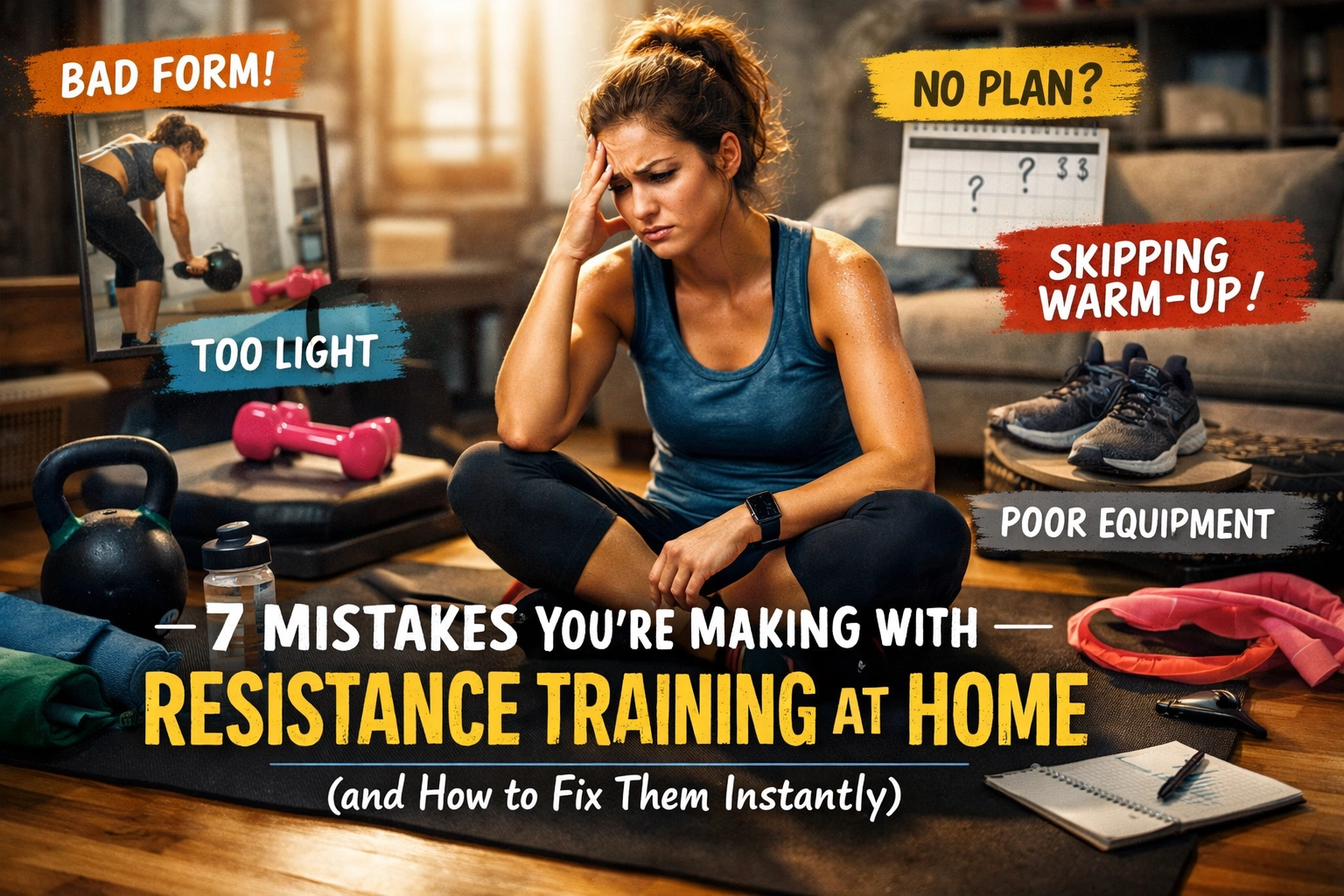
Let’s get one thing straight: Training at home isn’t a "scaled-down" version of the gym. Or at least, it shouldn’t be. For the serious athlete: the Ninja Warriors, the gymnasts, the CrossFit junkies, and the MMA fighters: the home environment is where the real work happens when no one is watching. But here’s the cold, hard truth: most people are sabotaging their gains before they even break a sweat.
You’ve invested in home gym equipment, carved out a corner of your garage or living room, and committed to the grind. Yet, you’re hitting plateaus. Your joints are nagging you. Your "explosive" movements feel like damp firecrackers.
At Bold Body Fitness, we don’t do "average." We build gear for people who want to push the limits of human performance. If your full body workout at home feels more like a chore than a challenge, you’re likely falling into one of these seven traps. Here is how to fix them and turn your space into a high-performance lab.
1. The "Cold Start" Sabotage
We get it. You’re busy. You want to walk into your gym space and immediately start ripping reps. But jumping straight into high-intensity resistance training or explosive bodyweight training at home without a specific warm-up is a recipe for a torn labrum or a blown-out knee.
Your muscles might be ready, but your central nervous system (CNS) and your tendons are still in "couch mode." Tendons have less blood flow than muscles; they need time to catch up to your ambitions.
The Fix:
Stop thinking of a warm-up as "cardio." It’s "movement preparation." Spend 8 minutes on dynamic movements. Think arm circles, hip hinges, and pogo hops. If you’re using the Resistance Rail, perform high-rep, low-tension face pulls and rotations. Get the blood flowing to the rotator cuffs and the connective tissue. If you aren't sweating before your first "real" set, you aren't ready.

2. Flying Blind (The Feedback Gap)
In a commercial gym, you have mirrors everywhere. At home, you’re often training in a vacuum. Without visual feedback, your "neutral spine" is usually a rounded mess, and your "deep squat" is probably four inches high. Bad movement patterns become ingrained in muscle memory incredibly fast. If you’re a calisthenics practitioner, an inch of misalignment is the difference between a perfect handstand push-up and a shoulder impingement.
The Fix:
Video your sets. Every single one. But better yet, use physical cues. This is why we designed our floor to ceiling gym systems to be vertical references. A fixed vertical rail, like the one found at Bold Body Fitness, provides an immediate physical line of reference. If your back is off the rail or your alignment is skewed, you’ll feel it instantly. You don't need a wall of mirrors when you have a precision-engineered anchor point to keep you honest.
3. The Trap of Routine Repetition
Consistency is king, but repetition is a slow death for progress. If you do the same three sets of ten push-ups every Monday, your body has no reason to adapt after week four. Serious athletes: especially those in MMA or CrossFit: need multi-planar stress. Most home gym equipment forces you into "linear" movements. You move up, you move down. Real life and real combat happen at angles.
The Fix:
Change the vectors. If you’re doing chest presses, don’t just push straight out. Use a versatile home gym setup to perform high-to-low flies, then low-to-high punches. By changing the angle of resistance, you force your stabilizing muscles to fire in ways they never do during a standard bench press. This is how you build "functional" strength that actually translates to the mat or the obstacle course.
4. Ego Overload vs. Quality Tension
We see it all the time in calisthenics equipment for home setups: people trying to progress to a one-arm pull-up when they can’t even control the eccentric phase of a standard one. They "ego lift" their own bodyweight, using momentum instead of muscle.
If you’re just throwing weight around or kipping through every movement without a foundation of strict strength, you’re just waiting for an injury to happen.
The Fix:
Slow. It. Down. If you lack heavier weights or higher resistance, increase the "Time Under Tension" (TUT). Slow down the negative phase of your movement to a 4-second count. Add a 2-second pause at the peak of the contraction. This creates massive metabolic stress without needing a 500lb rack. When using your resistance training bands, focus on the "snap back": don't let the band pull you; you control the band.

5. Redlining Your CNS (All Gas, No Brakes)
There’s a toxic culture in the CrossFit home gym world that says if you aren't collapsing in a pool of sweat, you didn't work hard enough. Training at 100% intensity every single day is the fastest way to fry your central nervous system. When your CNS is fried, your power output drops, your coordination fails, and your risk of injury skyrockets.
The Fix:
Periodize your home training. You need "Strength" days (heavy resistance, low reps), "Hypertrophy" days (moderate resistance, higher reps), and "Power/Speed" days (explosive movements with perfect form). If you’re feeling sluggish, don't just "push through it." Switch to a recovery-focused session using light tension on your Resistance Rail to work on mobility and blood flow.
6. The "Core-Less" Movement
Many athletes think "core work" is something you do at the end of a workout with a few sit-ups. This is a massive mistake. In a full body workout at home, your core is the bridge that transfers power from your legs to your arms. If that bridge is weak, your power leaks out. Poor core engagement during push-ups, rows, or squats leads to lower back pain and "hollow" strength.
The Fix:
Integrate your core into every movement. If you’re using a pull up bar alternative or a suspension trainer, your abs should be braced as if someone is about to punch you. Use tools like the Resistance Rail to perform "Pallof Presses": standing perpendicular to the rail and resisting the urge to be pulled toward it. This builds anti-rotational strength, which is the secret weapon of MMA fighters and gymnasts.
7. Settling for "Toy" Equipment
This is the big one. If you’re serious about your fitness, why are you training on equipment held up by a tension rod in a door frame? If you don't trust your gear, your brain will subconsciously hold your muscles back. You can't go 100% on a sketchy, cheap pull-up bar. You can't perform explosive lateral movements if you're worried about your anchor point ripping out of the drywall.
Most "home solutions" are built for the casual user who wants to lose five pounds. They aren't built for the athlete who wants to break records.
The Fix:
Invest in professional-grade gear. You need a no wall damage workout system that actually handles the torque of a 200lb athlete going full tilt. The Resistance Rail from Bold Body Fitness was born from this exact frustration. It’s a floor-to-ceiling, rock-solid anchor that gives you the stability of a commercial power rack with the footprint of a coat rack.

Why the Resistance Rail is the Ultimate Fix
If you’ve recognized yourself in these mistakes, don’t sweat it: fix it. The Resistance Rail was designed to solve the specific limitations of home training.
- No Wall Damage: Perfect for renters or those who don't want to drill into their studs. It’s a no wall damage workout system that stays put.
- Infinite Adjustability: Unlike a fixed pull-up bar, you can slide your resistance points to any height in seconds. This allows for the vector training we talked about: going from a high-anchor lat pull to a low-anchor bicep curl instantly.
- Total Stability: It provides the "visual and physical feedback" you need to keep your form perfect. It’s the ultimate calisthenics equipment for home use because it supports your weight and your ambition.
The Bottom Line
Your home is your sanctuary, and your body is your machine. Don't treat them with "budget" intensity or "budget" equipment. Avoid the "cold start," stop flying blind, and quit settling for gear that limits your potential.
Ready to stop making excuses and start making progress? Check out our full line of professional-grade home gym equipment at the Bold Body Fitness Shop. Whether you're a gymnast looking for better stability or a CrossFit athlete needing a more versatile home gym, we have the tools to help you dominate.

Stop training like an amateur. Start training like a pro: at home.
Explore the Bold Body Fitness Gallery to see how elite athletes are transforming their spaces with the Resistance Rail. It’s time to be Bold.
