
You decided to stop paying for a membership you barely use and start building your own kingdom. You bought the weights, you’ve got the motivation, and you’re ready to crush a full body workout at home. But there’s a problem. Your house wasn't built like a commercial CrossFit box.
Most people treat their home walls like they’re indestructible. They aren't. If you’re a serious athlete: a ninja warrior, a gymnast, or an MMA fighter: you’re putting forces on your home’s structure that it was never designed to handle. We’ve seen beautiful homes turned into Swiss cheese by poorly planned calisthenics equipment for home setups.
At Bold Body Fitness, we believe your home gym should make you stronger, not make your house weaker. If you want a versatile home gym without the structural repair bills, you need to stop making these seven common mistakes.
1. The "Doorway Disaster" (Telescopic Pull-Up Bars)
The biggest lie in the fitness industry is the "no-drill" doorway pull-up bar. It’s marketed as the ultimate pull up bar alternative, but it’s a silent killer for your door frames.
These bars rely on lateral pressure or leverage against the thin decorative trim around your doors. Here is the reality: that trim is usually held on by tiny finishing nails. It is not designed to support 200 lbs of swinging weight. Over time, you’ll see the wood split, the header shift, and the drywall above the door crack. Even worse, if you’re doing explosive movements: typical for crossfit home gym training: you risk the entire bar slipping, leading to a nasty fall.
The Fix: Stop trusting your safety to a piece of trim. You need a solution that anchors into the structural studs of your home. If you want a real no wall damage workout system, you need to look at high-grade tracks like the Resistance Rail. It distributes weight across multiple points of contact, ensuring the force is handled by the house's frame, not its skin.

2. Ignoring Vertical Clearance for Overhead Movements
You measured the floor space, but did you measure the ceiling? Nothing kills a bodyweight training at home session faster than banging your knuckles on a popcorn ceiling during a muscle-up or a snatch.
For athletes focused on resistance training, verticality is everything. If you’re installing a floor to ceiling gym system, you need to account for the "working zone." This includes your height plus the length of your arms, plus the equipment itself. Many athletes buy a standard rack only to realize they can't actually use the pull-up bar because their head would go through the attic.
The Fix: Before buying any home gym equipment, perform a "reach test." Stand in the spot where you plan to train and reach as high as you can. If you have less than 12 inches of clearance above your hands, you need adjustable equipment. This is where the Bold Body Fitness philosophy comes in: our gear is designed to be modular. Check out our workout category for tips on maximizing small, low-ceiling spaces.
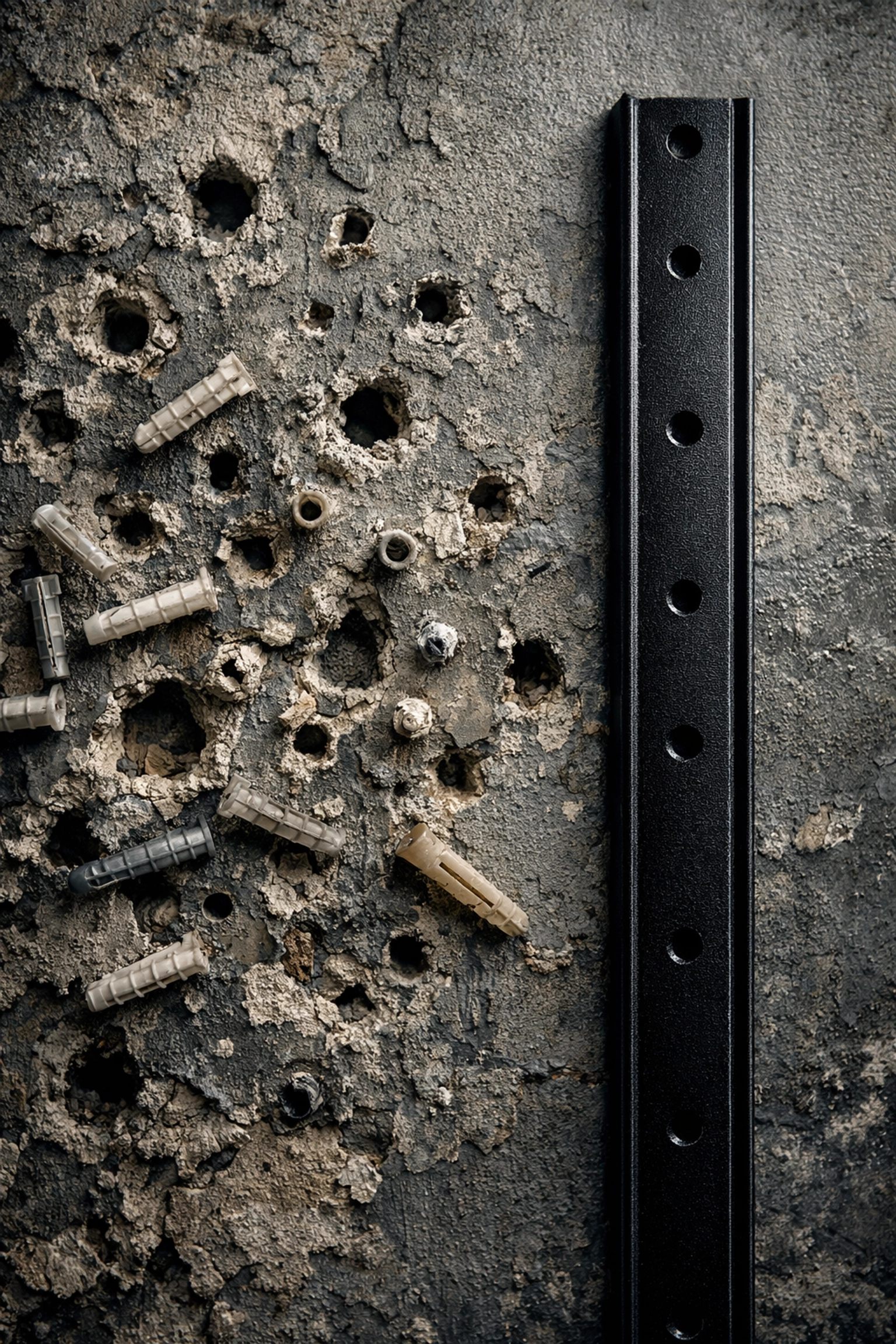
3. The "Swiss Cheese" Wall: Over-Drilling
We see it all the time. An athlete buys a TRX mount. Then they buy a single pull-up bar. Then they buy a weight plate rack. Six months later, their wall has twenty different holes in it.
Every hole you drill into a stud slightly weakens its integrity. If those holes are too close together, you’re creating a "perforation line" that can lead to stud failure under heavy loads. For calisthenics practitioners who need absolute stability, a wall full of random holes is a safety hazard.
The Fix: Think long-term. Instead of buying five different mounts, invest in a single, high-tensile track system. A versatile home gym should allow you to change your anchor points without drilling new holes every time you want to switch from a heavy bag to resistance bands. This is the core benefit of a rail-based system; you drill once, and then you have infinite adjustability.
4. Using the Wrong Fasteners for Resistance Training
Are you using the screws that came in the box? Stop. Often, manufacturers include cheap, zinc-plated screws that are prone to shearing under the high-torque loads of resistance training.
When you’re performing explosive movements: common in MMA and ninja warrior training: you aren't just putting your body weight on the wall; you’re putting "live loads" that can be 3x your actual weight. If you use standard drywall screws or cheap lag bolts, they can snap, sending you and your equipment crashing down.
The Fix: Go to the hardware store and buy Grade 5 or Grade 8 lag bolts. Ensure they penetrate at least 2.5 inches into the center of the stud. If you aren't sure about your wall’s structural capacity, join the conversation on our forums to see how other heavy-hitters have reinforced their setups. You can even see some gymnastic shots of pro-level home setups for inspiration.
5. Neglecting Subfloor and Wall Impact
If you’re building a crossfit home gym, you’re probably dropping weights. Even if you have "bumper plates," the vibration from a 225-lb drop travels through the floor and right into your walls. Over time, this vibration loosens the nails holding your drywall to the studs, leading to "nail pops": those ugly circular bumps on your walls.
Furthermore, if your equipment is pushed directly against the wall, the micro-vibrations from a treadmill or a rowing machine will scuff and dent the paint, ruining the aesthetics of your room.
The Fix:
- Flooring: Use at least 3/4-inch stall mats. Don't settle for the cheap foam tiles; they are useless for serious lifting.
- Gap: Leave a 2-inch "breathing gap" between your equipment and the wall.
- Anchoring: Use a floor to ceiling gym mount that is decoupled from the wall if you’re in a high-vibration environment.

6. Buying Single-Use Machines for a Small Space
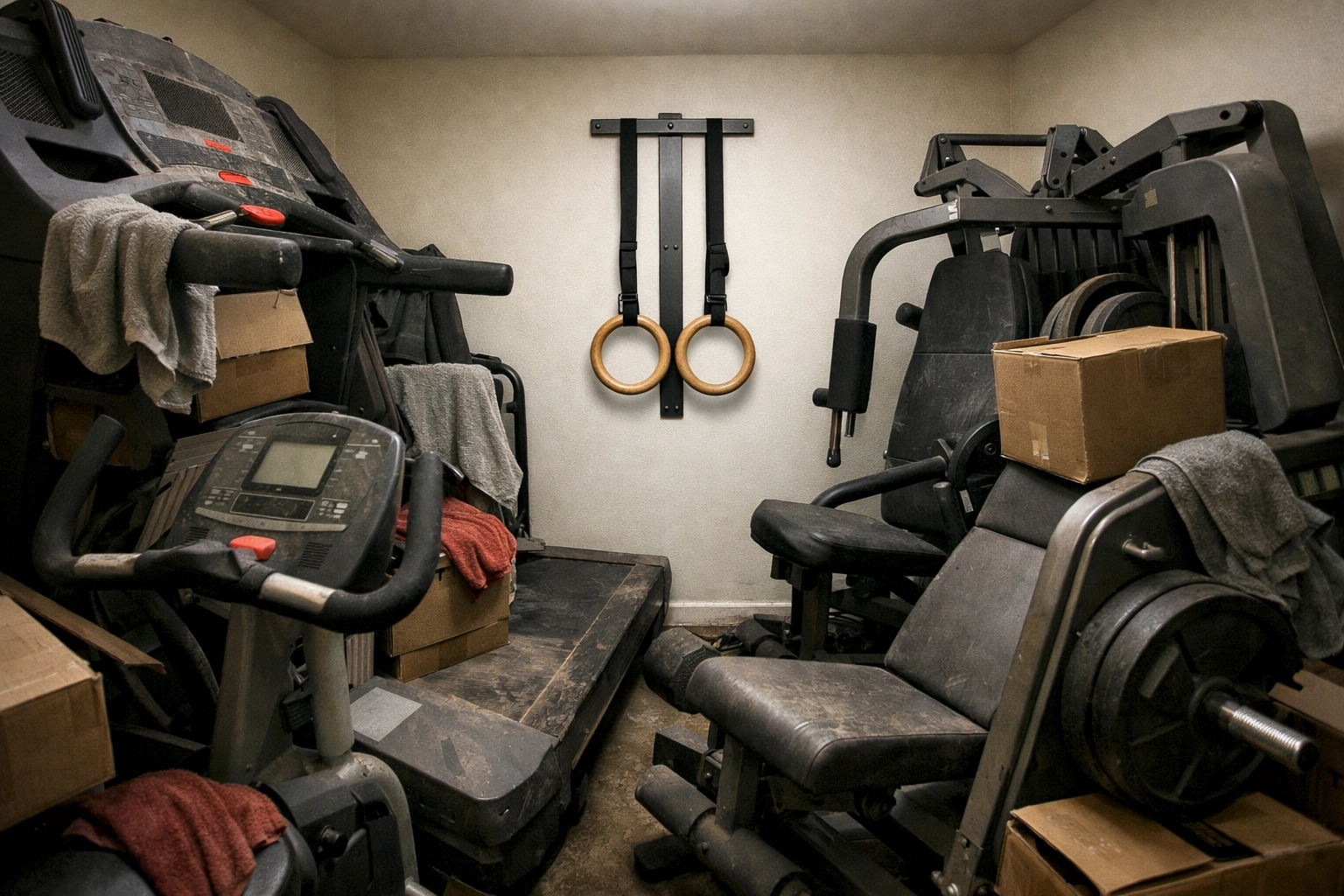
Mistake number six is the "Clutter Trap." You buy a leg extension machine, a dedicated bench press, and a stationary bike. Suddenly, your "gym" is a storage unit where you can’t even do a burpee without hitting your shin.
A cramped space isn't just annoying; it’s dangerous. When you don't have a clear "fall zone" for bodyweight training at home, you end up compensating with poor form to avoid hitting furniture. This leads to injury. For a full body workout at home, you need open floor space, not a graveyard of specialized machines.
The Fix: Prioritize multi-functional home gym equipment. A single anchor point on a Resistance Rail can replace a cable crossover machine, a pull-up station, and a TRX mount while taking up zero floor space. Check out our shop for gear that mounts to the wall and stays out of the way.
7. The "Drywall Anchor" Myth
We have to say this loudly: NEVER anchor fitness equipment into drywall alone.
It doesn't matter if the anchor claims to hold 100 lbs. Drywall is compressed gypsum and paper. It has zero structural integrity for "pull-out" forces. If you try to mount a no wall damage workout system using only drywall anchors, you are guaranteed to end up with a massive hole in your wall and a potential trip to the ER.
The Fix: Use a high-quality stud finder. If your studs aren't where you need them to be, you must install a "stringer": a horizontal piece of 2x4 or 3/4-inch plywood that is bolted to the studs, which you then mount your equipment to. Or, better yet, use a vertical rail system designed to span the distance between the floor and the ceiling, bypassing the need for perfect stud alignment.
The Bottom Line
Building a home gym is an investment in yourself, but it shouldn't come at the cost of your home. Whether you’re a calisthenics pro or just starting your journey with resistance training, your gear needs to be as tough as your workout.
Don't be the person who ruins their living room with a $20 doorway bar. Build it right the first time. Focus on high-quality, versatile tools that respect the structural limits of your house.
Ready to level up without the wreckage? Explore our full range of professional-grade home gym equipment at Bold Body Fitness. From our signature Resistance Rail to expert advice on our community forums, we have everything you need to build a world-class gym in the comfort of your home.
Stop making excuses. Stop making mistakes. Start building a body that matches your ambition.
Shop the collection now: Bold Body Fitness Shop
