
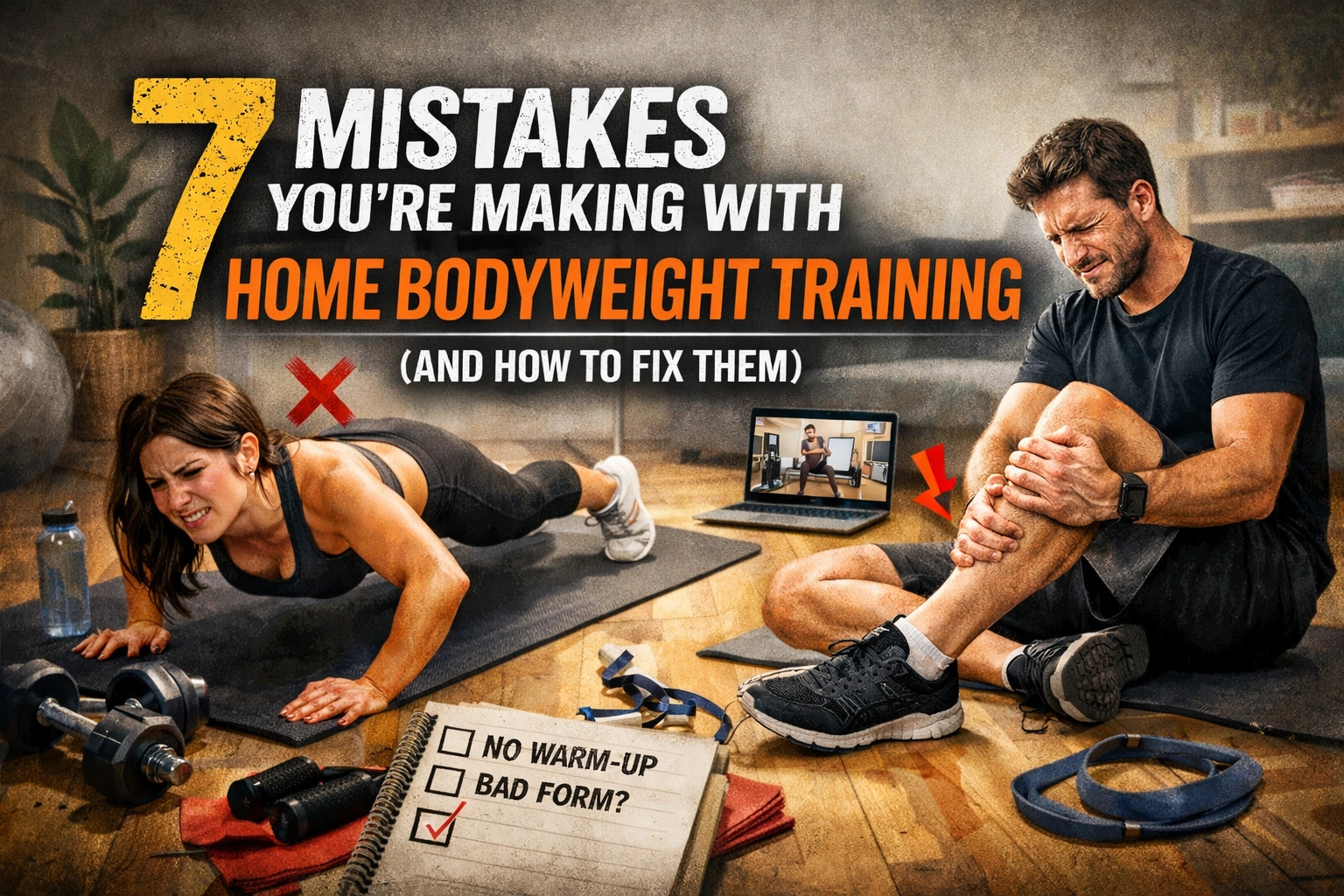
Listen, I get it. You’re a serious athlete. Whether you’re a Ninja Warrior tackling obstacles, a gymnast mastering the rings, or a CrossFit junkie looking to supplement your box sessions, you’ve realized that the convenience of training at home is unbeatable. But there’s a trap that most people fall into: they treat bodyweight training at home like a secondary, "lite" version of their "real" training.
At Bold Body Fitness, we don’t do "lite." We do results.
If your home workouts have hit a plateau, or if you’re starting to feel those nagging pains in your shoulders and lower back, it’s not because bodyweight training doesn’t work. It’s because you’re likely making one of these seven cardinal sins. Let’s break down exactly what you’re doing wrong and how to fix it using the right mindset and a versatile home gym setup.
1. Skipping the Warm-Up (The "Fast-Track to Injury" Mistake)
I see it all the time. You’ve only got 45 minutes, so you jump straight into muscle-ups or explosive handstand pushups. You think you're being "efficient." In reality, you’re just begging for a shoulder impingement or chronic tendonitis.
When you train at a high level: especially in disciplines like MMA or calisthenics: your joints and connective tissues take a beating. Bodyweight movements often put your joints at extreme angles. Starting cold means your synovial fluid isn't flowing, and your muscles aren't primed for the load.
The Bold Fix:
Stop being lazy. Spend 8 to 10 minutes elevating your core temperature. You need dynamic movements that mimic your workout.
- Arm circles and leg swings: Basic, but they work.
- Cat-cows and thoracic bridges: Essential for spine health.
- Scapular pulls: If you’re doing any upper body work, wake up those lats and traps first.
Aim for a light sheen of sweat before you even think about touching your calisthenics equipment for home.

2. Letting Your Form Rot (The "Hidden Plateau" Mistake)
In a commercial gym, you have mirrors everywhere. In a CrossFit box, you have a coach screaming at you to keep your chest up. At home? It’s just you and the TV. Without external feedback, your form will deteriorate.
Your elbows start flaring on pushups, your lower back arches during planks, and your "pull-ups" turn into half-rep chin-reaches. This doesn't just lead to injury; it robs you of strength. When you cheat the movement, you stop targeting the intended muscle groups.
The Bold Fix:
Be your own coach.
- Video Yourself: Set up your phone and record a set of every exercise. Compare your form to high-level athletes. You’ll be shocked at what you see.
- Use Mirrors: If you’re building a versatile home gym, invest in a full-length mirror.
- Mind-Muscle Connection: Slow down. If you can’t feel your lats engaging during a row, you aren't doing the row correctly.
3. The "Same Old, Same Old" (The Progression Mistake)
If you did 20 pushups yesterday and you do 20 pushups today, and you plan on doing 20 pushups tomorrow... congratulations, you’ve stopped getting stronger.
The biggest critique of bodyweight training is that it's "too easy" to plateau. This is only true if you don't understand progressive overload. Serious athletes know that to grow, you must constantly increase the demand on your body.
The Bold Fix:
You need to manipulate the variables. If you don't have a rack of dumbbells, you have to get creative.
- Tempo: Instead of banging out reps, take 4 seconds on the way down (eccentric) and hold the bottom for 2 seconds.
- Levers: Move from regular pushups to archer pushups or pseudo-planche pushups.
- Resistance Training: This is where the Resistance Rail changes the game. By adding band resistance to your bodyweight movements, you can create a linear progression that mimics traditional weightlifting while maintaining the functional benefits of calisthenics.
4. Ignoring the Posterior Chain (The "Caveman Posture" Mistake)
Humans love to train what they can see in the mirror. This leads to an obsession with pushups, dips, and core work. The result? "Caveman Posture": internally rotated shoulders, a rounded upper back, and a weak posterior chain.
For CrossFit athletes and gymnasts, this is a death sentence for performance. You need a strong back to stabilize your spine and power your explosive movements. The problem is that "pulling" exercises are the hardest to do at home without the right gear.
The Bold Fix:
You must prioritize pulling movements at a 2:1 ratio to pushing movements if you're trying to fix your posture.
- The Pull-Up Bar Alternative: Most doorframe pull-up bars are trash. They limit your range of motion and damage your house. We developed the Resistance Rail as a superior pull up bar alternative. It allows for high-to-low pulling, face pulls, and rows that actually target your rear delts and rhomboids.
- Floor to Ceiling Gym: Consider a floor to ceiling gym setup that allows for vertical pulling. If you can't do a full pull-up yet, use the Resistance Rail to perform assisted versions or inverted rows to build that foundation.

5. Getting the Intensity Wrong (The "Lounge Act vs. Kamikaze" Mistake)
Home training usually falls into two categories of failure:
- The Lounge Act: You spend more time picking a playlist or checking Instagram than you do under tension. Your heart rate never spikes, and you never reach true muscular failure.
- The Kamikaze: You go 100% every single day. You’re doing high-volume crossfit home gym WODs seven days a week until your central nervous system (CNS) fries and you can’t even do a single air squat.
The Bold Fix:
Train with intent.
- Track Your RPE: Use the "Rate of Perceived Exertion" scale. Most of your sets should be an 8 or 9 out of 10.
- Scheduled De-loads: Every 4th or 5th week, cut your volume in half. This allows your tendons and nervous system to recover so you can come back stronger.
- Focus on Tension: In bodyweight training at home, tension is king. Don't just move through space; squeeze the muscle you're working.
6. Training in a "Soft" Environment (The Mental Mistake)
If you work out in the same spot where you binge-watch Netflix, your brain isn't going to flip the switch into "beast mode." Your environment dictates your output. If your gear is unstable or you’re worried about breaking a doorframe, you will subconsciously hold back.
Many people avoid home gyms because they don't want to drill holes into their walls or take up an entire room with a power rack.
The Bold Fix:
Create a dedicated space, even if it’s small.
- No Wall Damage Workout System: This is one of the core philosophies at Bold Body Fitness. You shouldn't have to choose between a killer workout and your security deposit. Our Resistance Rail systems are designed to provide a rock-solid, no wall damage workout system that gives you the confidence to go all out.
- Psychological Anchors: Put on your gym shoes. Turn off the TV. When you enter your "Bold Zone," you are there to work.
7. Using Poor-Quality Equipment (The "Subconscious Fear" Mistake)
This is the biggest mistake of all. You’re a 200lb athlete trying to do explosive pull-ups on a $30 bar held up by plastic friction. Subconsciously, you know that equipment might fail. Because of that, you don't pull as hard as you can. You don't move as fast as you should. You are limiting your own gains because you don't trust your gear.
Furthermore, cheap bands snap, and cheap "multi-gyms" have limited range. If you want elite results, you need elite tools.
The Bold Fix:
Invest in yourself. You wouldn't wear flip-flops to run a marathon, so don't use "toy" equipment for your full body workout at home.
- Versatility is Key: A truly versatile home gym should allow you to perform everything from heavy resistance rows to mobility work.
- Bold Body Fitness Standards: We build equipment for the guys who break things. Our systems are designed for the calisthenics equipment for home market but built with the durability required for an MMA gym.
The Path Forward: A Full Body Workout at Home That Actually Works
If you’re ready to stop making these mistakes, you need a system that grows with you. Bodyweight training is the foundation, but resistance training is the architect that builds the structure.
A Sample "Bold Fix" Routine:
Perform this 3 times a week, focusing on perfect form and high intensity.
- Warm-Up (10 Mins): Thoracic bridges, scapular circles, and 2 sets of light band pull-aparts.
- Primary Pull: Weighted Pull-ups (or Band-Resisted Rows using the Resistance Rail). 4 sets of 8-10 reps.
- Primary Push: Deficit Pushups or Handstand Pushup Progressions. 4 sets of max reps (RPE 9).
- Posterior Chain: Single-leg RDLs or Banded Good Mornings. 3 sets of 15 reps.
- Core/Stability: Hollow Body Holds or L-Sits. 3 sets of 30-45 seconds.

Why Bold Body Fitness?
We didn't just want to make more "fitness gear." We wanted to solve the problems that stop athletes from training at home. The Resistance Rail was born out of the need for a pull up bar alternative that offered more than just one movement. It's a complete floor to ceiling gym solution that fits into your life without ruining your home.
Whether you are deep into calisthenics, training for a CrossFit competition, or just want to be the strongest version of yourself, you need a system that supports your ambition.
Don't let these seven mistakes hold you back any longer. Correct your form, prioritize your back, and get the gear that matches your intensity.
Ready to transform your home training?
Check out our full shop here and find the system that fits your goals.
It's time to stop making excuses and start making progress. Stay bold.
Brian Kerr
Founder, Bold Body Fitness
