
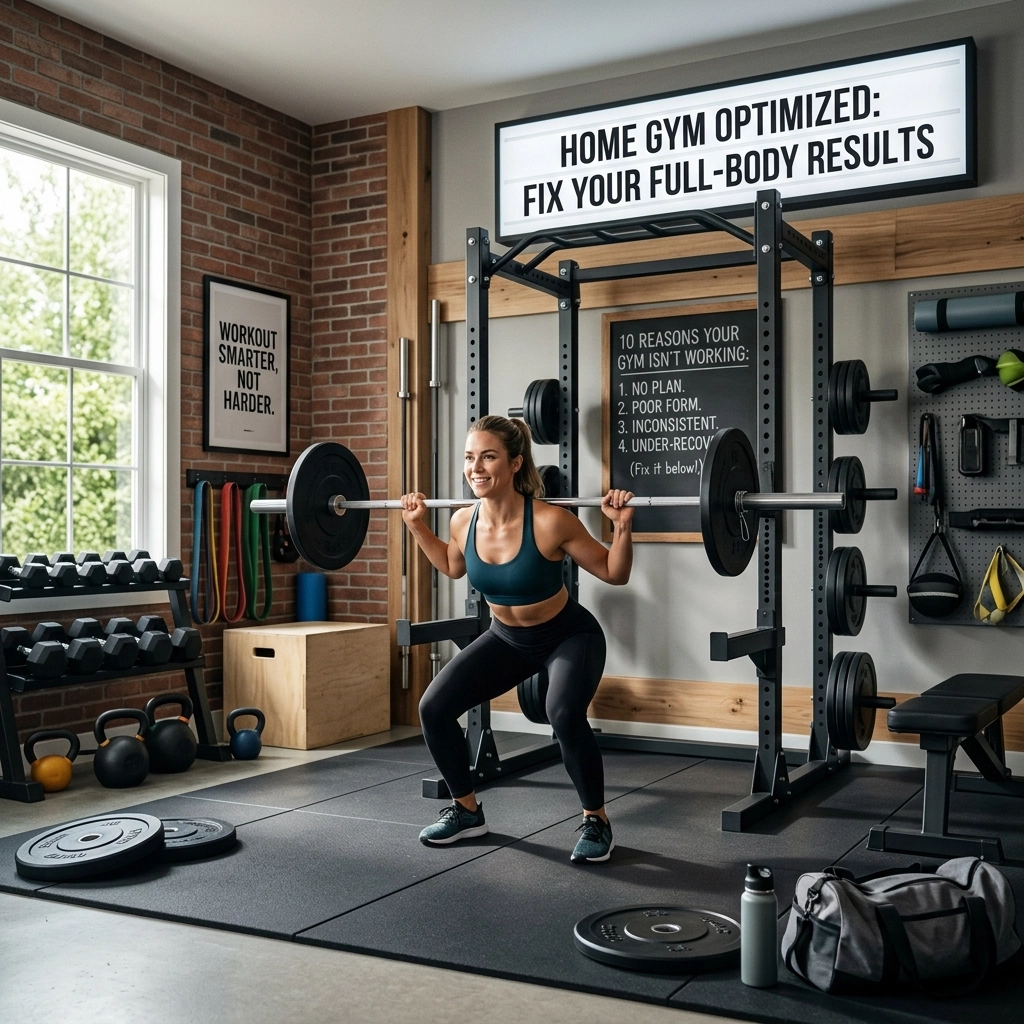
Let’s be honest: your home gym is probably a mess of mismatched iron, tangled bands, and a "multi-purpose" bench that’s currently serving as a laundry rack. You started with the best intentions: build an elite sanctuary where you could crush full body workouts at home without the commute, the crowds, or the questionable hygiene of a commercial box.
But a few months in, the results have stalled. Your gains are plateauing, your motivation is tanking, and you’re starting to think that maybe you just can’t get a "real" workout outside of a professional facility.
You’re wrong.
The problem isn't that you’re training at home; the problem is that your versatile home gym isn't actually versatile: it’s just cluttered. For serious fitness enthusiasts: the Ninja Warriors, the MMA fighters, the CrossFit addicts, and the calisthenics pros: a standard "home gym" setup often falls short of the demands of elite performance.
At Bold Body Fitness, we don’t do mediocre. We build gear for people who want to dominate. If your home setup is failing you, it’s likely due to one of these ten structural or psychological bottlenecks. Here is exactly why your gym isn't working and how to fix your full-body results forever.
1. You’re Training on a Shaky Foundation (The Stability Gap)
If your rig wobbles when you attempt a high-volume set of pull-ups or a weighted dip, your central nervous system (CNS) knows it. When your brain senses instability in your home gym equipment, it sends a signal to your muscles to "dial back" the power output to prevent injury. You aren't reaching failure because your muscles are tired; you're reaching failure because your brain is scared the equipment will collapse.
Most "versatile" setups rely on freestanding towers that take up massive floor space but offer zero actual rigidity.
The Fix: You need a floor to ceiling gym system. By anchoring your equipment between the floor and the ceiling, you create a structural pillar that mimics the stability of a bolted-down commercial rack. This stability allows you to push your resistance training to the absolute limit. When the equipment doesn't move, you can.

2. Your "Full Body" Setup is Actually Just "Some Body"
A lot of home equipment claims to offer a "full body workout," but they usually focus on the sagittal plane (forward and backward). If you’re an MMA fighter or a gymnast, life happens in 360 degrees. If your equipment doesn't allow for lateral movement, rotation, and high-angle pulls, you’re developing "mirror muscles" that fail in the cage or on the obstacle course.
The Fix: Stop thinking in terms of "machines" and start thinking in terms of "angles." Your versatile home gym should allow for high-to-low, low-to-high, and lateral resistance. This is where the Resistance Rail changes the game. By allowing you to slide your anchor points instantly, you can transition from a chest press to a woodchop to a face pull in seconds, ensuring every muscle fiber is hit.
3. You’re Petrified of Your Landlord (The Wall Damage Dilemma)
We’ve seen it a thousand times: an athlete wants a serious crossfit home gym, but they live in a rental or a high-end home where drilling holes into the studs is a non-starter. As a result, they settle for a flimsy doorway pull-up bar that ruins the trim and limits their range of motion. Because they’re afraid of damage, they don't train with the intensity required for elite results.
The Fix: Switch to a no wall damage workout system. You shouldn't have to choose between your security deposit and your deadlift. Systems that use compression or clever structural engineering to stay in place without bolts allow you to go 100% hard without the "property damage" anxiety hanging over your head.
4. You’ve Outgrown Your Resistance
For those focused on bodyweight training at home, there comes a point where standard reps just don't cut it anymore. If you can do 50 pushups, doing 51 isn't making you stronger; it’s just making you better at doing 51 pushups. To build the explosive power needed for Ninja Warrior obstacles or heavy grappling, you need to add resistance to those bodyweight moves.
The Fix: Incorporate variable resistance training. Use heavy-duty bands and adjustable anchors to add "weight" to your calisthenics. A pull up bar alternative that allows you to integrate bands means you can do assisted reps when you're learning a muscle-up, or resisted reps when you're trying to build back thickness. Check out our full shop for tools that help you scale your resistance properly.
5. You’re Using a Compromised Pull-Up Bar
The doorway pull-up bar is the biggest lie in fitness. It limits your grip width, bangs your knees against the door, and prevents any kind of explosive "kipping" or "L-sit" work. If you’re a gymnast or a calisthenics practitioner, a doorway bar is a toy, not a tool.
The Fix: You need a legitimate calisthenics equipment for home solution that offers overhead clearance and verticality. Your pull-up station should be the centerpiece of your gym, not an afterthought tucked into a closet door. When you have the space to move your body through a full range of motion, your results will skyrocket.

6. Space Friction is Killing Your Consistency
If you have to spend 15 minutes moving the car, unhooking the bike rack, and dragging out your weights just to start a session, you’re going to skip workouts. "Friction" is the silent killer of the full body workout at home.
The Fix: Your gym needs to be "always on." This is why vertical systems are superior. A floor to ceiling gym takes up almost zero square footage but provides a permanent station that’s ready the second you walk into the room. If your equipment is already set up and looking at you, the "I don't have time" excuse disappears.
7. You’re Ignoring the "Grip" Component
MMA fighters and Ninja Warriors know that your workout is only as good as your grip. Most home gym gear uses cheap, thin, or overly cushioned handles that do nothing for your forearm development. If you're only training on standard-sized bars, you'll find your hands failing you when it matters most.
The Fix: Upgrade your home gym equipment with specialized attachments. Your system should be modular enough to accept fat grips, cannonball orbs, and climbing holds. This turns every back day into a grip strength session.
8. You Lack a "Progression Pathway"
The reason people see results in CrossFit boxes is the baked-in progression. At home, people tend to do the same three sets of the same four exercises. Without a way to objectively measure and increase the difficulty of your movements, you will plateau within six weeks.
The Fix: You need a system that allows for micro-adjustments. The Resistance Rail allows you to change the angle of pull by as little as an inch. That slight change in leverage can be the difference between a movement being "easy" and it being a "struggle." Track your anchor points, track your band tension, and treat your home training with the same data-driven intensity you would a professional lab.

9. Your Recovery is Non-Existent
Most home gyms are focused entirely on the "work" and zero on the "reset." If your versatile home gym doesn't include a way to perform decompressing movements: like hanging or assisted stretching: you’re going to end up stiff, immobile, and prone to injury.
The Fix: Use your rig for mobility as much as for strength. A solid overhead anchor point allows for spinal decompression and deep lat stretching that you simply can't get on the floor. If you’re doing heavy resistance training, you owe your joints the courtesy of a proper stretch-out using the same equipment.
10. You’re Falling for the "All-in-One" Gimmick
There’s a difference between a "Versatile" gym and a "Gimmick" gym. Gimmick gyms try to replicate 50 different machines in one cheap plastic frame. They end up doing 50 things poorly. Versatile gyms provide you with a high-quality "chassis" that you can adapt to your specific needs.
The Fix: Focus on a high-quality, heavy-duty anchor system. For the serious athlete, a floor to ceiling gym acts as that chassis. You can hang rings from it for gymnastic work, attach bands for MMA-style punching resistance, or use it as a pull up bar alternative for high-volume calisthenics.

Why the Resistance Rail is the Answer
We didn't design the Resistance Rail for the person who wants to do five minutes of "toning" and call it a day. We designed it for the athlete who lives in an apartment but trains like they're in a professional fight camp.
It addresses every failure point listed above:
- Stability: It's a floor to ceiling gym that utilizes the structure of your home to create a rock-solid training pillar.
- No Wall Damage: It’s the ultimate no wall damage workout system. No drills, no studs, no angry landlords.
- Versatility: It transforms from a crossfit home gym rig to a calisthenics equipment for home station in seconds.
- Full Body: It allows for true 3D movement, making your full body workout at home more effective than anything you can do on a standard machine.
The Bold Truth
Your home gym isn't working because you've been settling for "good enough" equipment. But you aren't a "good enough" athlete. You’re a Ninja Warrior. You’re a gymnast. You’re a fighter. You need gear that can handle the violence of your training.
Stop making excuses about your space, your walls, or your schedule. It’s time to upgrade to a system that actually produces results.
Ready to stop making excuses and start making gains?
Shop the Resistance Rail and Build Your Elite Home Gym Now.
Key Takeaways for Your Home Training:
- Prioritize Stability: If it wobbles, it’s holding you back.
- Optimize Space: Use verticality to keep your gym ready 24/7.
- Variable Resistance: Use bands and rails to scale your bodyweight movements.
- No Damage: Choose systems that protect your home while building your body.
- Multi-Planar: Train in every direction, not just up and down.
Your training environment dictates your training outcome. If you’re ready to see what your body is actually capable of, build a gym that doesn't place limits on your potential. Bold Body Fitness is here to help you get there.
For more tips on optimizing your home setup, check out our blog or join the conversation in our community forum.
