
Look, if you're a serious CrossFit athlete or calisthenics pro, you already know that bodyweight training at home isn't just for beginners doing air squats in their living room. It's a legitimate training methodology that can build serious strength, power, and conditioning: if you know what you're doing.
The problem? Most guides treat bodyweight training like it's some casual fitness hobby. But you're not here for casual. You're here to build elite-level performance without needing a 2,000-square-foot commercial gym. You want a full body workout at home that actually challenges you, not some watered-down routine designed for people who've never seen the inside of a CrossFit box.
This guide cuts through the noise and gives you exactly what you need: advanced bodyweight training strategies, equipment solutions that don't destroy your rental deposit, and programming that'll actually move the needle on your performance.
Why Bodyweight Training Deserves Respect in Your Program
Let's clear something up right away: bodyweight training at home isn't a compromise. It's a deliberate training choice used by gymnasts, special forces operators, and elite martial artists worldwide.
The human body is the most sophisticated piece of fitness equipment you'll ever own. It weighs enough to create serious resistance (anywhere from 100-250+ pounds depending on your build), moves through three-dimensional space, and requires zero maintenance costs.
For CrossFit athletes specifically, bodyweight mastery translates directly to competition performance. Think about it: muscle-ups, handstand push-ups, pistol squats, burpees. These movements show up in every Open workout, yet many athletes neglect the focused bodyweight work that would make them unstoppable.
Calisthenics practitioners already know this truth, but here's what takes your training to the next level: structured periodization, progressive overload principles, and the right home gym equipment to expand your movement vocabulary beyond what you can do with just a floor.
The Equipment Reality: What You Actually Need
Here's where most bodyweight training guides lose the plot. They either tell you that you need absolutely nothing (wrong) or that you need to install permanent wall-mounted rigs (also wrong, especially if you're renting).
The truth sits in the middle. You need strategic equipment that expands your movement options without requiring contractor-level installation or leaving permanent damage.
At Bold Body Fitness, we've seen thousands of athletes solve this exact problem with floor-to-ceiling gym solutions that don't require drilling, bolting, or explaining awkward holes to a landlord.
The Essential Home Setup:
-
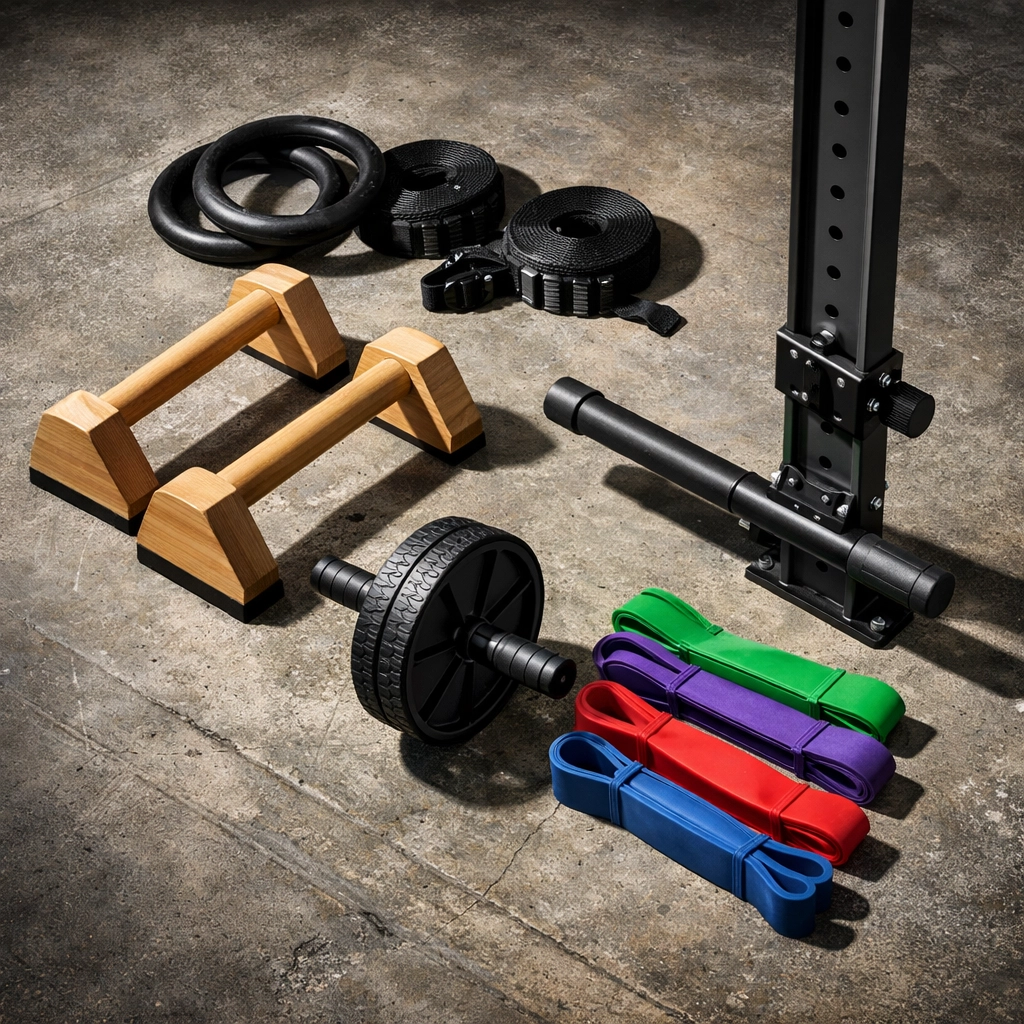
Pull-up bar alternative: Traditional doorway bars limit your movement patterns and can damage frames. A proper floor-to-ceiling system gives you variable grip positions and can handle explosive movements without wobbling.
-
Parallette bars or dip station: Non-negotiable for building the straight-arm strength that separates intermediate from advanced athletes.
-
Gymnastics rings: The single best investment for upper body strength, period. They force stabilization in ways fixed bars can't match.
-
Ab wheel: Cheap, brutal, effective.
-
Quality floor mats: Protect your joints and your security deposit.
The game-changer? A versatile home gym system that combines multiple functions without eating your entire living space. The Resistance Rail solves this exact problem: it's a no wall damage workout system that gives you pull-up variations, resistance band attachment points, and dip station functionality in one adjustable setup. You can move it, adjust it, and take it with you when you relocate. That's what we call smart equipment.
Programming Structure: Beyond Random Workouts
Random workouts create random results. If you want consistent progress, you need structured programming that respects the fundamental principles of adaptation.
The 6-Movement Pattern Framework
Your weekly training should hit six major movement functions, whether you're designing a CrossFit home gym routine or a pure calisthenics program:
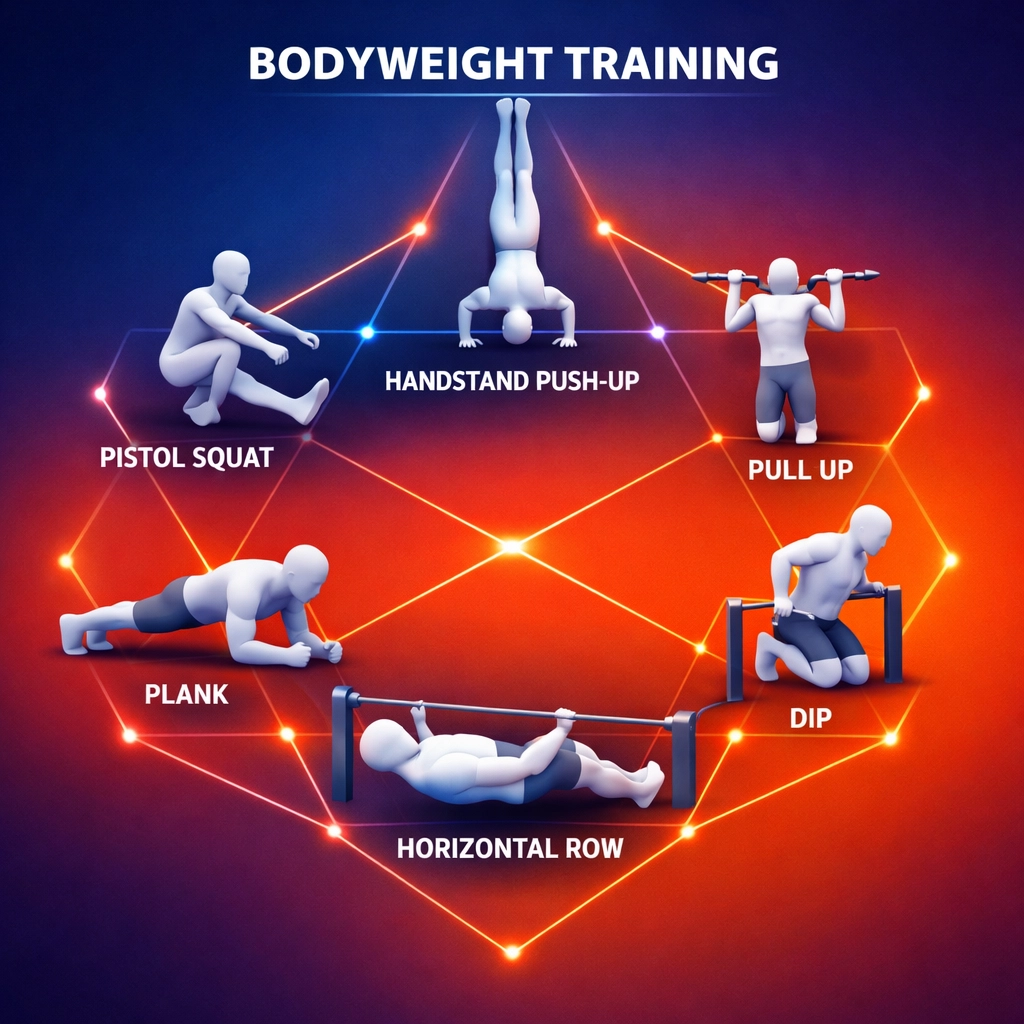
- Upper Body Push (Vertical): Handstand push-ups, pike push-ups, wall walks
- Upper Body Push (Horizontal): Push-up variations, pseudo planche push-ups
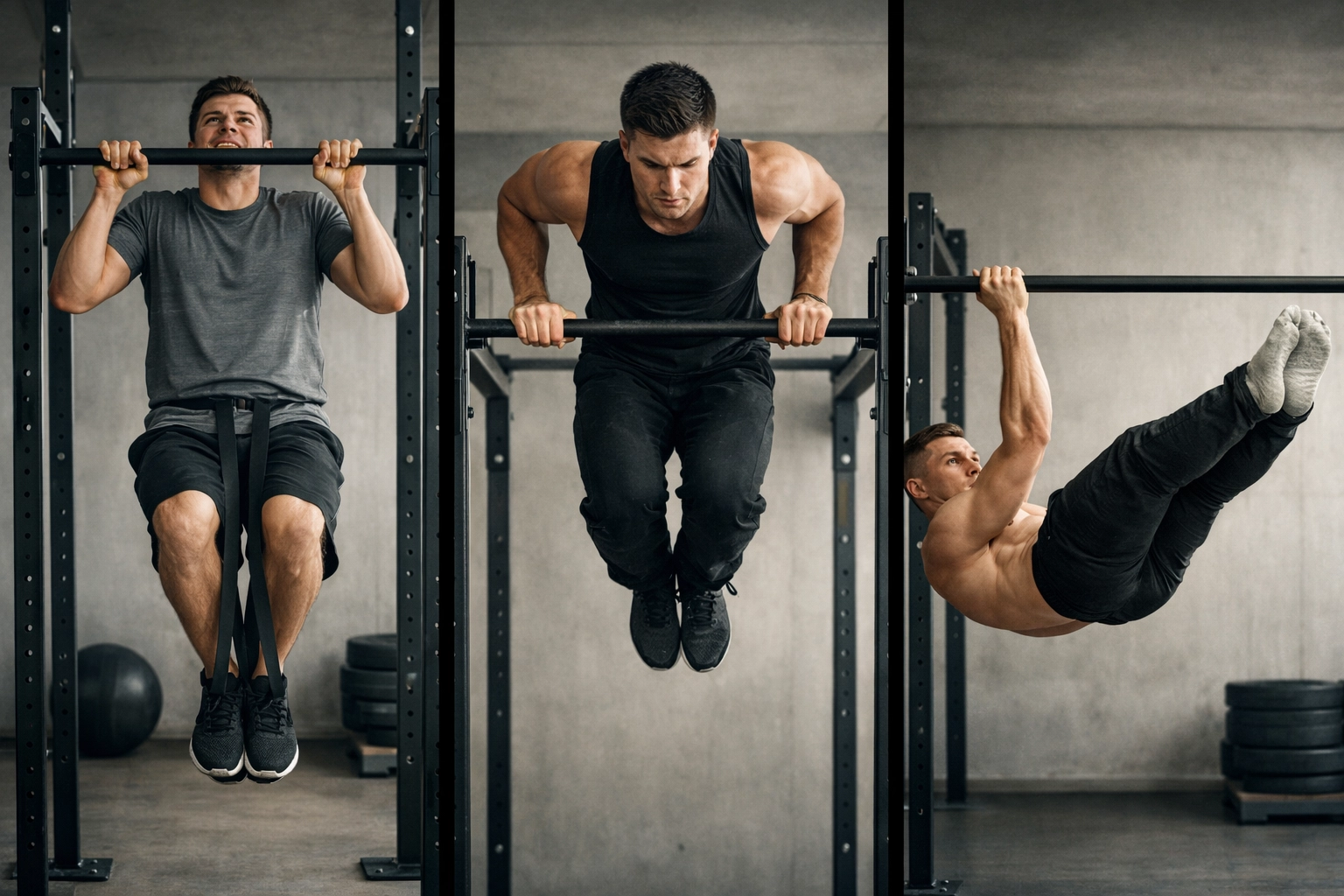
- Upper Body Pull (Vertical): Pull-ups, muscle-ups, L-sit pull-ups
- Upper Body Pull (Horizontal): Ring rows, front lever progressions
- Lower Body: Pistol squats, Nordic curls, single-leg deadlifts
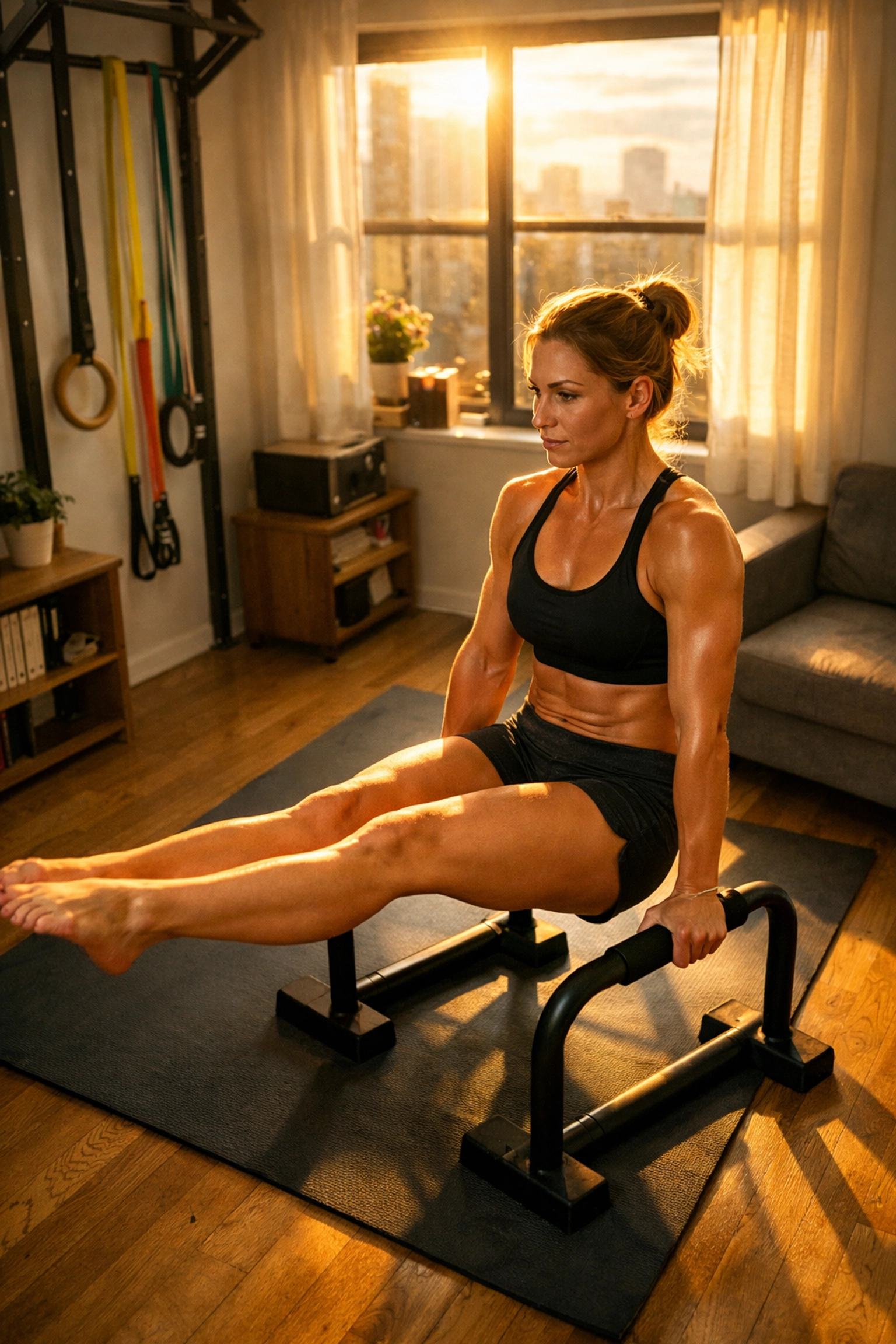
- Core/Midline: Hollow holds, L-sits, dragon flags
This isn't rocket science, but it is systematic. Each movement pattern should be trained 2-3 times per week with varying intensities.
Progressive Overload Without Weights
The biggest mistake athletes make with bodyweight training is thinking they can just do more reps forever. That's endurance training, not strength development.
Real progression looks like this:
- Leverage manipulation: Moving your center of mass further from the fulcrum (think progressing from regular push-ups to pseudo planche push-ups to full planche)
- Tempo variation: 5-second negatives will humble even the strongest athletes
- Range of motion expansion: Deficit work, deep squat variations, full ROM pull-ups
- Unilateral progressions: Two-leg to single-leg, two-arm to single-arm
- Skill complexity: Muscle-up transitions, handstand entries, kipping efficiency
- Added resistance: Strategic use of weighted vests or resistance bands for key movements
The Advanced Athlete's Weekly Template
Here's a sample week that balances volume, intensity, and recovery for serious athletes. Adjust based on your competition schedule and other training obligations.
Monday: Upper Push Emphasis
- Handstand push-up progression: 5x3-5 (against wall or freestanding based on skill)
- Ring dips: 4x6-8 with 3-second negative
- Pseudo planche push-ups: 3x max reps (stop 2 reps before failure)
- Pike push-ups: 3x12-15
- Core circuit: L-sit holds, hollow rocks, weighted planks
Tuesday: Lower Body & Conditioning
- Pistol squat progression: 5x5 each leg
- Nordic curl progression: 4x4-6
- Single-leg glute bridges: 3x12 each leg
- Jump training: Box jumps, broad jumps, single-leg bounds
- EMOM conditioning: 10 minutes alternating burpees and jump squats
Wednesday: Active Recovery
- Mobility work focusing on shoulders, hips, and ankles
- Easy movement: walking, swimming, or light yoga
- Skill practice: handstand holds, L-sit progressions (sub-maximal)
Thursday: Upper Pull Emphasis
- Weighted pull-ups or advanced variation: 5x3-5
- Muscle-up practice: 6-8 singles with perfect form
- Ring rows: 4x8-10 with feet elevated
- Front lever progression: 5x max hold
- Bicep/forearm finisher: Chin-up variations, dead hangs
Friday: Full Body Power
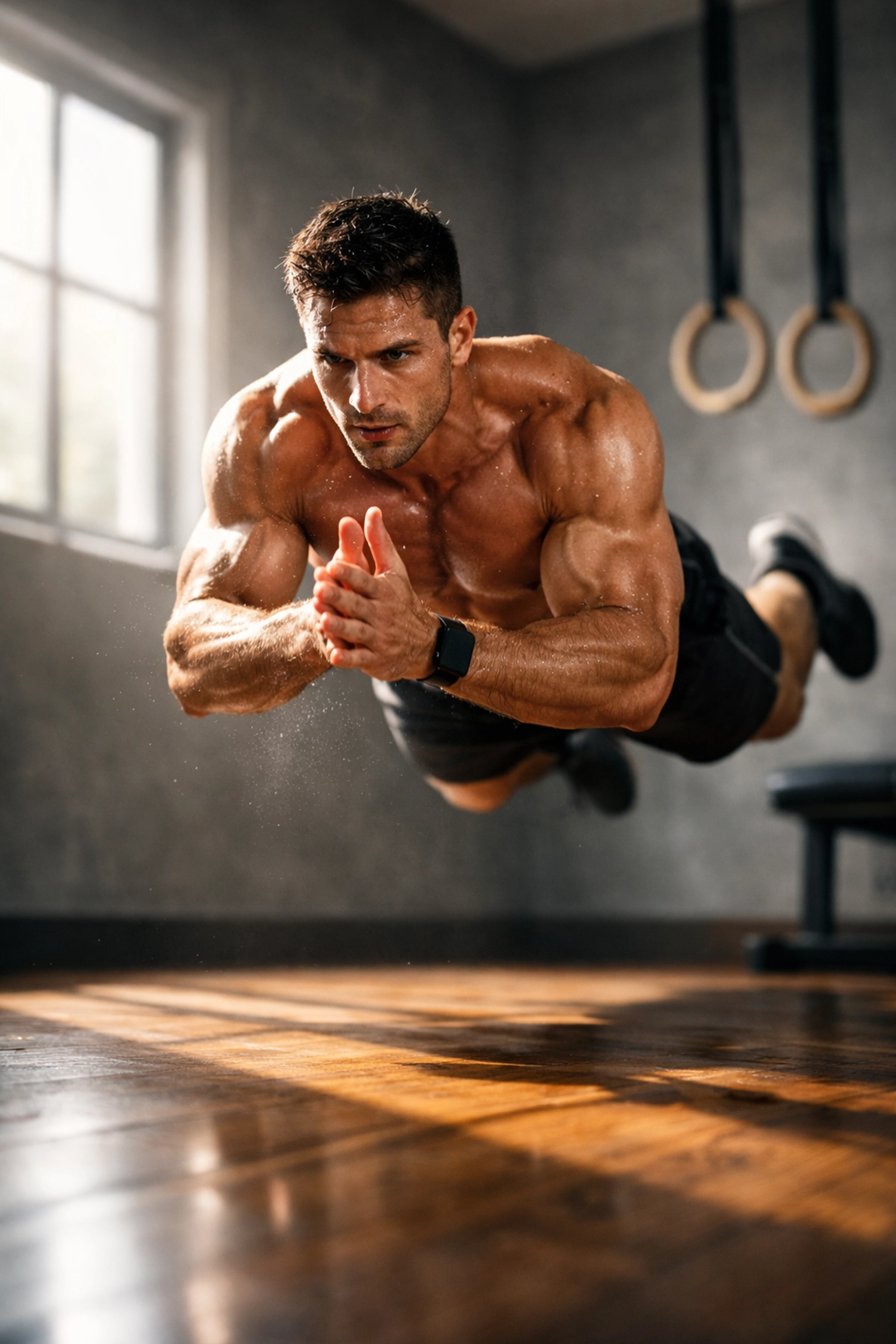
- Clapping push-ups: 5x5
- Explosive pull-ups: 5x3
- Box jump variations: 5x5 at challenging height
- Burpee muscle-ups: 5 rounds of 3-5 reps
- Farmer carries or sandbag work if available
Saturday: CrossFit-Style Metcon
Design workouts using the movements you've built throughout the week:
- 21-15-9: Pull-ups, push-ups, air squats
- AMRAP 20: 5 muscle-ups, 10 handstand push-ups, 15 pistols
- Tabata mix: Burpees, L-sit holds, jump lunges
Sunday: Complete Rest
Your body adapts during recovery, not during training. Honor that.
Advanced Progressions: Pushing Beyond Basics
If you're already crushing standard pull-ups and dips, here's where to take your training next.
Pull-Up Mastery Track:
Standard pull-ups → Weighted pull-ups → L-sit pull-ups → Archer pull-ups → Typewriter pull-ups → One-arm pull-up progressions
Push-Up Evolution:
Standard push-ups → Pseudo planche push-ups → Tuck planche push-ups → Advanced tuck planche push-ups → Straddle planche → Full planche
Lower Body Dominance:
Two-leg squats → Assisted pistols → Full pistols → Weighted pistols → Shrimp squats → Dragon pistols
Core Supremacy:
Planks → Hollow holds → L-sits → V-sits → Manna progressions
The key is respecting the progression timeline. Trying to jump steps leads to injury, not achievement. Build your foundation before attempting flashy skills.
Dealing With Space and Equipment Limitations
Most athletes don't have unlimited space. You're probably training in an apartment, garage, or basement with low ceilings and neighbors who complain about noise.
This is exactly why traditional home gym solutions fail. Fixed power racks take up massive footprints. Wall-mounted pull-up bars require permanent installation. Bulky equipment becomes expensive furniture.
The solution is equipment that adapts to your space rather than forcing your space to adapt to it. Check out the versatile home gym options that work in spaces as small as 8x8 feet while still providing full training functionality.
For calisthenics equipment for home, prioritize multi-function pieces. Your pull-up bar should also work for hanging ab exercises. Your dip station should accommodate various grip widths. Your resistance training system should adjust for different exercises without requiring 20 minutes of setup between movements.
Nutrition and Recovery for Bodyweight Athletes
Training is only one part of the equation. If you're crushing advanced progressions multiple times per week, your nutrition and recovery need to match your ambition.
Protein Targets: Aim for 0.8-1.0g per pound of bodyweight daily. Despite not using external loads, high-intensity bodyweight work creates plenty of muscle damage that requires protein for repair.
Carb Timing: Place most of your carbohydrate intake around training sessions. Pre-workout carbs fuel performance; post-workout carbs aid recovery and replenish glycogen.
Sleep Non-Negotiable: Seven hours minimum, eight preferred. Skill-based movements like muscle-ups and handstands require neurological adaptation that happens during deep sleep.
Active Recovery: On off days, move but don't train. Walk, swim, do mobility work. Sitting completely still actually slows recovery by limiting blood flow to recovering tissues.
Common Mistakes That Stall Progress
Even advanced athletes make these errors:
Mistake 1: Ignoring progressive overload principles. Doing the same workout with the same difficulty every session won't create adaptation. Your body needs increasing challenges.
Mistake 2: Skipping fundamentals. You can't build an iron cross if your basic pull-up form is sloppy. Master the foundations before attempting advanced skills.
Mistake 3: Training through pain. Discomfort during difficult holds is normal. Sharp pain in joints or tendons is not. Learn the difference before you create chronic issues.
Mistake 4: Neglecting posterior chain work. Most bodyweight enthusiasts are push-dominant. Balance your anterior work with equal pulling and posterior chain emphasis.
Mistake 5: Inadequate warm-ups. Cold tissue tears. Spend 10-15 minutes preparing your body, especially before explosive or maximum-effort movements.
Mistake 6: Comparing your timeline to others. Social media shows highlight reels, not the years of consistent work behind them. Focus on your own progression, not someone else's Instagram feed.
Building Your CrossFit Home Gym on a Budget
You don't need $10,000 worth of equipment to train effectively at home. Here's the smart approach:
Phase 1 - Essential Foundation ($200-400):
Start with gymnastics rings, a quality ab wheel, and a resistance training system that doesn't require wall mounting. This gives you pulling, pushing, and core work immediately.
Phase 2 - Expansion ($200-300):
Add parallette bars, a quality jump rope, and resistance bands for assistance and added difficulty.
Phase 3 - Optimization ($300-500):
Invest in adjustable weights, a weighted vest, or specialized equipment for your specific weaknesses.
The beauty of this approach? You're functional from day one. Each phase adds capability without making previous purchases obsolete.
A proper calisthenics equipment for home setup should grow with you, not lock you into fixed capabilities. That's the advantage of adjustable systems over permanent installations.
The Mental Game: Staying Motivated in Your Home Space
Training alone at home tests your discipline differently than training in a competitive gym environment. Some days, you won't feel like working out. The couch is right there. Netflix is tempting. Your accountability is gone.
Here's what keeps serious athletes consistent:
Create environmental triggers. When you enter your training space, your body should know what's coming. Consistent location, consistent music, consistent routine.
Track everything. Write down your workouts. Film your form. Note how movements feel. Progress you can see is progress you'll chase.
Set process goals, not just outcome goals. "I want a muscle-up" is an outcome. "I'll do pull-up progressions three times weekly for 12 weeks" is a process. Control the process; outcomes follow.
Join online communities. Training alone doesn't mean training isolated. Connect with other athletes working toward similar goals.
Schedule your training like appointments. It's not "I'll work out if I have time." It's "I train Monday, Thursday, and Saturday at 6 AM, period."
Your Next Step
You've got the knowledge. The programming framework. The equipment understanding. The progression pathways.
Now comes the part that actually matters: consistent execution over months and years.
Bodyweight training at home isn't a shortcut or a temporary solution. It's a complete training methodology that can take you from competent to exceptional if you're willing to respect the process.
Start with honest assessment. Where are you actually at with pull-ups, dips, pistols, and handstands? Not where you want to be: where you actually are, right now.
Then build your plan. Choose appropriate progressions. Get the equipment that expands your capabilities without destroying your space. And most importantly, show up consistently.
The athletes who succeed aren't necessarily the most talented. They're the most consistent. They're the ones who train even when motivation is low. They're the ones who respect fundamentals while pursuing advanced skills.
That can be you. Your home can be your training ground. Your bodyweight can be your primary resistance. Your consistency can be your competitive advantage.
The question isn't whether bodyweight training at home works for serious athletes. It does. The question is whether you'll put in the work to make it work for you.
Ready to build your training space? Check out the complete selection of home gym equipment designed specifically for athletes who demand more than basic fitness solutions. No compromises. No permanent wall damage. Just serious equipment for serious training.
Now get to work.
