
Listen, if you’re still trying to build a world-class physique by doing basic push-ups on your living room carpet, you’re playing small. Real strength: the kind that turns heads and shatters personal records: requires more than just floor space. It requires the right tools.
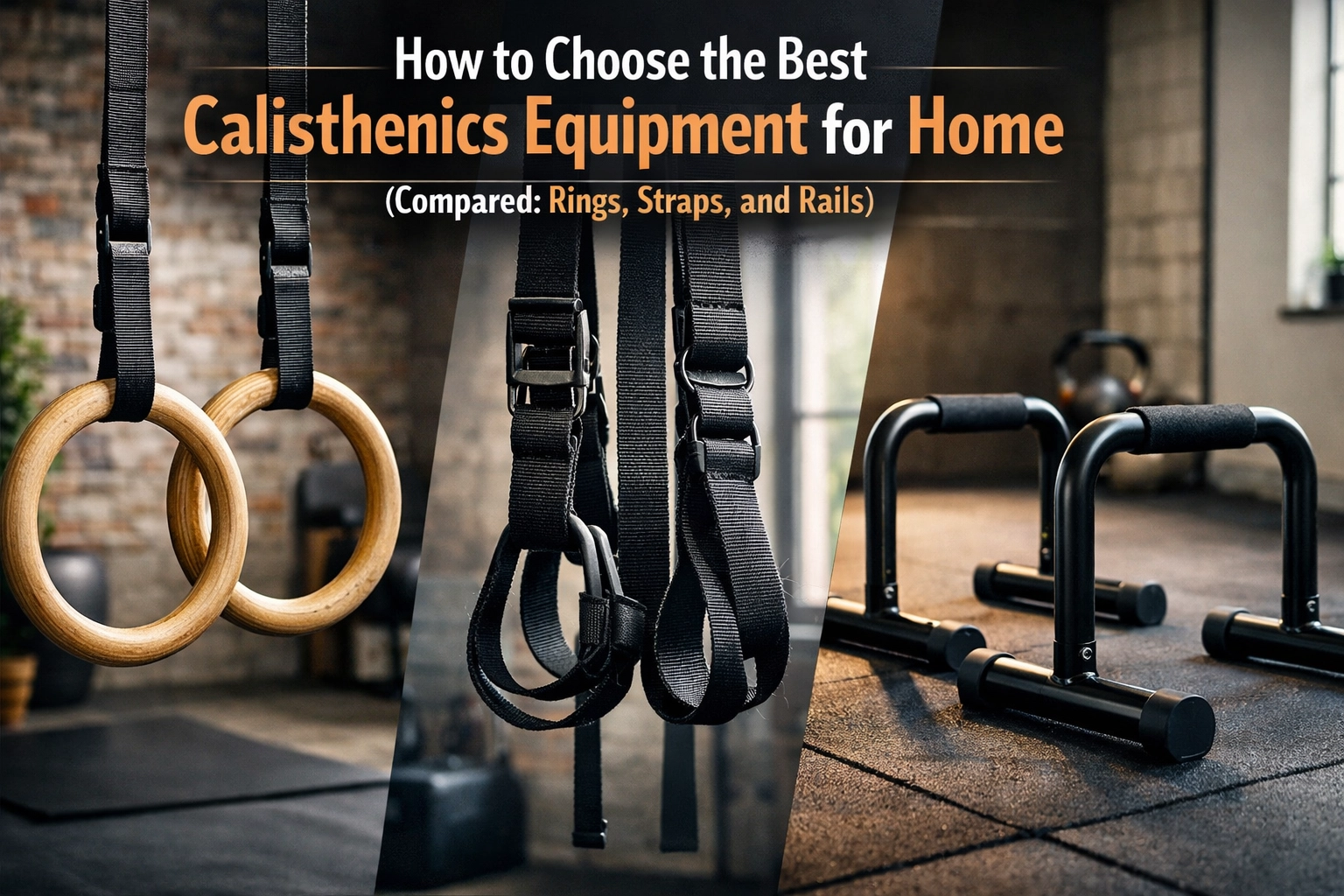
At Bold Body Fitness, we don’t do "average." We cater to the elite: the Ninja Warriors, the gymnasts, the CrossFit junkies, and the MMA fighters who demand more from their gear. When it comes to calisthenics equipment for home, you’ve probably seen the usual suspects: gymnastic rings, suspension straps, and the standard pull-up bar. But which one actually delivers a full body workout at home without turning your spare room into a construction zone?
Today, we’re stripping away the marketing fluff and getting into the grit. We’re comparing the heavy hitters to see which home gym equipment deserves a spot in your temple of gains.
The Calisthenics Revolution: Why Your Home Setup Matters
Bodyweight training is the ultimate test of relative strength. If you can’t move your own frame with precision and power, those heavy plates at the commercial gym don’t mean a thing. Bodyweight training at home has exploded in popularity, but most people settle for cheap, flimsy door-frame bars that creak and groan the moment you attempt a muscle-up.
If you’re serious about resistance training, you need a setup that offers stability, versatility, and intensity. You need a versatile home gym that adapts to your progress, not one that holds you back.
Whether you’re training for the Octagon or just trying to master the human flag, your equipment choices will dictate your results. Let's break down the three main contenders: Rings, Straps, and the revolutionary Rails.

1. Gymnastic Rings: The Gold Standard for Upper Body Chaos
If you want to train like an Olympic gymnast, you buy rings. Period. Gymnastic rings are arguably the most challenging calisthenics equipment for home. Why? Because they are inherently unstable.
The Pros:
- Unmatched Instability: Because the rings move independently, every stabilizer muscle in your shoulders, core, and arms is screaming for dear life. This builds a level of "functional" strength that is hard to replicate.
- Freedom of Movement: Unlike a fixed bar, rings allow your joints to rotate naturally. This is huge for preventing injury during high-rep bodyweight training at home.
- Advanced Progressions: Want to hit a front lever or a ring muscle-up? You need these.
The Cons:
- The Learning Curve is a Cliff: Beginners usually look like a baby deer on ice. The frustration level is high.
- Mounting Nightmares: Most home ceilings aren't designed to support a swinging 200lb athlete. You often need to drill heavy-duty eye bolts into your joists, which isn't exactly a no wall damage workout system.
- Height Requirements: To get the most out of rings, you need high ceilings. If you're in a basement or a standard apartment, your range of motion is going to be severely limited.
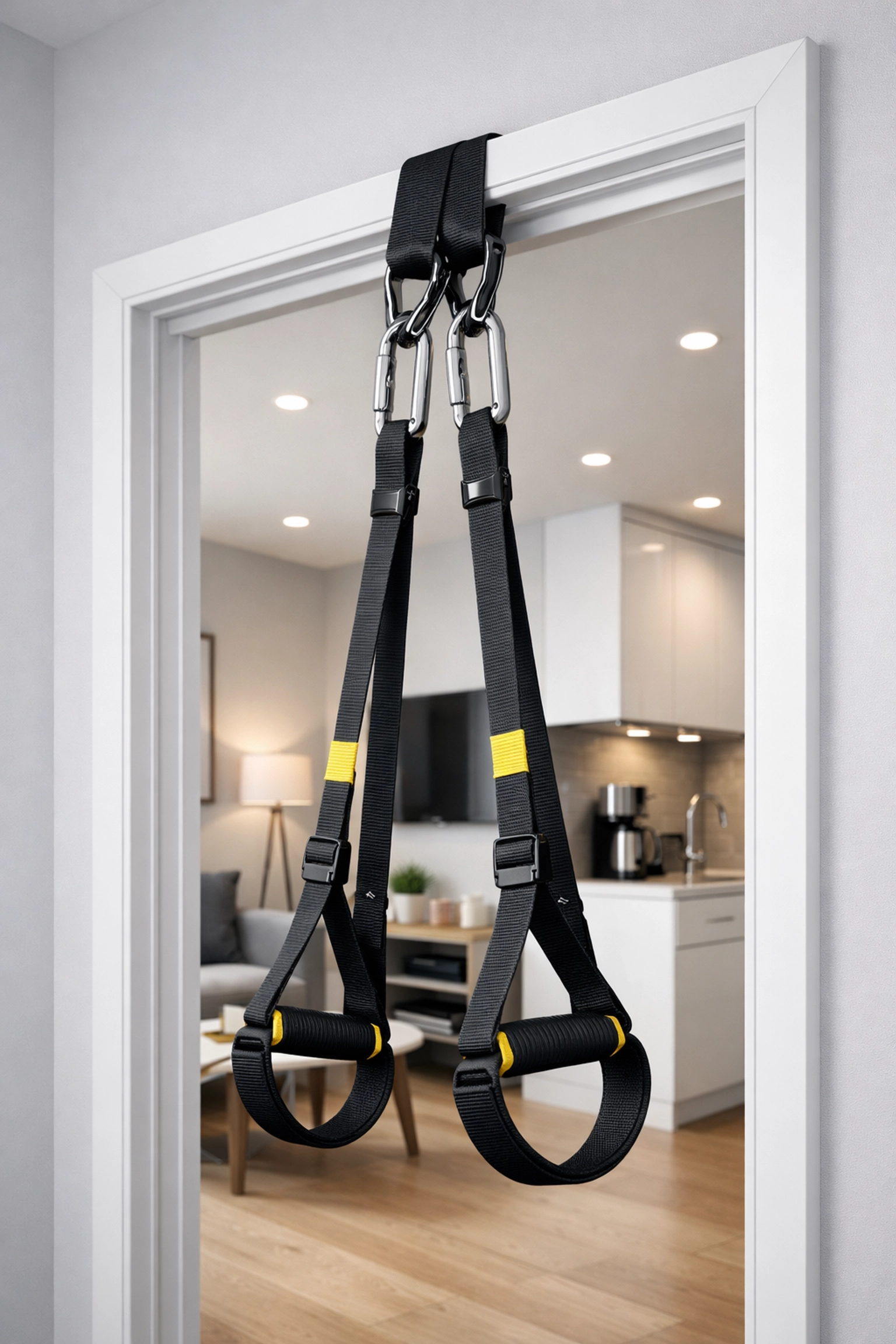
2. Suspension Straps: The Portable Utility Player
You’ve seen them in every CrossFit home gym. Suspension straps (like TRX) are the go-to for many because they are portable and easy to understand.
The Pros:
- Accessibility: Anyone can use them. By changing the angle of your body, you can make an exercise easier or harder in seconds.
- Portability: Throw them in a bag and you have a versatile home gym anywhere there’s a sturdy door or a tree branch.
- Full Body Integration: Great for rows, lunges, and core work.
The Cons:
- Not Great for Power: If you’re a Ninja Warrior or an MMA fighter, straps can feel a bit "light." They are excellent for metabolic conditioning but aren't the best tool for developing raw, explosive pulling power.
- The "Door Hang" Problem: Using a door anchor limits your movement. You’re always stuck facing or leaning away from a flat surface, which kills your ability to do 360-degree movements or explosive transitions.
- Durability: Cheap straps fray. If you’re training with high intensity, you’ll burn through them faster than you think.

3. The Resistance Rail: The Ultimate Pull Up Bar Alternative
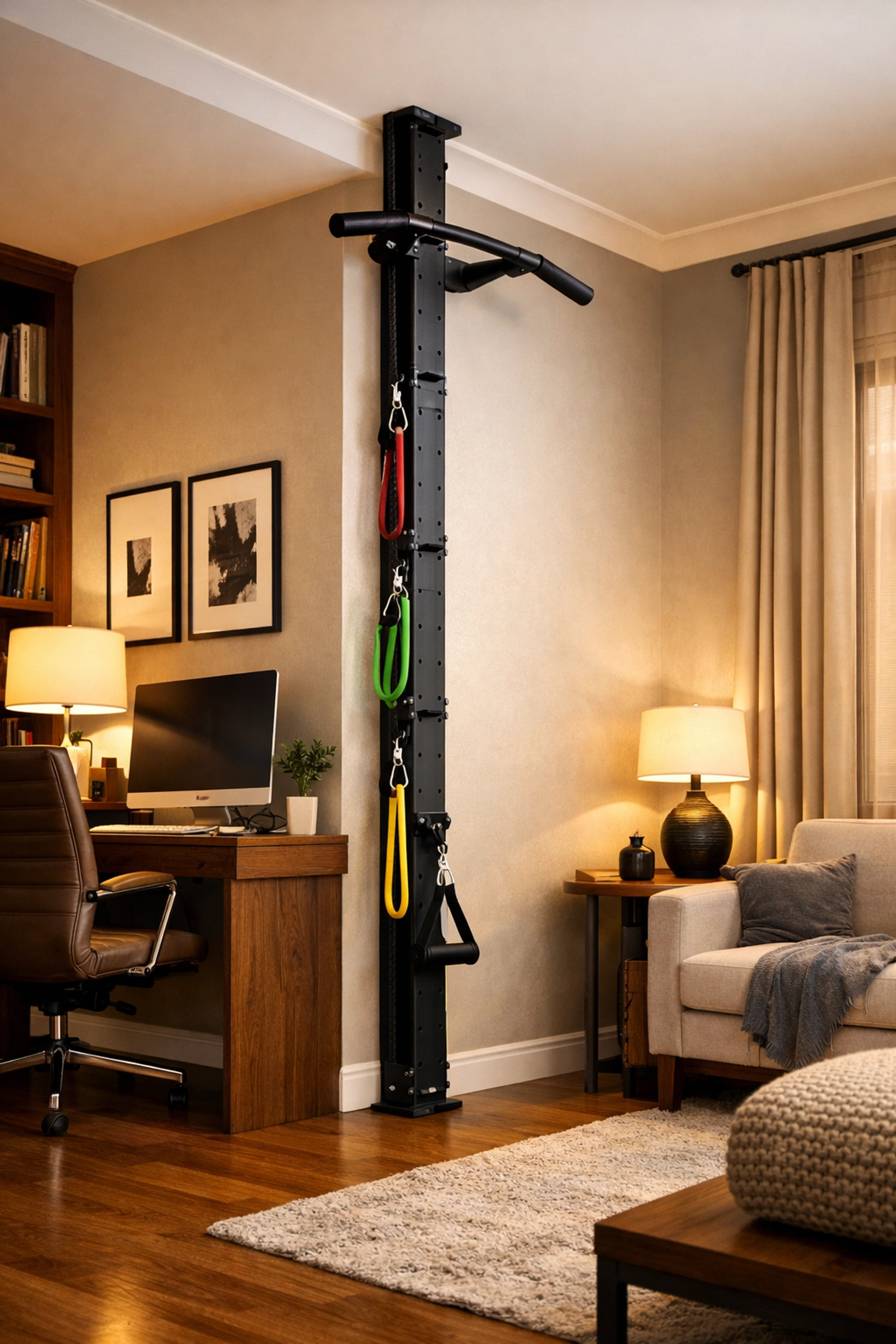
This is where things get interesting. At Bold Body Fitness, we looked at the limitations of rings and straps and decided to build something better. We call it the Resistance Rail, and it’s the centerpiece of a true floor to ceiling gym.
If you’re looking for a pull up bar alternative that doesn't ruin your walls and offers more than just a place to hang, this is it.
Why the Resistance Rail Wins:
- No Wall Damage Workout System: Our floor-to-ceiling design uses tension and precision engineering. No drilling into your studs, no permanent scars on your home, and no "hope this holds" moments. It’s rock-solid.
- Versatile Home Gym: The Rail isn't just a bar. It’s a vertical station that allows you to attach bands, rings, and specialized handles at any height. This makes it the most adaptable piece of home gym equipment on the market.
- The Ninja Warrior’s Best Friend: Because the Rail is stable and offers verticality, it’s perfect for practicing grip transitions and explosive movements that rings simply can't handle without significant sway.
- Compact Footprint: It takes up practically zero floor space, making it perfect for apartments or crowded garages.
Check out the Bold Body Fitness Shop to see the different configurations of the Resistance Rail.
Deep Dive: Comparing the Three for Your Specific Goals
Not all athletes are created equal. Depending on your discipline, one of these setups will serve you better. Let’s look at how they stack up for different types of "Serious Fitness Enthusiasts."
For the Ninja Warrior & Obstacle Course Racer
You need grip strength, explosive pulling power, and the ability to move through different planes of motion.
- Rings: Good for lock-off strength, but too much sway for speed work.
- Straps: Mostly useless for the high-impact demands of Ninja training.
- The Rail: Superior. The ability to set multiple attachment points on a vertical axis mimics the varied grips of an obstacle course. It’s the closest you’ll get to a professional rig in a home environment.
For the CrossFit Athlete
You need to move fast and hit high volume.
- Rings: Essential for muscle-up progressions.
- Straps: Good for accessory work and scaling movements.
- The Rail: Acts as the perfect anchor point. You can mount your rings to it, attach heavy resistance training bands, and perform kipping movements with more confidence than a flimsy door bar. It’s the anchor for your entire CrossFit home gym.
For the MMA Fighter
You need "mat strength": the ability to push, pull, and rotate against resistance.
- Rings: Great for shoulder health and stability.
- Straps: Excellent for high-rep endurance.
- The Rail: The verticality allows for band-resisted sprawls, clinches, and rotation exercises that are essential for the cage. When you combine the Rail with bands, you get a full body workout at home that actually translates to the fight.
The Anatomy of a Floor to Ceiling Gym
Why are we so obsessed with the "Floor to Ceiling" concept? Because most home equipment only uses one plane of space. A pull-up bar uses the top. A yoga mat uses the bottom. A floor to ceiling gym uses everything in between.
By utilizing the entire vertical height of your room, you unlock exercises that are impossible on a standard bar. Think about:
- High-to-Low Woodchops: Essential for core power.
- Vertical Grip Pull-ups: Testing your forearm strength in a way a horizontal bar never will.
- Adjustable Dip Stations: No need for a separate bulky dip stand taking up space.
- Band-Resisted Sprints: Anchor a band to the bottom of the Rail and work on your explosive takeoffs.
The Resistance Rail transforms a 2-foot square of floor space into a multi-functional training hub. If you want to see what this looks like in real homes, check out our Gallery.
Installation: Why "No Wall Damage" is a Game Changer
Let’s be real: your landlord or your spouse probably doesn't want you drilling 4-inch lag bolts into the wall. And those "no-screw" door-frame bars? They’re an ER visit waiting to happen. They rely on the trim of your door: which is usually held on by tiny finishing nails: to support your entire body weight. No thanks.
The no wall damage workout system used by Bold Body Fitness utilizes high-tensile strength and clever weight distribution. It’s a professional-grade solution that respects your home. You get the stability of a bolted-down rig with the flexibility of a portable system. This is the future of calisthenics equipment for home.
Resistance Training vs. Pure Calisthenics
Is there a difference? Absolutely. Pure calisthenics is just you vs. gravity. Resistance training often involves external loads, like bands or weights.
The magic happens when you combine them. By using the Resistance Rail as your base, you can add bands to your bodyweight movements.
- Struggling with Pull-ups? Use a band for assistance.
- Muscle-ups too easy? Add a band for resistance to make the transition harder.
- Need to build explosive legs? Use the Rail to anchor bands for resisted squats or lunges.
This hybrid approach is why our customers see faster results. You aren't limited by your current strength level; you can adjust the resistance to meet you where you are today and push you to where you want to be tomorrow.
Sample "Bold" Workout: The Rail Circuit
Ready to see what a full body workout at home looks like with the right gear? Try this circuit on your Resistance Rail.
- Rail Pull-Ups (Neutral Grip): 4 sets to failure. Focus on the squeeze at the top.
- Band-Resisted Push-ups: 4 sets of 12. Anchor the bands to the base of the rail and wrap them over your back.
- Single-Arm Rail Rows: 3 sets of 10 per arm. Use the verticality to find the perfect angle for your lats.
- Rail-Supported Pistol Squats: 3 sets of 8 per leg. Use the Rail for balance to ensure perfect form.
- Hanging Leg Raises: 4 sets of 15. The stability of the rail means no swinging, just pure core engagement.

The Verdict: Which Equipment Should You Choose?
If you have the space, the high ceilings, and the patience of a saint, Gymnastic Rings are a fantastic addition to your training.
If you’re always on the road and just need something to stay toned, Suspension Straps will do the job.
But, if you are a serious athlete who wants a versatile home gym that offers stability, allows for explosive resistance training, and won't destroy your house, the Resistance Rail is the clear winner. It is the ultimate pull up bar alternative and the foundation of any serious bodyweight training at home setup.
Stop settling for gear that limits your potential. You’re a beast; you need equipment that can keep up.
Take Action Now
Don't wait for "next Monday" to start building the home gym you deserve. Whether you're a gymnast looking for a stable anchor or an MMA fighter needing a complete training station, Bold Body Fitness has you covered.
- Explore our full range: Visit the Bold Body Fitness Homepage
- Get your setup: Shop the Resistance Rail and Accessories
- Join the community: Check out our Members Area for training tips and exclusive content.
The choice is yours. You can keep doing what you’ve been doing and getting the same results, or you can go Bold. Your move.
