
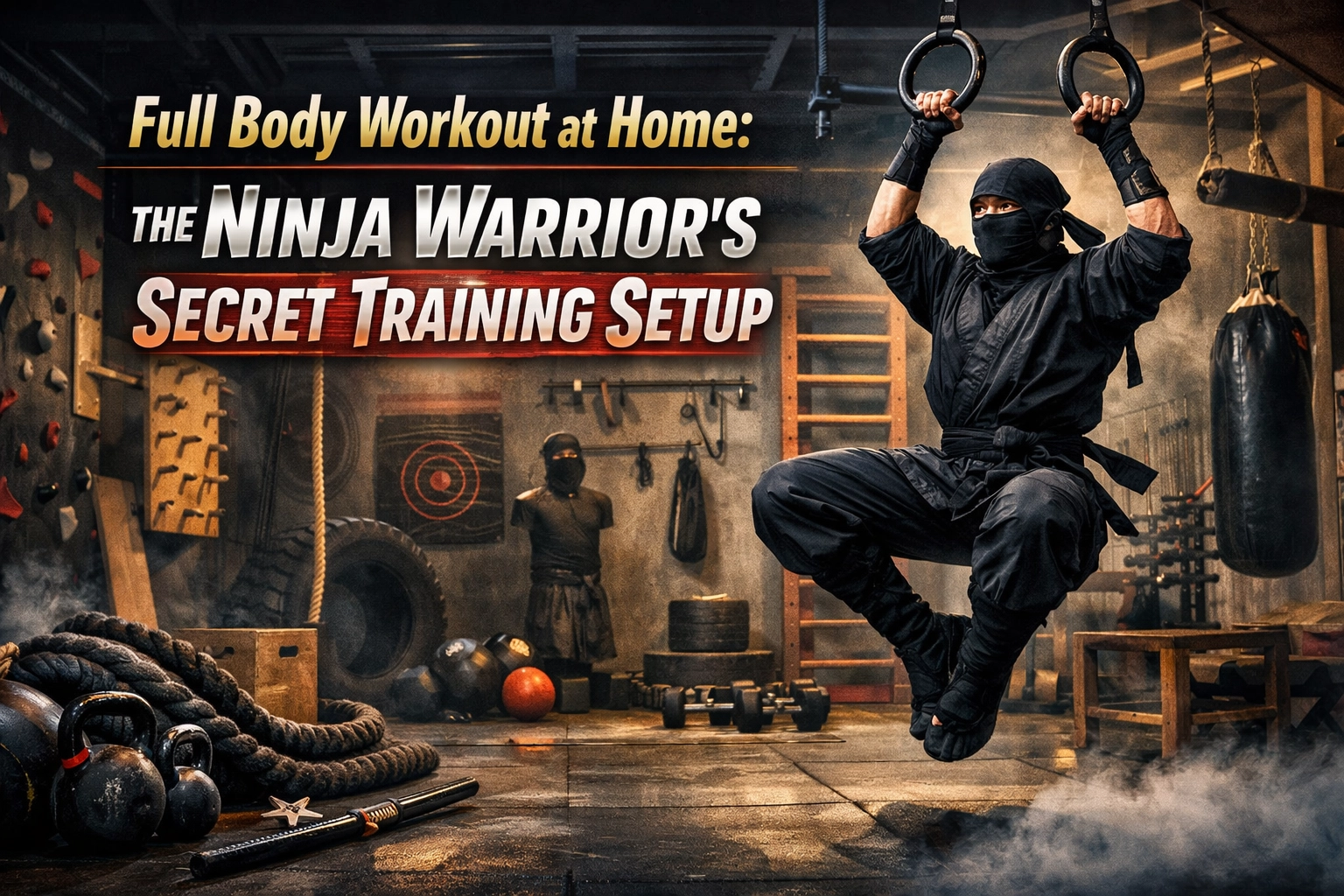
Look, if you're serious about conquering ninja warrior courses, or you just want to train like an absolute beast, you need to stop making excuses about not having access to a gym. The truth? Some of the most formidable athletes on the planet build their strength, power, and agility right in their living rooms, garages, or backyards.
The secret isn't having thousands of dollars worth of equipment or a warehouse-sized training facility. It's about understanding functional movement patterns, training with purpose, and setting up a versatile home gym that actually challenges your body the way those brutal obstacle courses do.
Let's cut through the noise and talk about what ninja warrior training really requires, and how you can build the ultimate training setup at home without destroying your walls or your bank account.
Why Ninja Warriors Train Differently Than Everyone Else
Here's what separates ninja warrior training from your typical gym bro routine: functional strength across the entire body. You're not isolating muscles to look good in a tank top. You're building explosive power, grip strength that could crush walnuts, core stability that keeps you glued to obstacles, and the kind of upper body pulling strength that lets you hang, swing, and climb like your life depends on it.
Because on an actual ninja course? It kind of does.
The three pillars of ninja training are ridiculously straightforward:
- Upper body pulling power and grip strength – You'll hang, swing, and pull yourself through 80% of obstacles
- Core stability and control – Everything flows through your midsection
- Lower body explosiveness and precision – Modern courses demand cat-like footwork and powerful jumps
Traditional gyms work fine for building these qualities, but the real game-changer is bringing this training home where you can practice daily, not just when you can squeeze in a gym session.

The Problem With Most Home Gym Setups
Let's be honest: most home gyms suck for ninja training. You've got three common scenarios:
Option 1: The Doorway Pull-Up Bar
Great for basic pull-ups, terrible for everything else. Limited grip positions, can't handle dynamic movements, and definitely won't support the kind of training volume serious athletes need. Plus, if you're over 200 pounds or training explosively, you're one kipping pull-up away from kissing your doorframe goodbye.
Option 2: Wall-Mounted Rig
Solid choice if you own your home, love drilling into studs, and never plan on moving. But renters? You're screwed. And even homeowners need to accept that you're committing to permanent holes in your walls.
Option 3: Freestanding Power Rack
Takes up half your garage, costs as much as a used car, and still doesn't give you the vertical space needed for rope climbs, pegboards, or the kind of movements that actually translate to ninja courses.
There's a better way, a floor to ceiling gym solution that gives you maximum training versatility without permanent installation or a massive footprint. But we'll get to that.
The Essential Components of a Full Body Workout at Home
Before we dive into specific workouts, let's break down what your home setup needs to deliver for comprehensive ninja warrior training.
Upper Body and Grip Dominance
Your upper body is your lifeline on any obstacle course. Every hang, every transition, every desperate lunge to catch a rope or bar requires pulling strength and grip that won't quit.
Essential exercises:
- Wide grip pull-ups (shoulder width and beyond)
- Weighted pull-ups to build raw strength
- Dead hangs for grip endurance (aim for 60+ seconds)
- Face pulls for shoulder health and posterior strength
- Australian pull-ups (horizontal rows) at various heights
The key is having equipment that lets you vary your grip width, hand position, and angle of attack. A single fixed bar severely limits your development.
Core That Won't Quit
Your core isn't just your abs, it's the entire muscular system that stabilizes your spine and transfers force between your upper and lower body. Weak core = failed obstacles.
Core-crushing movements:
- Hanging knee raises progressing to straight leg raises
- L-sits and L-hangs
- Kipping movements that demand dynamic core control
- Planks and side planks (the basics still matter)
- Windshield wipers for oblique strength
Notice something? Most of these require a sturdy overhead anchor point. Your core training is severely limited if you're stuck doing floor work only.

Lower Body Explosiveness and Precision
Modern ninja courses have evolved. It's not all upper body anymore. You need quads, glutes, and hip power that can launch you across gaps, stick precision landings, and power through footwork sections that look like they were designed by someone who hates fun.
Lower body essentials:
- Box jumps for vertical power
- Lateral bounds for multi-directional explosiveness
- Precision jumps to small targets
- Single-leg squats and pistol progressions
- Jump squats and other plyometric variations
You don't need much equipment for lower body work, but you do need space and the right mindset. This isn't leg day at Planet Fitness, this is about training your legs to be explosive, precise, and fatigue-resistant.
Sample Ninja Warrior Workouts You Can Do at Home
Let's get practical. Here are two complete workouts you can implement immediately with minimal equipment.
Workout 1: The Upper Body Destroyer (35 minutes)
This circuit-style session will build pulling strength, grip endurance, and core stability in one brutal package. Complete each exercise for 40 seconds of work, 20 seconds of rest. Run through the circuit 4-5 times.
- Wide Grip Pull-Ups – Go as wide as your equipment allows
- Dead Hang – Just hang and suffer; fight for every second
- Alternating Knee Raises – Control the movement; no swinging
- Australian Pull-Ups – Horizontal pulling to balance all that vertical work
- Bear Crawls – Forward and backward for 20 feet
- Burpee to Jump – Full body explosion every single rep
Rest 2-3 minutes between circuits. Your grip should be screaming by round three. That's the point.

Workout 2: Full Body Power Circuit (30 minutes)
This workout blends upper body, lower body, and core work into a comprehensive session that builds the kind of conditioning ninja courses demand.
Complete 3-4 rounds with 90 seconds rest between rounds:
- Pull-Ups – 8-10 reps (add weight if bodyweight is too easy)
- Box Jumps – 12 reps, focus on landing softly
- Hanging Leg Raises – 10-15 reps, straight legs if possible
- Lateral Bounds – 10 per side, stick each landing for 2 seconds
- Push-Ups – 15-20 reps, chest to floor every rep
- Jump Squats – 15 reps with explosive power
The beauty of this workout is its scalability. Beginners can reduce reps and rounds. Advanced athletes can add weight, increase reps, or decrease rest periods.
The Game-Changing Solution: Building Your Ideal Home Setup
Here's where most articles would tell you to cobble together random equipment and "make it work." But if you're serious about bodyweight training at home that actually progresses your skills, you need a foundation that supports everything we've discussed.
The reality is that calisthenics equipment for home needs to check several boxes:
- Support dynamic, explosive movements safely
- Offer multiple grip positions and heights
- Install without damaging walls or requiring permanent mounting
- Provide enough versatility to replace dozens of separate pieces of equipment
Bold Body Fitness developed the Resistance Rail specifically to solve these problems. It's a no wall damage workout system that uses floor-to-ceiling pressure mounting, meaning you get a bombproof training platform without drilling a single hole. For renters, frequent movers, or anyone who doesn't want to commit to permanent installation, this is the difference between having a real training setup and settling for subpar equipment.
The Resistance Rail Standard transforms any room into a versatile home gym optimized for pull-ups, muscle-ups, rope climbs, suspension training, and resistance band work. It's a pull up bar alternative that actually gives you more options, not fewer.
For athletes who want to train like CrossFitters, ninja warriors, or MMA fighters from home, having one piece of equipment that handles multiple training modalities beats cluttering your space with five different gadgets that each do one thing poorly.
Progressive Training: How to Actually Get Better
Having equipment is one thing. Using it intelligently is another. Here's how to structure your ninja warrior training at home for continuous improvement:
Phase 1: Foundation (Weeks 1-4)
Focus on basic pulling strength, core stability, and movement quality. If you can't do 10 clean pull-ups, that's your priority. Build your dead hang to 60 seconds. Master basic core movements before progressing to dynamic work.
Phase 2: Volume and Endurance (Weeks 5-8)
Increase training volume. More sets, more reps, shorter rest periods. Your body needs to handle high workloads without falling apart. This phase sucks, but it's essential.
Phase 3: Power and Explosiveness (Weeks 9-12)
Add weighted movements, plyometric variations, and dynamic transitions. This is where you start training the explosive qualities that separate good from great on obstacle courses.
Phase 4: Skill Integration (Week 12+)
If you have access to specific obstacles, now's the time to practice actual ninja movements. But even without specialty equipment, you can practice transitions, develop grip-specific strength, and work complex movement patterns.

The Recovery Factor Nobody Talks About
You know what derails more ninja warriors than anything else? Injuries from overtraining. Your enthusiasm will write checks your connective tissue can't cash.
Non-negotiable recovery practices:
- Dedicated stretching for quads and hip flexors (these get beat up from jumping and climbing)
- Grip rest days (yes, seriously: your forearms need recovery too)
- Sleep like your training depends on it (because it does)
- Proper nutrition to fuel intense training sessions
Training at home makes it tempting to work out every single day because the equipment is right there. Resist that urge. Strategic rest is what allows your body to adapt and grow stronger.
Building Your Complete Training Environment
Ready to stop making excuses and start training like you mean it? Here's your action plan:
- Assess your space – You need a ceiling height of at least 7.5 feet and a 4x6 foot training area minimum
- Invest in foundational equipment – Start with a solid overhead training system; everything else can be added gradually
- Create a training schedule – Random workouts produce random results; structured training produces ninjas
- Track your progress – Log your workouts, count your reps, time your hangs; what gets measured gets improved
- Join the community – Connect with other home trainers for motivation and accountability
Check out the complete Bold Body Fitness shop to see how you can build a crossfit home gym or ninja warrior training space that rivals commercial facilities: without the commute, monthly fees, or waiting for equipment.
Your Move
The difference between people who talk about training like a ninja warrior and people who actually do it comes down to one thing: taking action. You don't need perfect conditions, unlimited space, or a trust fund. You need a clear plan, the right foundational equipment, and the commitment to show up consistently.
Your home can be your training ground. Your living room can become the place where you build the strength, power, and skills that crush obstacle courses. But it starts with setting up a proper system that supports serious training: not just cobbling together whatever's cheapest or convenient.
The question isn't whether you can build an effective full body workout at home setup. The question is whether you're ready to stop settling for less than you're capable of.
Now go train.
