

Listen up: you don't need a $200-per-month gym membership or a garage full of iron to train like a fighter. The best MMA athletes in the world know that functional, explosive strength comes from mastering your own bodyweight and using smart home gym equipment that actually works.
If you're serious about building real combat strength without leaving your house, this guide will show you exactly how to create gym-quality workouts that develop the power, endurance, and resilience you need in the cage. No fluff. No BS. Just proven methods that work.
Why MMA Training Demands Full-Body Functional Strength
MMA isn't bodybuilding. You're not training to look good in a mirror: you're training to explode through takedowns, generate knockout power in your strikes, and maintain strength when you're gassed in the third round.
Every movement in MMA is a full-body affair. When you throw a hook, you're not just using your arm: you're generating power from your feet, driving through your hips, rotating your core, and transferring all that force through your fist. When you sprawl to defend a takedown, your entire posterior chain fires in milliseconds. When you're in the clinch, your grip strength, core stability, and leg endurance all get tested simultaneously.
This is why traditional "bro splits" fail fighters. You can't train chest on Monday, back on Tuesday, and legs on Wednesday when every technique you throw requires total-body integration. Your home training needs to reflect the chaos and demands of actual fighting.

The Foundation: Essential Movement Patterns for Combat Athletes
Every effective full body workout at home for MMA should be built around these fundamental movement patterns:
Push movements develop striking power and the ability to create space. Think push-ups, pike push-ups, handstand progressions, and explosive plyo variations.
Pull movements build the strength to control opponents in the clinch, execute submissions, and maintain posture. Pull-ups, rows, and face pulls are non-negotiable.
Hinge patterns develop explosive hip power for kicks, knees, and takedown defense. Burpees, broad jumps, and kettlebell swings dominate here.
Squat patterns build the leg endurance needed to maintain your stance and explosiveness for level changes. Goblet squats, pistol squats, and jump squats are your friends.
Rotation and anti-rotation movements develop the core strength that translates directly to striking power and takedown defense. Russian twists, wood choppers, and Pallof press variations are essential.
Loaded carries build grip strength, core stability, and mental toughness: all critical when you're grinding through a tough scramble.
The beauty of bodyweight training at home is that you can hit all these patterns with minimal equipment. But when you add smart, versatile home gym equipment into the mix, you multiply your training options without cluttering your space.
Building Your MMA Home Gym Setup
Here's the truth about home gym equipment: you don't need much, but what you do get needs to be bulletproof and versatile.
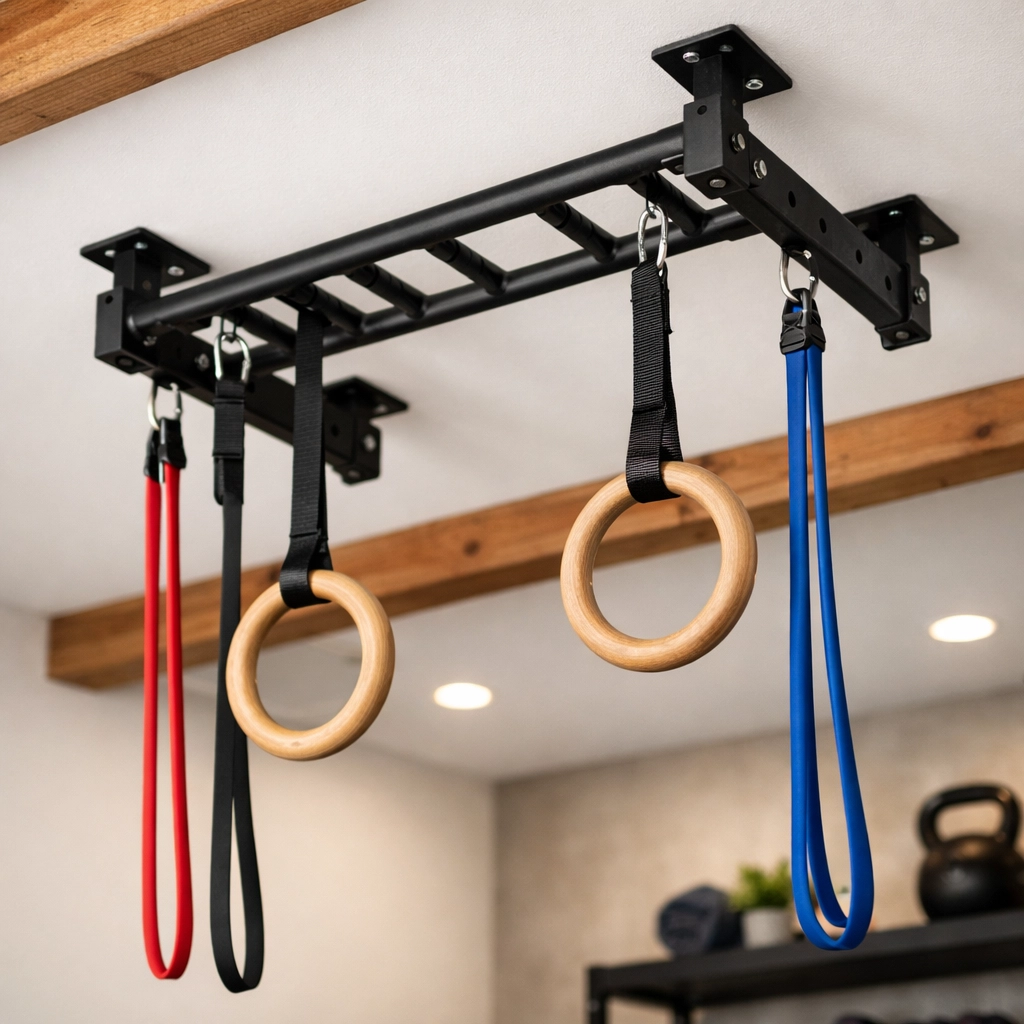
The game-changer for serious fighters training at home is a ceiling-mounted system like the Resistance Rail from Bold Body Fitness. This thing acts as a pull up bar alternative while giving you dozens of additional training options in one compact setup. It's a floor to ceiling gym that doesn't destroy your walls or take up floor space.
Why does this matter for MMA? Because you can do pull-ups for back strength, add resistance bands for explosive striking drills, hang rings for gymnastic strength work, and even set up suspension trainers for unstable surface training: all from one anchor point. It's the definition of a versatile home gym solution.
Beyond that, keep it simple:
- A set of resistance bands (light to heavy)
- One or two kettlebells (16kg and 24kg are solid choices)
- A set of gymnastics rings or TRX-style straps
- A pull-up bar or ceiling-mounted system
- Optional: light dumbbells (2-5 lbs) for punch endurance work
That's it. Everything else is noise. With this minimal setup, you can build world-class conditioning from your living room.
The MMA Home Workout Blueprint: Upper Body Power
Your upper body strength directly impacts your ability to generate knockout power, maintain frames in grappling, and defend takedowns. Here's how to build it at home:
Explosive Pushing Power
Standard push-ups are just the beginning. To develop the explosive power needed for strikes, you need to progress to plyometric variations:
- Plyo push-ups: Explode up so your hands leave the ground
- Clapping push-ups: Add a clap at the peak
- Pike push-ups: Elevate your hips to target shoulders
- Archer push-ups: Shift your weight side-to-side for unilateral strength
Complete 3-5 sets of 8-12 reps, focusing on explosive concentric (pushing) phases.
Pulling Strength and Shoulder Stability
This is where a proper calisthenics equipment for home setup becomes critical. Pull-ups are the king of pulling exercises, but most fighters need progressions and variations:
- Standard pull-ups: Build to 10-15 clean reps
- Wide-grip pull-ups: Develop lat width and pulling power
- Chin-ups: Target biceps and grip strength
- L-sit pull-ups: Add core integration
- Typewriter pull-ups: Build unilateral strength
If you're using the Bold Body Fitness Resistance Rail, you can also add:
- Ring rows: Adjust difficulty by changing your body angle
- Face pulls with bands: Essential for shoulder health
- Band-resisted shadow boxing: Build striking endurance
The key is variety. Your shoulders need strength from multiple angles to stay healthy and powerful through fight camp.
Strike Endurance Work
This is an underrated component. Grab light dumbbells (2-3 lbs max) and throw punches in combinations for 3-minute rounds. Your shoulders will be on fire, but this builds the muscular endurance to throw power shots in the championship rounds.
Core and Rotational Power: The Engine of Striking
Every powerful strike originates in your core. Your ability to generate and transfer rotational force determines how much damage you can do.

Rotational Strength Exercises:
- Russian twists (with or without weight): 3 sets of 20 reps per side
- Wood choppers: Use resistance bands or a single dumbbell, 3 sets of 12 reps per side
- Landmine rotations: If you have a barbell setup
- Medicine ball slams: Pure explosive power
Anti-Rotation and Stability:
Just as important as rotation is your ability to resist rotation: this keeps you balanced and powerful even when you're off-balance:
- Pallof press: Use bands anchored to your home gym system, 3 sets of 10-15 reps per side
- Dead bugs: 3 sets of 10 reps per side
- Bird dogs: 3 sets of 10 reps per side
- Plank variations: Front planks, side planks, stir-the-pot
Mountain Climbers and Dynamic Core Work:
Don't forget movements that combine cardio with core strength:
- TRX mountain climbers: 4 sets of 30 seconds
- Bicycle crunches: 3 sets of 20 reps per side
- Hollow body holds: 3-5 sets of 20-45 seconds
Train your core 4-5 times per week. Unlike other muscle groups, your core can handle high frequency because it's designed for endurance.
Lower Body Explosiveness: Building Fight-Ending Power
Your legs are your foundation. Every explosive movement starts from the ground up.
Explosive Lower Body Exercises:
- Box jumps: 5 sets of 5 reps on a 24-30 inch box
- Broad jumps: 5 sets of 3-5 reps for maximum distance
- Burpees: The ultimate full-body conditioner, 4-5 sets of 10-20 reps
- Jump squats: 4 sets of 8-10 reps
Strength and Stability:
- Goblet squats: 4 sets of 12-15 reps with a kettlebell
- Bulgarian split squats: 3 sets of 10 reps per leg
- Pistol squat progressions: Build to full single-leg squats
- Single-leg glute bridges: 3 sets of 12 reps per side
- Wall sits: 3-5 sets of 60-90 seconds for quad endurance
Agility and Footwork:
- Lateral lunges with hop: 3 sets of 10 reps per side
- Skater hops: 4 sets of 30 seconds
- Shadowboxing with movement: 5 rounds of 3 minutes
Your lower body training should emphasize both strength and explosiveness. Heavy, slow lifts build strength, but plyometric exercises build the fast-twitch power you need to explode on command.
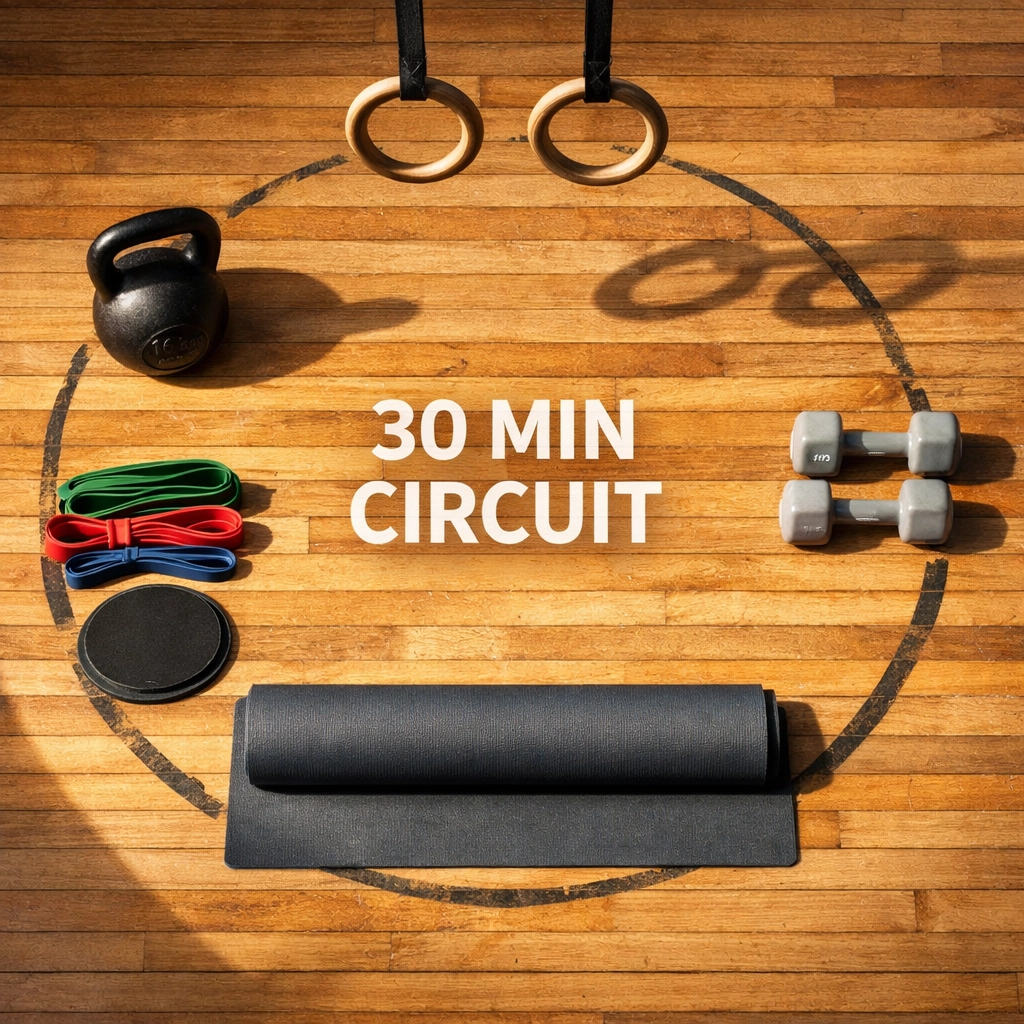
Sample 30-Minute MMA Full-Body Circuit
Here's a complete workout you can do at home with minimal equipment. Complete 5 rounds with 60 seconds rest between rounds:
Round 1:
- 10 alternating single-arm overhead presses (dumbbell or kettlebell)
- 10 hanging leg raises (from your pull-up bar or Resistance Rail)
- 10 goblet squats
Round 2:
- 10 explosive push-ups
- 10 single-arm dumbbell rows per side
- 10 rear delt flyes with bands
Round 3:
- 10 pike push-ups
- 10 alternating lateral lunges with hop
- 10 Russian twists (with weight)
Round 4:
- 10 burpees
- 10 single-leg glute bridges per side
- 10 pull-ups (or jumping pull-ups)
Round 5:
- Maximum side plank hold (both sides)
- 20 bicycle crunches
- 30-second shadowboxing combination
This circuit hits every major muscle group, builds explosive power, and conditions your gas tank. As you get stronger, repeat the entire sequence twice for a full 60-minute session.

Weekly Training Structure for Home-Based Fighters
Effective full body workout at home programming requires strategic planning. Here's a sample weekly structure:
Monday: Striking power and upper body (push/pull emphasis)
Tuesday: Lower body explosiveness and agility
Wednesday: Full-body MMA circuit (like the one above)
Thursday: Core and rotational power with light cardio
Friday: Heavy conditioning: burpees, sprints, jump rope
Saturday: Active recovery: light mobility work, stretching
Sunday: Rest or flow work (shadowboxing, movement practice)
The key is variation. Your body adapts quickly, so rotate exercises, adjust rep ranges, and progressively overload your training.
The Long-Term Game: Progression and Recovery
Building gym-quality strength at home isn't about crushing yourself every day: it's about consistent, intelligent progression over months and years.
Progressive Overload Strategies:
- Increase reps before adding weight
- Decrease rest periods between sets
- Add tempo variations (slow eccentrics)
- Progress to more difficult exercise variations
- Add additional sets or rounds
Recovery Essentials:
Training is only half the equation. You build strength during recovery, not during workouts.
- Sleep 7-9 hours per night: Non-negotiable
- Nutrition: Prioritize protein (1g per pound of bodyweight), complex carbs for energy, and healthy fats for hormone production
- Foam rolling and stretching: 15-20 minutes daily
- Active recovery: Light movement on rest days keeps blood flowing
- Deload weeks: Every 4-6 weeks, reduce training volume by 40-50%
Consistency Over Intensity:
The fighter who trains consistently at 80% effort beats the guy who goes 100% once a week and burns out. Build the habit first, then push the intensity.
Making Your Home Your Dojo
The modern fighter doesn't need a traditional gym. With the right mindset, smart programming, and quality equipment like the no wall damage workout system from Bold Body Fitness, you can build world-class strength and conditioning from your own home.
The Resistance Rail system, in particular, transforms any room into a complete training facility. It's the ultimate crossfit home gym solution because it gives you pulling strength options, allows for suspension training, accommodates resistance bands for explosive work, and doesn't require drilling into studs or damaging your walls.
This is the future of resistance training: versatile, space-efficient, and built for serious athletes who demand results.
Your Next Fight Starts Now
Stop making excuses about not having access to a gym. The fighters who dominate aren't the ones with the fanciest facilities: they're the ones who show up every single day and do the work.
Your home is your training ground. Your floor is your mat. Your ceiling is your anchor point. Everything you need to build elite-level functional strength is within reach.
Ready to build your ultimate home training setup? Check out the complete line of equipment at Bold Body Fitness and start training like the fighter you're meant to be.
Now get to work. Your next victory is waiting.
