

You've committed to training at home. You're crushing pushups, smashing through burpees, and your living room has become your personal training ground. But here's the brutal truth: your results aren't matching your effort.
If you're stuck in a plateau, frustrated by lackluster gains, or wondering why your home bodyweight training isn't delivering the strength and physique you're after, you're not alone. Most home training setups fail for predictable, fixable reasons that have nothing to do with your dedication.
Let's break down the 10 most common mistakes sabotaging your full body workout at home, and more importantly, how to fix them so you can finally start seeing the results you deserve.
1. You're Not Progressively Overloading (And No, More Reps Isn't the Answer)
The biggest mistake in bodyweight training at home? Doing the same damn workout for months on end.
Your body adapts to stimulus within 2-3 weeks. That means the pushup routine that crushed you in January is barely maintenance work by March. Yet most people keep grinding out the same 3 sets of 20 pushups, wondering why their chest stopped growing.
The Fix: Progressive overload doesn't mean adding endless reps. That's cardio, not strength training. Instead, manipulate these variables:
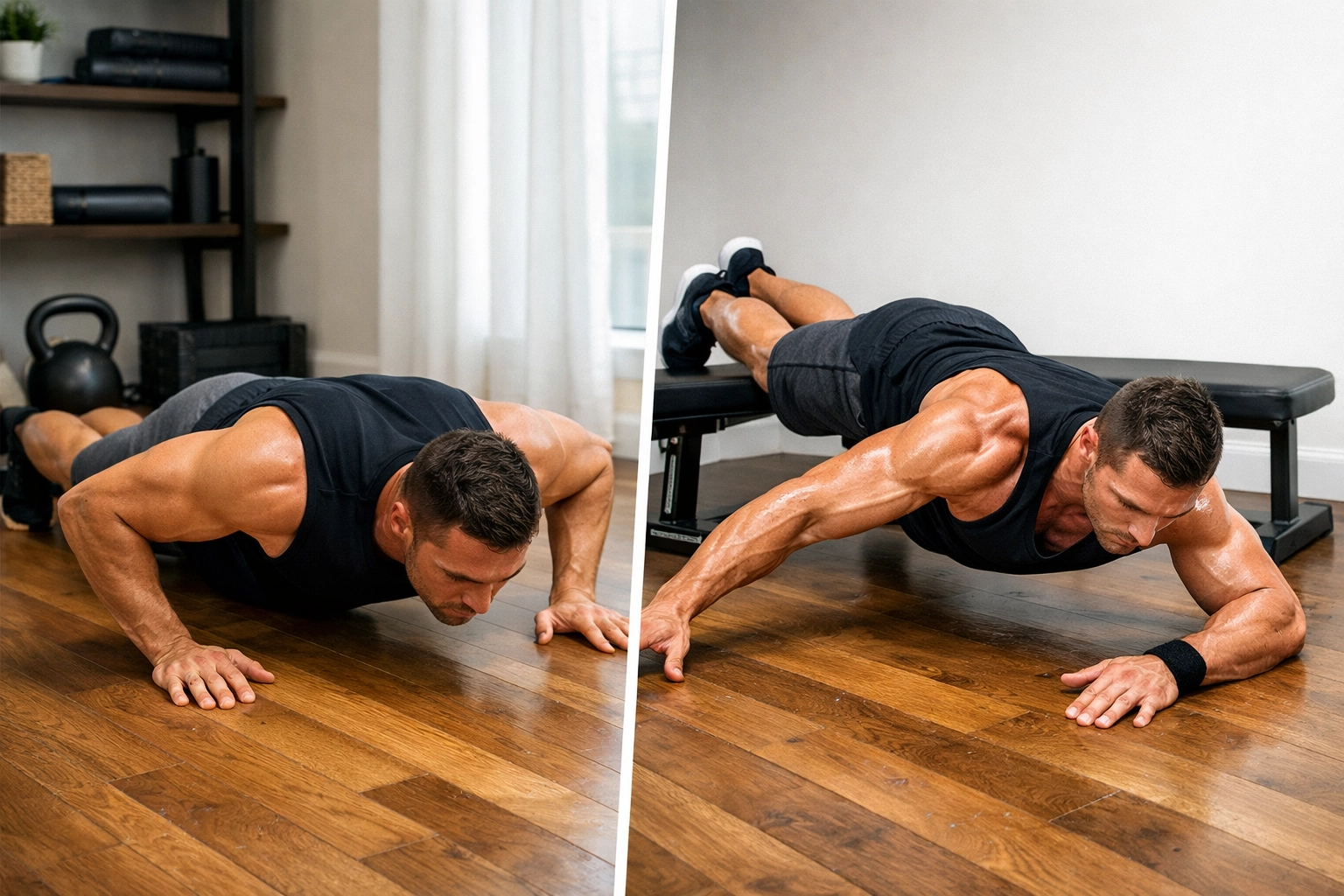
- Leverage angles: Elevate your feet for pushups, or progress to pseudo planche variations
- Tempo: Add 3-second negatives or pause at the bottom of each rep
- Range of motion: Work toward deeper positions that increase time under tension
- Difficulty progressions: Standard pushup → diamond pushup → archer pushup → one-arm pushup
For pull-based movements, this is where most home setups completely fail. Without a proper pull up bar alternative or versatile home gym equipment, you're stuck doing Superman holds and calling it "back work." That's not going to cut it.
2. Your Equipment Sucks (Or You Don't Have Any)
Let's get real: bodyweight training without the right equipment is like trying to build a house with only a hammer. Sure, it's possible, but you're making life unnecessarily hard.
Most home gym equipment fails in one of three ways:
- Takes up massive space (power racks, squat stands)
- Damages walls and ceilings (permanent pull-up bars that require drilling)
- Limits movement variety (basic doorframe bars that wobble)
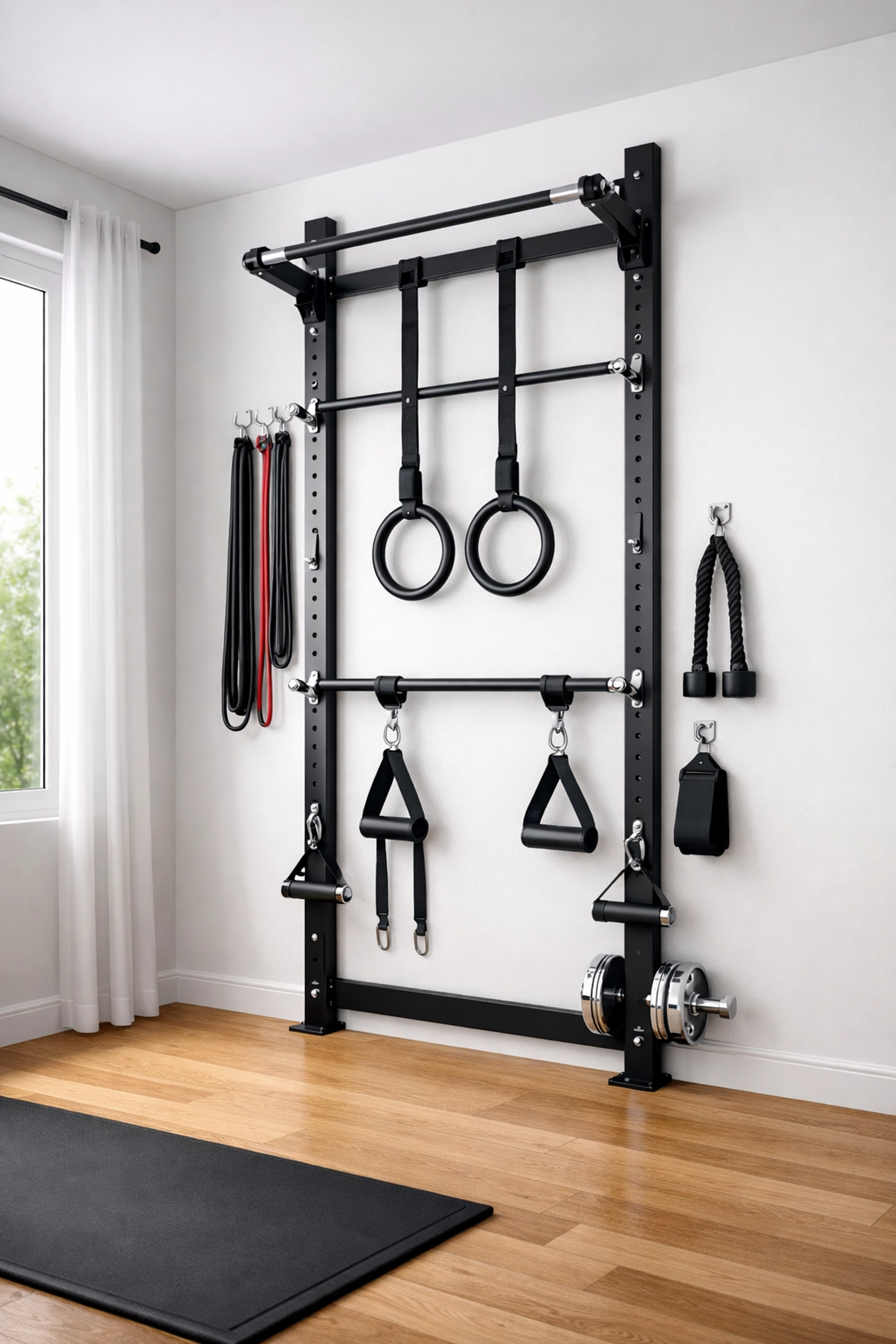
This is why serious athletes are moving toward floor to ceiling gym systems that provide stability without permanent installation. Equipment like the Resistance Rail gives you a full calisthenics equipment for home setup with zero wall damage: critical if you're renting or training in shared spaces.
The Fix: Invest in quality equipment that expands your exercise library. At minimum, you need:
- A stable pull-up system that supports dynamic movements
- Resistance bands for accommodating resistance
- Parallettes or rings for dip variations
- Enough open space for explosive movements
The right home gym equipment isn't a luxury: it's a requirement for continued progress.
3. You're Ignoring Your Posterior Chain (And It's Destroying Your Performance)
Quick test: What percentage of your workout focuses on your back compared to your chest, arms, and abs?
If you're like most people training at home, you're crushing 100+ pushups weekly while your back gets whatever leftover energy you have for some half-assed Superman holds. This creates massive imbalances that not only limit your strength but set you up for shoulder injuries and postural dysfunction.
The Fix: For every pressing movement, program an equal or greater volume of pulling movements. This means:
- 2-3x weekly dedicated back training
- Pull-ups, inverted rows, and face pulls as staples
- Matching your pushup sets with row variations
- Adding posterior shoulder work (band pull-aparts, reverse flyes)
This is where having a proper setup matters. You can't build a strong back without vertical and horizontal pulling options. If your current setup doesn't allow for strict pull-ups, weighted rows, and various grip positions, you're training with one arm tied behind your back.
4. Your Form Is Garbage (And You Don't Even Know It)
Without a mirror, training partner, or coach providing feedback, you've likely developed compensation patterns that are killing your gains and setting you up for injury.
That "full range" pushup? You're probably cutting depth by 3 inches. Those pull-ups? Kipping when you should be strict. Your pistol squats? Your knee is caving inward.
The Fix: Video yourself. Seriously.
Set up your phone and record your working sets from multiple angles. Compare your form to high-level athletes performing the same movements. Look for:
- Full range of motion (are you actually reaching full extension/flexion?)
- Stable core position (are you arching your back or letting your hips sag?)
- Joint alignment (knees tracking over toes, elbows at proper angles)
- Controlled tempo (or are you bouncing and using momentum?)
If something feels wrong or causes pain, scale back the difficulty and master proper technique. Grinding through bad reps with poor form is how you develop chronic injuries, not strength.
5. You're Programming Like an Amateur
Opening Instagram, scrolling until you find something that looks hard, and then crushing yourself with that workout? That's not training: that's exercise tourism.
Random workout selection creates inconsistent stimulus. Your body never gets the repeated exposure needed to adapt and grow stronger. This "DVD workout phenomenon" keeps you spinning your wheels indefinitely.
The Fix: Build a structured program with logical progression. Your training week should include:
For Strength Athletes (CrossFit, MMA, Ninja Warriors):
- 2-3 strength-focused days (lower reps, higher difficulty progressions)
- 1-2 conditioning days (circuit training, HIIT)
- 1 skill work day (handstands, muscle-ups, technical movements)
For Hypertrophy Focus (Bodybuilders, Calisthenics):
- 4-5 days of volume training (3-5 sets of 8-15 reps)
- Progressive overload built into each cycle
- Dedicated muscle group focus per session
Map out 4-6 weeks at a time. Track your numbers. Progress deliberately. Stop treating every workout like a random YouTube challenge.
6. Your Training Environment Is Killing Your Focus
Training in front of Netflix. Stopping mid-set to check your phone. Working out in your bedroom where your brain associates the space with sleep and relaxation.
Your environment directly impacts your ability to generate intensity. If your training space doubles as your living room, office, and entertainment center, your brain never fully shifts into training mode.
The Fix: Designate a specific training area: even if it's just clearing a corner of one room. This psychological separation matters more than you think.
- Remove all distractions before training (phone on airplane mode, TV off)
- Clear sufficient space for explosive movements and full range of motion
- If possible, use different lighting or music to signal "training time"
- Keep your equipment visible and accessible (out of sight = out of mind)
This is also why space-efficient equipment matters. The easier your setup, the less friction between "thinking about training" and actually training. Check out what's possible with modern home gym equipment that doesn't require permanent installation or dedicated rooms.
7. You're Doing Too Much Too Soon (Or Not Enough, Period)
Two opposite mistakes with the same outcome: no progress.
Scenario A: You go from zero to hero: five intense workouts weekly, advanced movements you're not ready for, zero rest days. Result? Injury, burnout, or both.
Scenario B: You do one casual bodyweight session weekly and wonder why you're not getting stronger. Spoiler: you need more than 30 minutes of exercise weekly to drive adaptation.
The Fix: Build a realistic training frequency based on your current fitness level and recovery capacity:
Beginners/Returning Athletes: 3x weekly, full-body sessions with rest days between
Intermediate: 4-5x weekly, upper/lower split or push/pull/legs
Advanced: 5-6x weekly, specialized programming with strategic deload weeks
Progressive frequency matters. Don't jump from 2 sessions weekly to 6 overnight. Build up gradually over months, not weeks.

8. You're Over-Relying on Conditioning Instead of Building Strength
Burpees. Mountain climbers. Jumping jacks. High-knees. All great conditioning tools. All terrible for building muscle and strength.
If your full body workout at home looks more like a cardio boot camp than a strength session, you're training the wrong energy system. You'll build endurance while simultaneously losing muscle: the exact opposite of what most people want.
The Fix: Prioritize strength-building movements that create mechanical tension:
Primary Movements (Foundation of Every Program):
- Pull-ups and progression variations
- Dips and push-up progressions
- Pistol squats and single-leg work
- Core compression work (L-sits, toes-to-bar)
Secondary Movements (Supplementary Volume):
- Rows (all variations and angles)
- Nordic curls for hamstrings
- Pike pushups progressing toward handstand pushups
- Hanging leg raises
Save the conditioning work for the last 10 minutes of your session or dedicate specific days to it. Your primary focus should be exercises that challenge you for 5-12 controlled reps, not movements you can grind through for minutes at a time.
9. Your Pull-Up Situation Is a Joke
Here's an uncomfortable truth: if you can't do at least 10 strict pull-ups, your upper body training is incomplete. Period.
Most home training setups completely fail at providing proper pulling options. Doorframe bars wobble and limit dynamic movements. Permanent installations require drilling. And horizontal rows: while useful: don't replace vertical pulling.
This is where your training setup makes or breaks your progress. Gymnasts, CrossFit athletes, and Ninja Warriors need rock-solid pulling variations. Without them, you're leaving massive strength gains on the table.
The Fix: Get serious about your pull-up setup. You need equipment that provides:
- Stability for explosive movements (no wobbling during muscle-ups or kipping)
- Multiple grip options (pronated, supinated, neutral)
- Sufficient height for hanging ab work and leg raises
- Zero permanent installation (if you're renting or don't want ceiling damage)
This is exactly why Bold Body Fitness designed the Resistance Rail system: a no wall damage workout system that gives you gym-level stability without the permanent installation. For serious athletes training at home, this is non-negotiable equipment.
10. You're Not Actually Challenging Yourself
Final truth bomb: most people aren't working hard enough.
Not "sweating" hard enough. Not "moving" hard enough. They're not creating sufficient mechanical tension to trigger adaptation.
You finish your sets with 5-10 reps left in the tank. Your muscles never approach true failure. You avoid the uncomfortable positions where real strength is built. You program easy variations instead of progressions that genuinely challenge you.
The Fix: Train with intentional difficulty. Here's what that means:
- End working sets 1-3 reps from failure (not 10 reps from failure)
- Increase difficulty before increasing reps (harder variations > more reps)
- Add tempo variations that increase time under tension
- Program movements you can't do yet (work negatives, partials, and assisted reps)
If you can do 3 sets of 20 pushups with ease, stop doing pushups. Move to decline pushups, archer pushups, or pseudo planche variations. Always be working toward a variation that you can't complete with perfect form yet.

The Real Issue: You're Treating Home Training Like Second-Rate Training
Here's the bottom line that nobody wants to hear: your home training fails because you treat it like a backup plan instead of your primary method.
You compromise on equipment. You skip exercises because they're "too hard to set up." You tolerate limitations that you'd never accept in a commercial gym. You convince yourself that "bodyweight only" is enough when deep down you know you need more resistance options.
Elite athletes training at home: Ninja Warriors preparing for competition, gymnasts maintaining strength, CrossFit athletes staying sharp, MMA fighters in fight camp: don't treat their home setup as inferior. They build systems that rival commercial facilities because they understand a fundamental truth:
Your training environment shapes your results.
Stop accepting compromises. Stop telling yourself that "bodyweight training at home" means limited results. Stop working around equipment limitations instead of fixing them.
Build a legitimate training setup with versatile home gym equipment that expands your capabilities rather than limiting them. Program with the same intensity and structure you'd follow in any high-level facility. Hold yourself to the same standards you'd maintain with a coach watching.
Your full body workout at home can deliver world-class results: but only if you stop sabotaging yourself with amateur mistakes.
Fix your setup. Fix your programming. Fix your intensity. The results will follow.
