
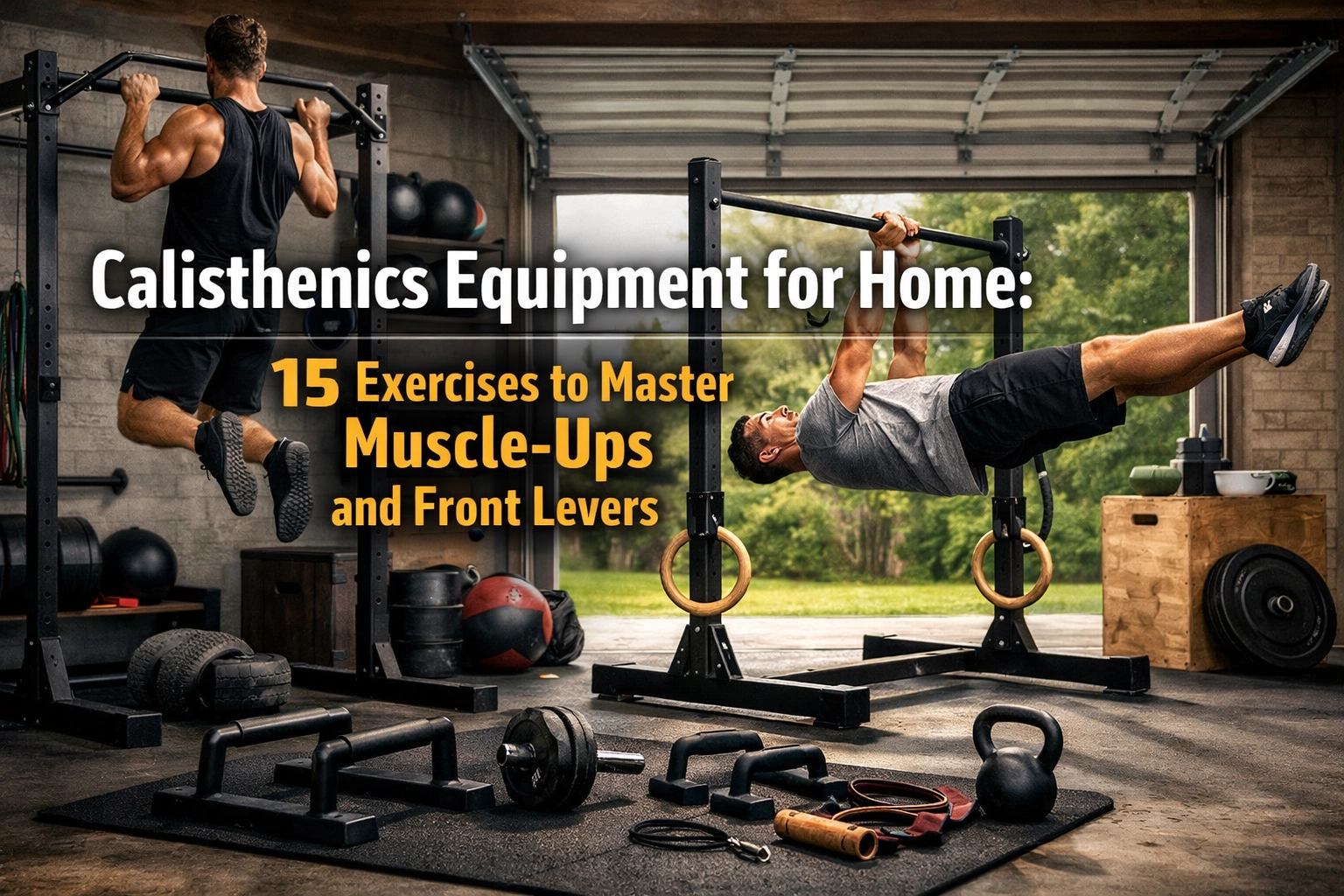
Let's get straight to it: muscle-ups and front levers aren't party tricks. They're legitimate tests of pulling power, core stability, and body control that separate weekend warriors from serious calisthenics athletes. And here's the thing: you don't need a $5,000 gym membership or a garage packed with machines to master them.
What you need is the right calisthenics equipment for home, a structured progression, and the guts to put in the work. This guide breaks down 15 essential exercises that'll take you from struggling with pull-ups to floating through muscle-ups and holding rock-solid front levers.
The Essential Calisthenics Equipment You Actually Need
Before we dive into the exercises, let's talk gear. The beauty of bodyweight training at home is its minimalism, but "minimal" doesn't mean "nothing." You need equipment that can handle dynamic movements, support progressive overload, and not destroy your walls or ceiling.
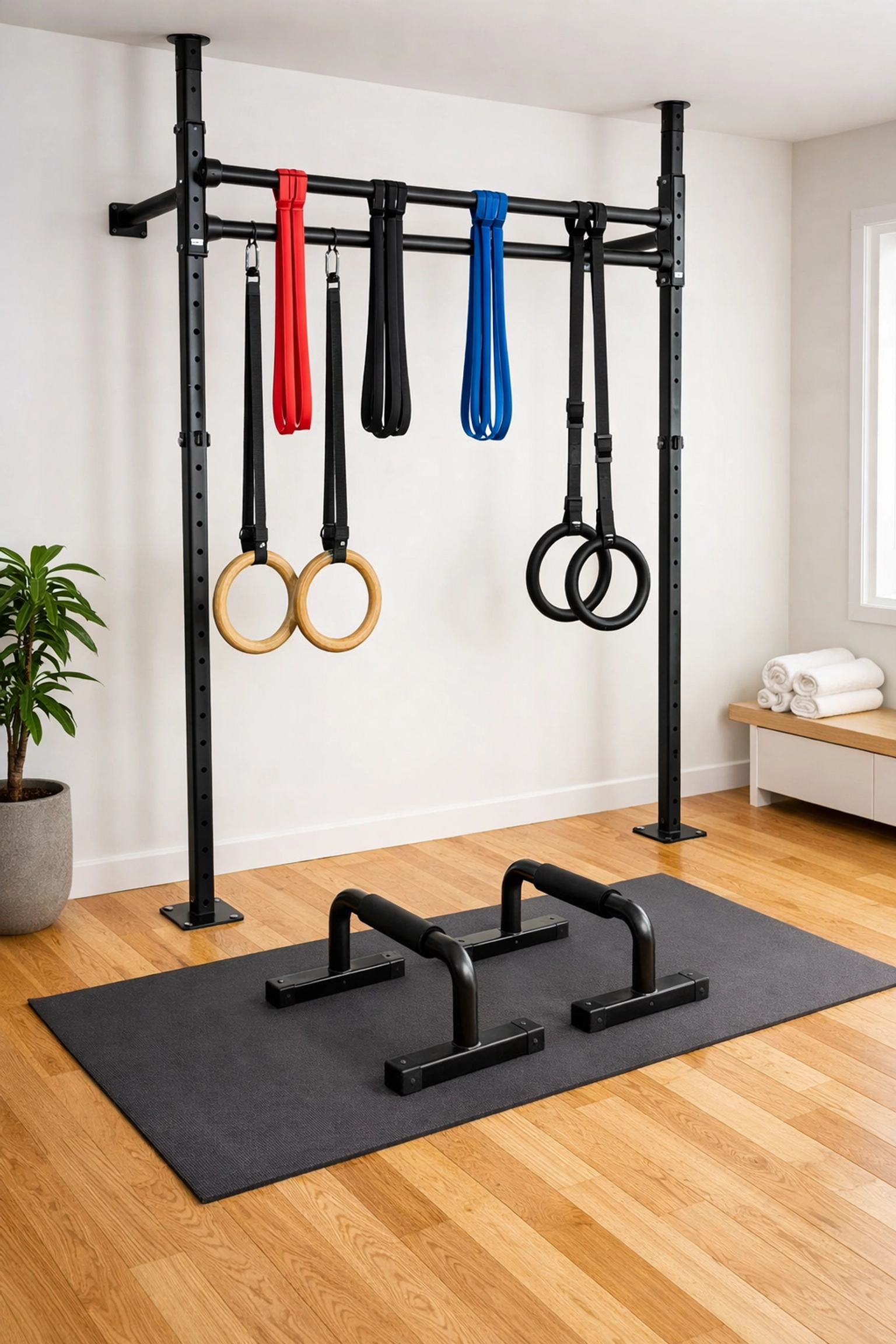
The foundation starts with a solid pull-up bar setup. Traditional doorway bars work for basic pull-ups, but they're limiting for advanced movements. A floor to ceiling gym system like the Resistance Rail offers the versatility serious athletes demand: multiple grip positions, the ability to add resistance bands, and zero wall damage. It's the kind of versatile home gym setup that grows with your skills.
Beyond the bar, you'll need:
- Resistance bands (multiple resistances for assisted work and added tension)
- Parallettes or dip bars for support holds and transitions
- Gymnastics rings for unstable training variations
- Weight vest or belt for progressive overload
Don't cheap out on equipment. Your calisthenics gear takes serious abuse, and the difference between a solid setup and garbage is often the difference between progress and injury.
Understanding the Progression Path
Here's what most people get wrong: they try to jump straight to muscle-ups or front levers without building the prerequisite strength patterns. That's like trying to deadlift 500 pounds when you can barely pick up 225.
Both muscle-ups and front levers demand:
- Pulling strength (vertical and horizontal)
- Core compression and stability
- Shoulder mobility and control
- Explosive power (especially for muscle-ups)
- Straight-arm strength (critical for front levers)
The 15 exercises below target these qualities systematically. We're splitting them into two categories: muscle-up progressions and front lever progressions. Master these, and those "impossible" skills become inevitable.
Muscle-Up Progression: Exercises 1-8
1. Chest-to-Bar Pull-Ups
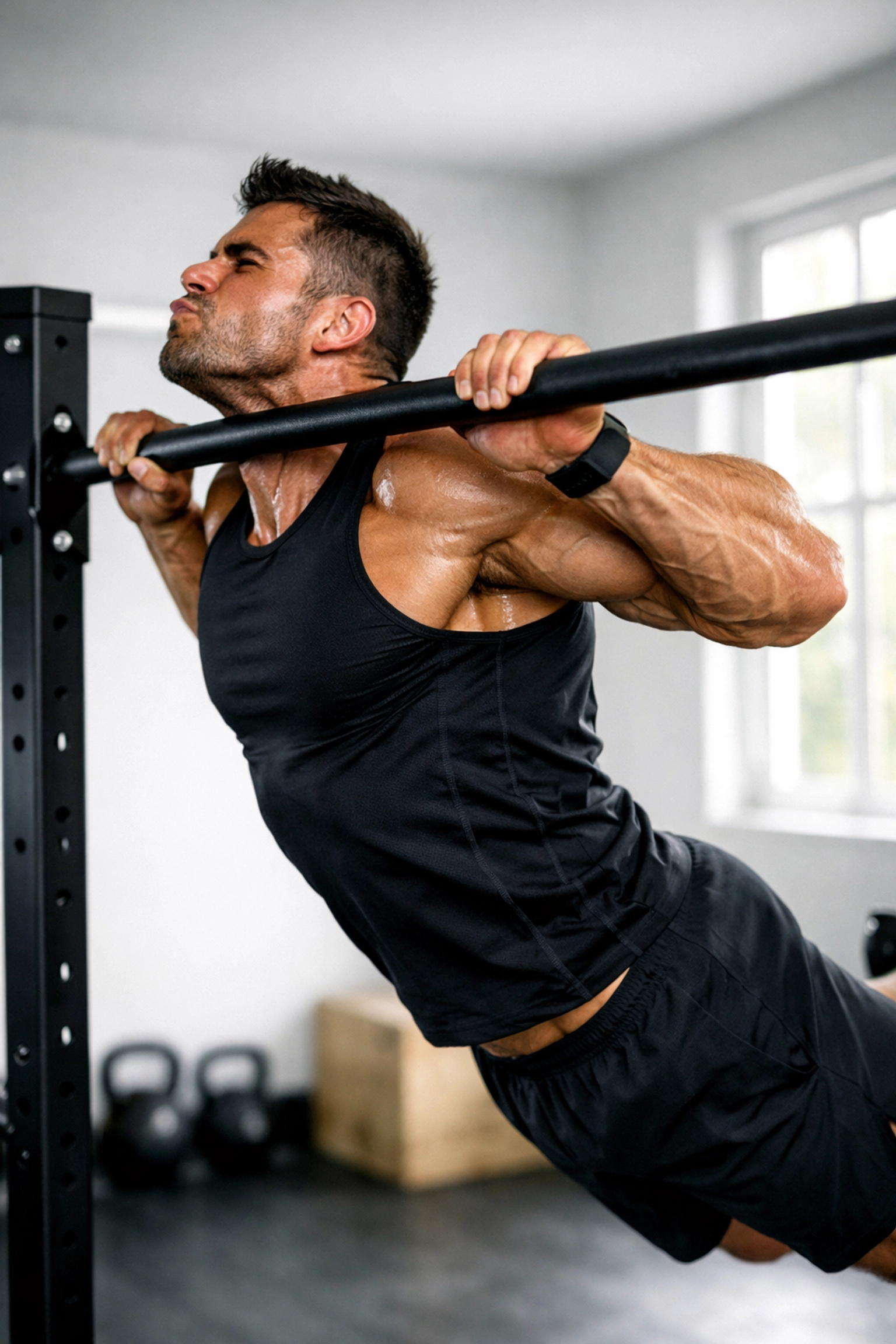
Standard pull-ups won't cut it. You need to pull high: chest touching the bar at the top. This builds the explosive pulling power and range of motion required for the transition phase of the muscle-up.
Execution: Grip the bar slightly wider than shoulder-width. Pull explosively, driving elbows down and back. Your chest should make contact with the bar, not your collarbone. Control the descent.
2. Hollow Body Holds
The muscle-up transition destroys athletes with weak cores. Hollow body holds build the compression strength that keeps your body tight during the movement.
Execution: Lie on your back, press your lower back into the floor, and lift your shoulders and legs off the ground. Arms extended overhead. Hold 30-60 seconds. If your lower back arches, you're doing it wrong.
3. Straight Bar Dips
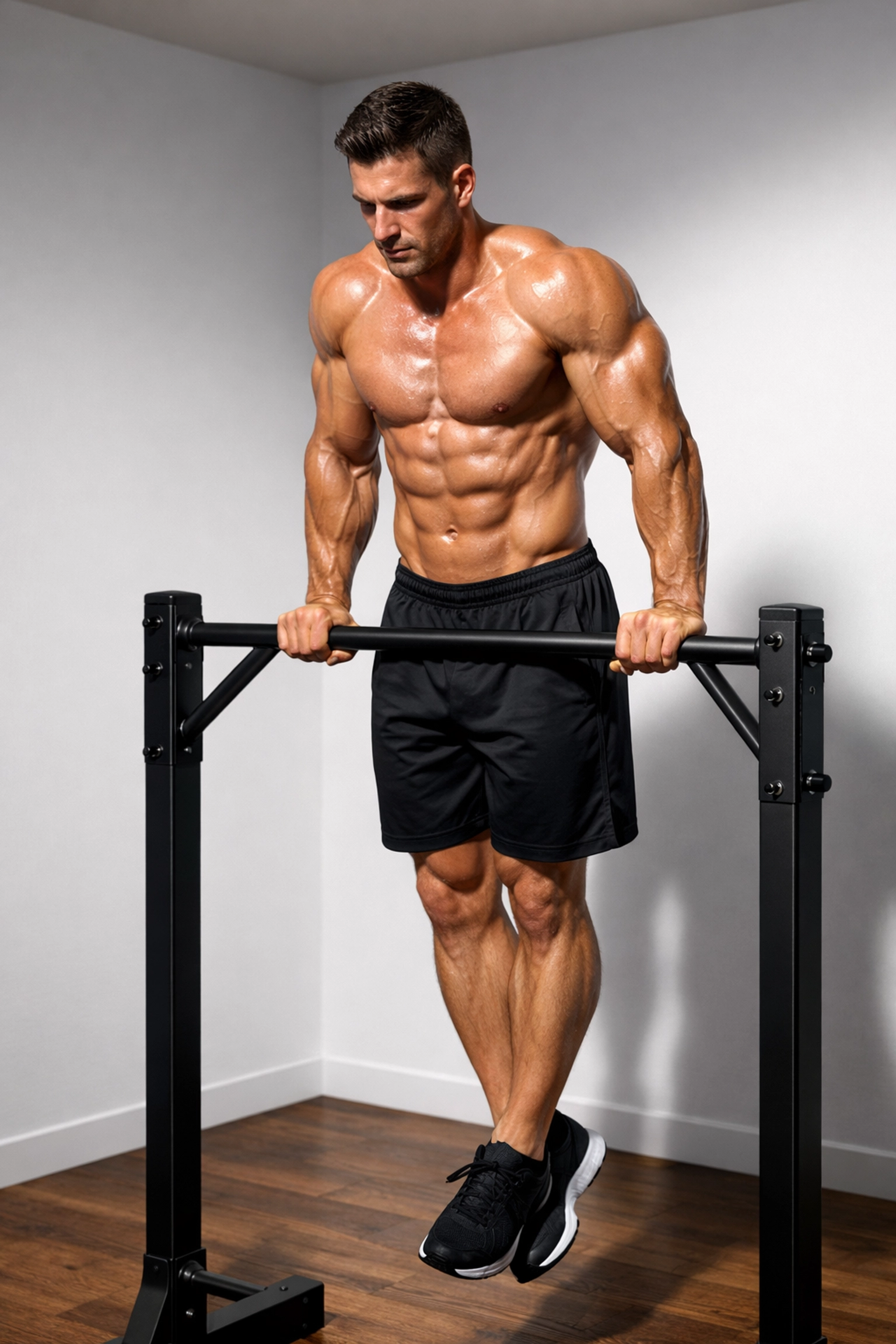
You need serious pressing strength to complete the second half of a muscle-up. Straight bar dips on your home gym equipment build that power while teaching the specific movement pattern.
Execution: Start in a support position above the bar, hands pronated (overhand grip). Lower until your chest approaches the bar, then press back to support. Keep your body as vertical as possible.
4. Explosive Pull-Ups (High Pulls)
Time to add speed. Explosive pull-ups teach your nervous system to generate force quickly: exactly what you need to get over the bar.
Execution: From a dead hang, pull explosively trying to get as high above the bar as possible. At the peak, your hips should approach bar height. Land softly and reset.
5. Band-Assisted Muscle-Ups
Progressive overload for the full movement. Loop a resistance band over your bar and step into it. This reduces bodyweight while letting you practice the complete motor pattern.
Execution: Start with a thick band that makes the movement manageable. Pull explosively, shift your hands forward at the transition point, and press out. Gradually decrease band thickness as you build strength.
6. Negative Muscle-Ups
Eccentric training builds strength fast. Jump or step up to the top position of a muscle-up, then lower yourself with maximum control through both the dip and pull-up phases.
Execution: Take 5-10 seconds to lower through the dip portion, another 5-10 seconds through the pull-up. Reset and repeat. This crushes you, but it works.
7. Weighted Pull-Ups
Raw pulling power matters. Once you're crushing 15+ clean pull-ups, add weight. A weight vest or belt progressively overloads your pulling muscles.
Execution: Start with 10% of your bodyweight. Build up to sets of 5-8 reps with 25-50 pounds. Your unweighted pull-ups will feel absurdly light afterward.
8. L-Sit to Muscle-Up Transition Practice
This drill isolates the hardest part: the transition. Hold an L-sit hang, then explosively pull and rotate your hands over the bar.
Execution: Hang with legs extended parallel to the ground (L-position). Pull explosively while rotating your hands from overhand to top support position. Even if you can't complete the full movement initially, this builds the specific strength and coordination you need.
Front Lever Progression: Exercises 9-15

9. German Hangs
Before you can hold a front lever, you need shoulder extension flexibility and straight-arm strength. German hangs develop both.
Execution: Using rings or a bar, rotate backward into a hang position with your back toward the ground, arms straight. Your shoulders should feel a deep stretch. Hold 20-30 seconds.
10. Scapular Pulls
Front levers require massive scapular retraction strength. This isolation exercise targets exactly that.
Execution: Hang from the bar with straight arms. Without bending your elbows, pull your shoulder blades down and together, lifting your body slightly. Hold for 2 seconds, release. Perform 10-15 reps.
11. Tuck Front Lever Hold
Your first actual lever position. Tuck your knees to your chest to shorten the lever arm and make the hold manageable.
Execution: From a dead hang, engage your lats and pull your body horizontal while tucking your knees tight to your chest. Hold 10-30 seconds. Keep your back rounded and core engaged.
12. Advanced Tuck Front Lever
Extend the difficulty by moving your knees away from your chest while keeping them bent.
Execution: Same as tuck position, but create a 90-degree angle at your knees. Your shins should be parallel to the ground. This significantly increases the leverage challenge.
13. Single-Leg Front Lever
Asymmetrical training bridges the gap to the full lever. Extend one leg while keeping the other tucked.
Execution: From advanced tuck position, extend one leg straight while keeping the other tucked. Alternate legs. Work up to 15-20 second holds per side.
14. Straddle Front Lever
Spreading your legs wide reduces the leverage demand compared to a full lever while building the straight-arm strength you need.
Execution: From your lever pull, extend both legs straight but spread them as wide as possible. Keep your body horizontal and arms completely straight. Squeezing your glutes helps maintain position.
15. Front Lever Pulls
Dynamic strength matters as much as static holds. Front lever pulls build the strength to enter and exit the position with control.
Execution: From a full front lever (or your current progression), pull your body up toward the bar while maintaining horizontal body position. Lower back to lever with control. These are brutally difficult but incredibly effective.
Programming Your Training
Don't try to hammer all 15 exercises in one session. That's a recipe for overtraining and burnt-out connective tissue.
Smart resistance training at home follows periodized blocks. Start with 3-4 exercises per session:
Sample Muscle-Up Focus Day:
- Hollow body holds (3 sets)
- Chest-to-bar pull-ups (5 sets)
- Straight bar dips (4 sets)
- Band-assisted muscle-ups (3 sets)
Sample Front Lever Focus Day:
- Scapular pulls (3 sets)
- Tuck front lever holds (5 sets)
- Single-leg front lever (3 sets each side)
- Front lever pulls (3 sets)
Train each focus 2-3 times per week with at least one rest day between sessions. The connective tissue adaptations these skills demand take time: patience beats intensity here.
The Equipment That Makes the Difference
Look, you can train calisthenics anywhere. Parks, playgrounds, doorway bars: they all work to a point. But if you're serious about mastering advanced movements, your home gym equipment needs to support your progression.
A no wall damage workout system like the Resistance Rail gives you the stability for heavy resistance band work, the height clearance for full range-of-motion exercises, and the durability to handle years of training. It's the kind of versatile home gym setup that works whether you're grinding away at muscle-up progressions or holding 60-second front levers.
Plus, when you're setting up your crossfit home gym or building a dedicated training space, you want equipment that multitasks. The same setup that supports your calisthenics work should handle your resistance bands, suspension trainers, and anything else you throw at it.
From Practice to Performance
Here's the reality: these 15 exercises work, but only if you work them consistently. Most athletes spend 6-12 months going from basic pull-ups to their first muscle-up. Front levers often take longer: 12-18 months isn't unusual.
That's not discouraging news. That's honest news. And honestly, the journey builds more than just party tricks. You'll develop pulling strength that makes you dangerous in any athletic context, core stability that bulletproofs your spine, and body awareness that translates to every movement you do.
The athletes who succeed with calisthenics equipment for home training aren't the ones with the fanciest gear or the most elaborate programs. They're the ones who show up, follow progressive overload principles, and trust the process even when progress feels slow.
Set up your training space properly, master these 15 exercises systematically, and those "impossible" movements become your warm-up. That's not hype. That's just what happens when you train smart with the right tools and refuse to quit.
Now get to work.
