
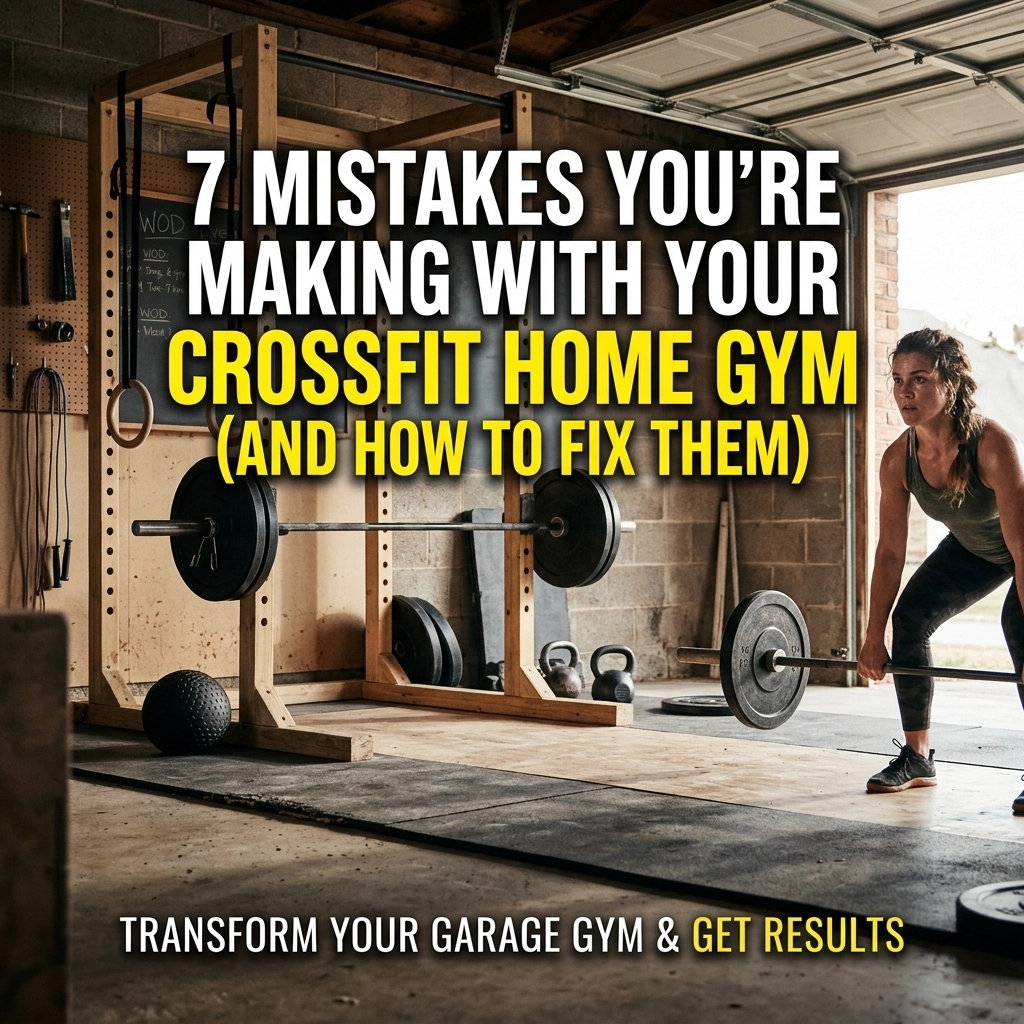
Listen, I get it. You decided to ditch the $200-a-month CrossFit box to build your own sanctuary of gains. You bought some bumper plates, a barbell that’s seen better days, and maybe a jump rope. You thought the CrossFit home gym dream was going to be all PRs and shirtless morning sessions.
But here’s the reality: most home gyms are where progress goes to die.
I’m Brian Kerr, founder of Bold Body Fitness, and I’ve seen it all. I’ve seen Ninja Warriors training in cramped garages, MMA fighters hitting plateaus because their gear is trash, and gymnasts struggling because they can’t find a decent place to hang their rings without the ceiling coming down.
If your "box" feels more like a storage unit than a high-performance facility, you’re making mistakes. Huge ones. And these mistakes aren't just costing you gains: they're setting you up for an injury that will sideline you for months.
Let’s tear down the 7 biggest mistakes people make with their home training and show you how to fix them with a bold approach to fitness.
1. The "Zero to Sixty" Warm-Up Fail
The biggest mistake I see in the CrossFit home gym community is the total lack of a structured warm-up. At the local box, the coach forces you through ten minutes of mobility and dynamic movement. At home? You roll out of bed, walk ten feet to your garage, and immediately try to snatch 135 lbs.
That is a recipe for a torn rotator cuff or a blown-out hamstring.
The Fix: You need to treat your full body workout at home with the same respect you give a heavy session at a professional facility. Spend 5 to 10 minutes on a dynamic warm-up that mimics the movements of your WOD.
If you're doing overhead squats, don't just start squatting. Use a versatile home gym setup like the Resistance Rail to perform face pulls, band pull-aparts, and overhead reaches. This primes your central nervous system and gets blood flowing to the connective tissues that actually hold your joints together.

2. Sacrificing Form for the Clock
We’ve all been there. The music is blasting, the timer is ticking, and you’re chasing a PR on "Grace." Suddenly, your back starts rounding on those power cleans. Your hips are rising faster than the bar. You're "winning" against the clock, but you’re losing the war for longevity.
In a home gym environment, you don't have a coach yelling at you to "keep your chest up." You have total freedom, and for many athletes, that freedom leads to absolute technical garbage.
The Fix: Film yourself. Every. Single. Session.
Set up your phone and record your heavy sets or high-volume rounds. Review the footage between sets. If you see your form deteriorating, the weight comes off. Period.
Furthermore, incorporate instability training. If you’re focused on bodyweight training at home, use equipment that demands perfect form, like gymnastic rings or a high-quality floor to ceiling gym system. When you train with instability, your body is forced to recruit stabilizer muscles, making your form nearly impossible to fake.
3. Treating Your Gym Like a Storage Unit
If you have to move a lawnmower, three bags of mulch, and a mountain of holiday decorations just to do a burpee, you don't have a gym: you have a cluttered mess.
Space is the most valuable commodity in any CrossFit home gym. When your space is cluttered, your mind is cluttered. You find yourself cutting movements short because you’re afraid of hitting a wall or tripping over a stray kettlebell. This lack of "flow" kills intensity, and intensity is the "secret sauce" of CrossFit.
The Fix: You need to maximize your footprint. This is where a floor to ceiling gym or a versatile home gym setup becomes a game-changer. Stop buying bulky power racks that take up 25 square feet of floor space.
At Bold Body Fitness, we believe in verticality. Systems like the Resistance Rail offer a no wall damage workout system that keeps your gear off the floor and out of the way. When your equipment is mounted properly and your floor is clear, you have the mental and physical freedom to go all-out.

4. Buying Cheap, Unstable Equipment
I see it every day: an athlete spends $1,000 on a high-end barbell but then buys a $40 "doorway" pull-up bar. Then they wonder why they can't do kipping pull-ups or muscle-ups without the whole house shaking.
Cheap equipment isn't just a waste of money; it’s a mental block. If you don't trust your home gym equipment, you won't push your limits. You’ll subconsciously hold back on your explosive movements because you’re afraid the gear is going to fail.
The Fix: Invest in professional-grade calisthenics equipment for home.
If you’re serious about your training, you need a pull up bar alternative that is rock solid. The Resistance Rail is designed for serious athletes: MMA fighters, gymnasts, and Ninja Warriors: who need a system that won't budge.
When you buy once, you cry once. Buy gear that is rated for high-intensity use. Check out our full range of professional-grade gear at the Bold Body Fitness Shop.
5. The "Home Comfort" Trap (Lack of Accountability)
The hardest part about training in a CrossFit home gym isn't the heavy weights: it’s the lack of a "tribe." When you’re at a box, the person next to you is pushing you to finish that last rep. At home, it’s just you. It is incredibly easy to shave a rep here or take an extra 30 seconds of rest there.
This "home comfort" trap leads to plateaus. You’re working out, sure, but you’re not training.
The Fix: Create a system of accountability.
- Use a Timer: A visible, loud timer is non-negotiable. If you say you’re resting for 60 seconds, you rest for 60 seconds.
- Join a Community: Even if you train alone, you don't have to be alone. Join the Bold Body Fitness Members area or find an online leaderboard to post your scores.
- The "Live" Factor: Record a "Live" session on social media. Knowing someone might be watching is the best way to ensure you don't cheat your reps.

6. Zero Movement Variety
A lot of home gym owners get stuck in a "Barbell Only" rut. They do the same five movements: Squat, Deadlift, Press, Clean, and Snatch. While these are the kings of resistance training, ignoring other planes of motion leads to overuse injuries and massive gaps in your physical profile.
If you're an MMA fighter or a Ninja Warrior, you need rotational strength and varied grip angles. If all you ever touch is a 28mm barbell, your hands and joints are going to pay the price.
The Fix: Diversify your calisthenics equipment for home.
Incorporate movements that require you to pull from different angles. This is where the Resistance Rail shines. Because it allows for multiple attachment points, you can switch from high-anchor pull-ups to mid-anchor rows or low-anchor rotational work in seconds.
A versatile home gym should allow for:
- Vertical Pulling (Pull-ups, Muscle-ups)
- Horizontal Pulling (Rows)
- Rotational Power (Band chops, MMA-style striking drills)
- Unilateral Work (Single-arm presses and pulls)

7. Neglecting the "Slow" Gains (Tempo and Eccentrics)
CrossFit is often about speed: AMRAP (As Many Reps As Possible) or For Time. In the quest for speed, many home athletes completely forget about tempo. They bounce the bar off their chest in a bench press or use massive momentum to swing through a pull-up.
This ignores the eccentric (lowering) phase of the movement, which is actually where the most muscle damage and strength adaptation occur.
The Fix: Dedicate at least one session a week to "Tempo Training."
Instead of rushing your full body workout at home, slow it down. Try a 4-second descent on your squats and a 2-second pause at the bottom. When doing bodyweight training at home, focus on "slow-motion" pull-ups.
Controlling the movement through the full range of motion builds bulletproof connective tissue. It makes you a more durable athlete. If you’re using a resistance training system, focus on resisting the pull of the bands or the weight as it returns to the starting position.
The Bold Solution: Rethinking the Home Gym
Building a CrossFit home gym is an investment in yourself. But if you're filling your garage with junk and ignoring the fundamentals of movement, you're just spinning your wheels.
At Bold Body Fitness, we don't do "average." We don't build flimsy equipment for people who want to "stay active." We build systems for the obsessed.
Our flagship product, the Resistance Rail, was born out of a need for a no wall damage workout system that could handle the intensity of a pro-level athlete. It’s the ultimate pull up bar alternative and the foundation of a truly versatile home gym.
Why the Resistance Rail is the Fix for Your Home Gym Mistakes:
- Space Saving: It’s a floor to ceiling gym that takes up zero floor space. Say goodbye to the storage unit vibe.
- Safety First: No more shaky doorway bars. This is a rock-solid system that supports high-intensity resistance training.
- Versatility: From calisthenics equipment for home to band-based power work, it covers every movement plane.
- No Damage: Perfect for renters or those who don't want to drill massive holes into their studs.

Ready to Level Up?
If you’re ready to stop making these rookie mistakes and start training like a pro, it’s time to upgrade your environment. A bold athlete needs bold gear.
Don't let your home gym be the reason you plateau. Fix your warm-up, fix your form, clear your space, and get the right tools for the job.
Check out our latest gear and join the tribe:
- Shop the Resistance Rail: Click here to view the standard setup
- Browse Our Full Catalog: Explore our home gym equipment
- Learn More About Us: Visit Bold Body Fitness
Stop making excuses. Start making progress. Get Bold.
