
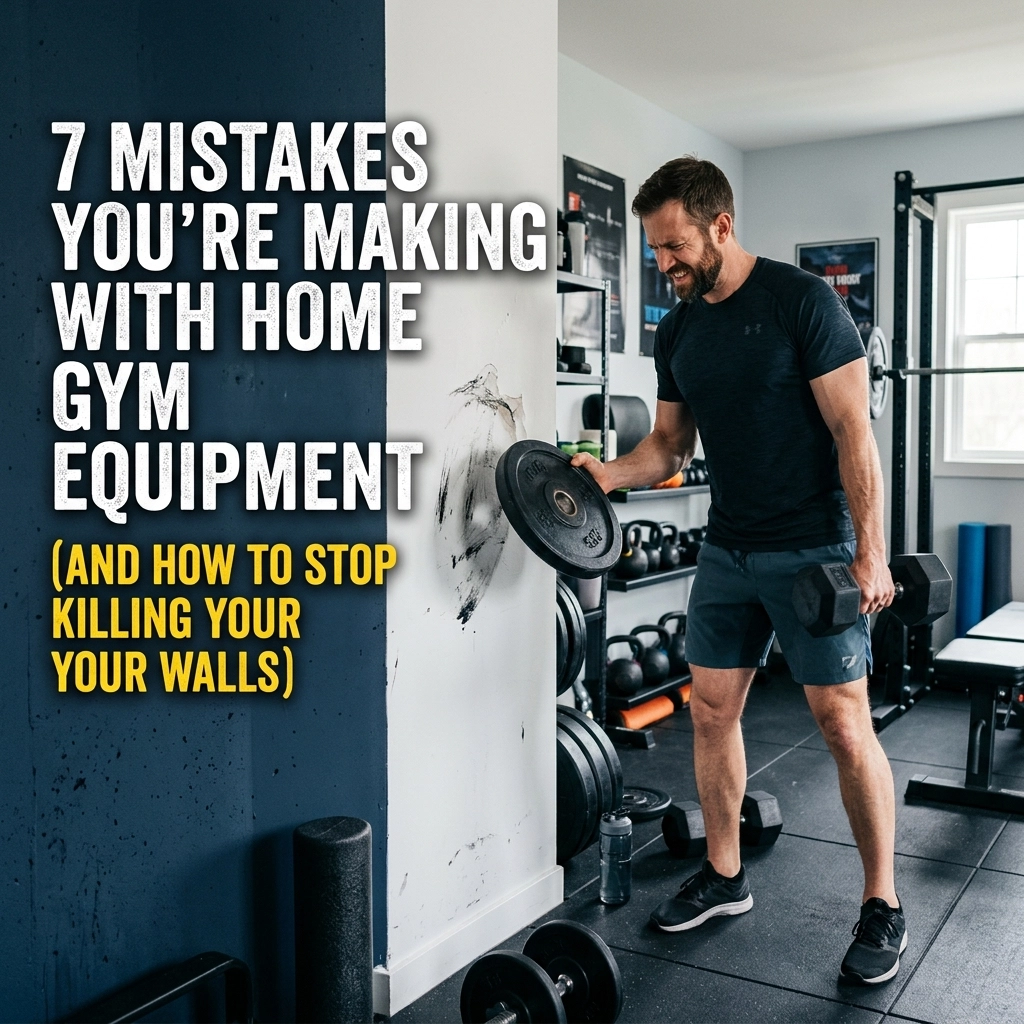
You decided to take your training seriously. No more waiting for the squat rack at the local mega-gym. No more breathing in some stranger's chalk dust. You’re building a fortress of gains in your own home. But here’s the cold, hard truth: most home gyms are absolute train wrecks.
Whether you’re a Ninja Warrior in training, a dedicated CrossFitter, or a calisthenics practitioner trying to master the human flag, your home environment is under attack. Between the cracked drywall, the scuffed baseboards, and the equipment that shakes every time you look at it, your "temple" is likely becoming a renovation nightmare.
At Bold Body Fitness, we don't do mediocre. We build gear for people who actually move. If you want a full body workout at home that doesn’t end with a security deposit forfeit or a call to a contractor, you need to stop making these seven amateur mistakes.
1. You Measured the Machine, But Not the Movement
This is the rookie mistake that kills the flow of any crossfit home gym. You found a power rack or a cable machine, looked at the "footprint" dimensions in the manual, and thought, "Yeah, that’ll fit in the corner next to the guest bed."
The Reality Check: A footprint is just the base. It doesn’t account for the seven-foot Olympic bar that needs to be loaded with plates on either side. It doesn't account for your wingspan during a chest fly or the overhead clearance needed for a snatch or a muscle-up.
If you’re a gymnast or a ninja warrior, your "space" isn't a rectangle on the floor; it’s a sphere of movement. When you install home gym equipment, you must measure for the arc of the athlete, not just the metal on the floor.
The Bold Fix: Before buying, map out your movements. If you’re doing bodyweight training at home, literally stand in the space and perform a burpee, a lunging kick, and an overhead reach. If your knuckles hit the ceiling or your shins hit the radiator, that spot is a no-go. This is why a floor to ceiling gym system is superior: it utilizes the vertical axis without demanding a massive horizontal footprint.

2. You’re Using "Wall-Mounted" Gear That Isn't Built for Real Force
Let’s talk about those "heavy duty" pull-up bars you bought on a whim. You find the studs (maybe), drill some holes, and start cranking out reps. Three weeks later, there’s a hairline crack spreading across your drywall, or worse, the whole thing rips out mid-set.
Standard wall-mounted equipment is often designed for static loads: meaning it can hold weight if it just sits there. But athletes aren't static. We kip, we swing, we generate explosive torque. Most residential walls are built with 2x4 studs and half-inch drywall. They weren't meant to handle the lateral force of a 200lb athlete doing calisthenics.
The Solution: You need a no wall damage workout system. If you’re looking for a legitimate pull up bar alternative, you shouldn't be looking at something that puts all the stress on three inches of wood and a prayer.
The Resistance Rail by Bold Body Fitness was engineered specifically to solve this. Instead of pinpointing all the stress on a small patch of drywall, we utilize a system that distributes force properly. Whether you're doing high-tension resistance training or heavy calisthenics, your walls stay pristine because the engineering accounts for the physics of human movement. Check out our shop to see how we’ve re-engineered home mounting.
3. The Floor is Not Your Friend (Yet)
You wouldn't build a skyscraper on a swamp, so why are you putting your versatile home gym on bare concrete or, God forbid, shag carpet?
Concrete is deceptive. It looks tough, but it’s brittle. Drop a 45lb bumper plate once too often, and you’ll start seeing spiderweb cracks. Even worse, concrete has zero "give," meaning your joints are taking 100% of the impact during plyometrics. On the flip side, carpet is an unstable mess that hides dust and bacteria, and it’s a death sentence for your balance during heavy squats.
The Bold Fix: Invest in high-density rubber flooring. We’re not talking about those cheap foam puzzle mats that slide around like air hockey pucks. You need 1/2-inch to 3/4-inch vulcanized rubber. It protects the subfloor, deadens the sound (your neighbors or spouse will thank you), and provides the grip necessary for serious calisthenics equipment for home.

4. Falling for the "Single-Use" Machine Trap
Unless you live in a literal warehouse, you don't have room for a dedicated leg press, a pec deck, and a standing calf raise machine. These are the "Shiny Objects" of the fitness world. They look impressive, but they are the least efficient way to spend your budget and your square footage.
Serious athletes: CrossFitters, MMA fighters, gymnasts: know that the best full body workout at home comes from equipment that forces your body to stabilize itself.
The Bold Fix: Think modular. Think versatile. Your equipment should allow you to transition from a pull-up to a row, to a chest press, to a squat in seconds. This is the core philosophy behind the Resistance Rail. By using a vertical rail system, you can adjust your anchor points instantly, turning a single strip of wall space into a total body annihilation station. It’s the ultimate versatile home gym because it adapts to your workout, not the other way around.
Explore the Resistance Rail Standard to see how one piece of gear replaces an entire room of junk.
5. Underestimating the "Z-Axis" (Vertical Space)
Most people look at their spare room and see a floor. They think about where the treadmill goes, where the bench goes, and where the rack goes. Within three purchases, the room is full, and you’re tripping over dumbbells.
You’re ignoring 90% of your room’s potential: the walls and the ceiling.
A floor to ceiling gym approach is how professional training centers maximize small spaces. By utilizing vertical mounting and high-anchor points, you open up the floor for movement-based training like shadowboxing, yoga, or metabolic conditioning.
The Bold Fix: Stop buying wide. Start buying tall. If your equipment doesn't help you utilize the vertical space in your home, it’s wasting your money. Verticality allows for better resistance training angles, especially for movements like lat pulldowns, face pulls, and overhead tricep extensions that are often awkward with traditional home setups.

6. Buying "Residential-Grade" When You Have "Pro-Grade" Goals
There is a massive difference between a pull-up bar designed for a kid’s bedroom and calisthenics equipment for home designed for a 220lb athlete practicing explosive muscle-ups.
When you buy cheap, you pay twice. You pay once for the equipment, and you pay again when it breaks, usually taking a chunk of your wall or a piece of your floor with it. Worse, "cheap" equipment often has lower weight tolerances and poor ergonomics, which leads to injury.
The Bold Fix: If you are a ninja warrior, a gymnast, or an MMA fighter, you are putting professional-grade stress on your gear. You need "over-built" equipment. Look for high-gauge steel, industrial-grade mounting hardware, and finishes that won't chip the first time a carabiner hits them. At Bold Body Fitness, we build for the 1% who actually push their limits.
7. Neglecting the Resistance Curve
The final mistake is a lack of variety in how weight is applied. A lot of home gyms are strictly "iron" (dumbbells and plates). While iron is great, it has a fixed resistance curve. Gravity only works in one direction: down.
If you want a truly full body workout at home, you need to incorporate resistance training that utilizes bands and cables. This allows for lateral resistance, diagonal loading, and "accommodating resistance": where the weight gets harder as you reach the strongest part of your lift.
The Bold Fix: Your setup needs to be an anchor point for everything. Your home gym equipment should be able to handle a 45lb plate one minute and a 100lb resistance band the next. This is why a rail-based system is a game-changer. It allows you to set the perfect height for any resistance band exercise, ensuring you're hitting the muscle from the optimal angle without the bands slipping or snapping because they were looped around a sharp chair leg.

Stop Compromising Your Home for Your Gains
You don't have to choose between a legendary physique and a beautiful home. The "garage gym" aesthetic of cracked floors and holey walls is a badge of honor for some, but it’s a sign of poor planning for the rest of us.
By avoiding these seven mistakes, you can build a CrossFit home gym or a calisthenics sanctuary that looks as professional as it performs.
Why the Resistance Rail is the Missing Link
We built the Resistance Rail because we were tired of seeing athletes settle for flimsy door-frame bars and wall-damaging racks. We wanted something that offered:
- A No Wall Damage Workout System: Engineering that respects your architecture.
- A Legitimate Pull Up Bar Alternative: Stable, secure, and height-adjustable.
- Total Versatility: From bodyweight training at home to high-tension resistance work.
If you’re ready to stop making these mistakes and start training with gear that matches your intensity, it’s time to upgrade.
Check out our Gallery to see how real athletes are transforming their spaces without killing their walls.
Bold Body Fitness isn't just about selling equipment; it's about providing the foundation for your best self. Don't let your home gym be a source of stress. Make it your ultimate weapon.

Final Thoughts for the Serious Athlete
Whether you are perfecting your handstand pushups or grinding through a metabolic circuit, your environment dictates your output. If you’re constantly worried about the equipment wobbling or the wall cracking, you’re not giving 100% to your set.
Invest in your space. Measure twice. Buy quality. And for the love of your drywall, stop using equipment that wasn't designed for the way you move.
Stay Bold.
Ready to revolutionize your home workouts? Visit the Bold Body Fitness Shop today and discover the power of the Resistance Rail.
