
Think you need a garage full of iron to build serious strength? Think again.
Your body is the most versatile, accessible piece of equipment you'll ever own. Bodyweight training has forged the physiques of gymnasts, ninja warriors, and elite military operators for decades. And here's the truth bomb: you can build legitimate, functional strength at home without spending thousands on equipment or sacrificing an entire room to a weight rack.
This isn't about doing endless jumping jacks in your living room. We're talking about systematic, progressive bodyweight training that delivers real results. Whether you're starting your fitness journey or you're a seasoned athlete looking to build a home gym setup that doesn't destroy your walls or your budget, bodyweight training is your foundation.
Let's dive into how to build serious strength using nothing but gravity, your body, and the right approach.
Why Bodyweight Training Actually Works
Bodyweight exercises aren't just "better than nothing": they're legitimately effective for building strength, muscle, and athletic performance. Here's why:
Progressive Overload Through Leverage: You don't need to add weight to make exercises harder. By changing angles, ranges of motion, and leverage points, you can make bodyweight movements brutally challenging. A regular push-up becomes a decline push-up, then a pike push-up, then eventually a handstand push-up. Each progression demands more from your muscles.
Functional Strength: When you're pressing, pulling, and moving your own body through space, you're building strength that translates directly to real-world movement. You're not isolating muscles: you're integrating entire kinetic chains.
Zero Equipment Barriers: No gym membership. No waiting for equipment. No "I can't work out because the gym is closed" excuses. Your training space is anywhere you have floor space.
Joint-Friendly Loading: Bodyweight training allows you to build strength while respecting your joints. You're not compressing your spine under a loaded barbell or stressing your shoulders with awkward cable angles. The resistance is distributed more naturally across your body.
The Essential Bodyweight Exercises Every Beginner Needs to Master
Let's get specific. These movements form the foundation of any effective bodyweight training program. Master these, and you've got everything you need for a complete full body workout at home.
Lower Body Foundations
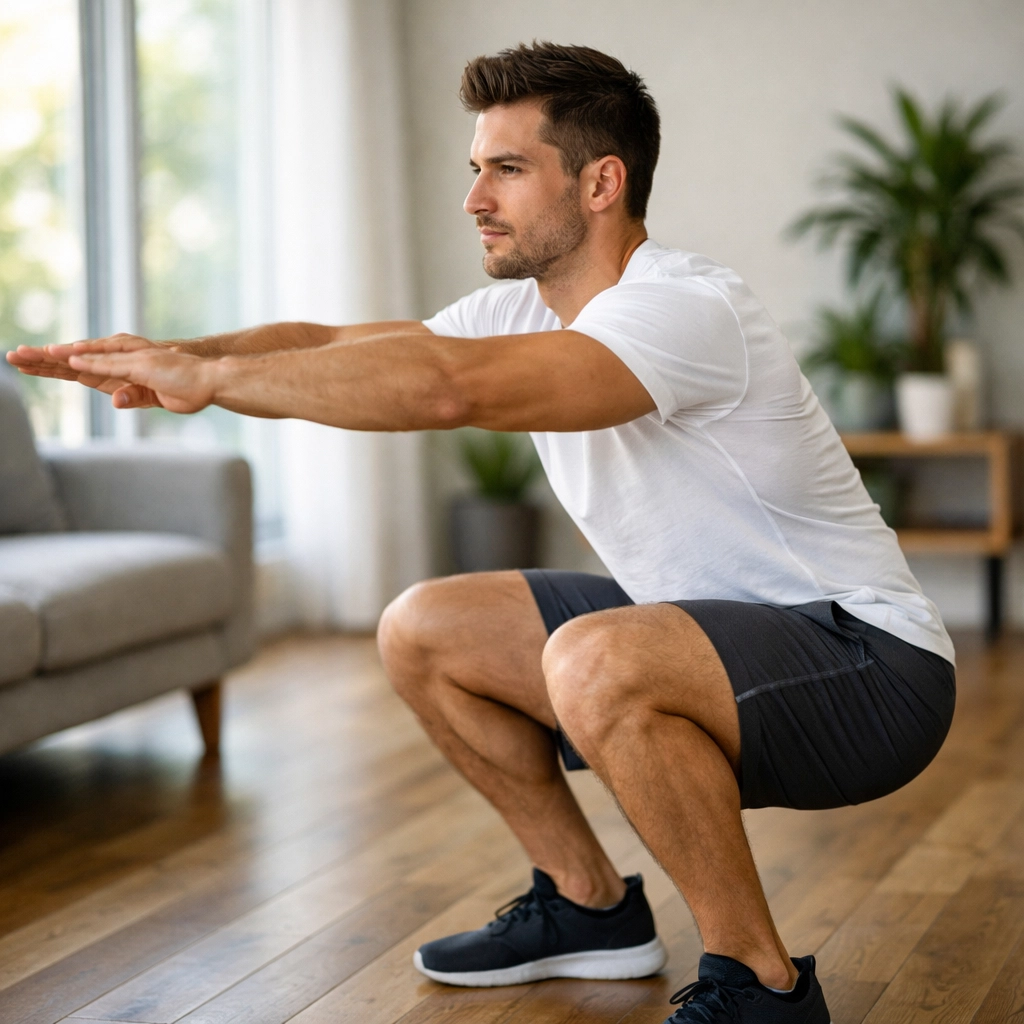
Bodyweight Squat
The king of lower body movements. Stand with feet hip-width apart, toes slightly turned out. Engage your core like someone's about to punch you in the stomach. Push your hips back and bend your knees, lowering yourself as if you're sitting into a chair. Keep your chest upright and your weight balanced through your entire foot: not just your toes.
Lower until your thighs are parallel to the ground (or deeper if your mobility allows). Your knees should track over the middle of your feet, not caving inward. Press through your entire foot to stand back up, squeezing your glutes at the top.
Target: 3 sets of 12-15 reps
Glute Bridge
Lie on your back with knees bent and feet flat on the floor, about hip-width apart. Your feet should be close enough that you can barely touch your heels with your fingertips. Squeeze your glutes and press your hips toward the ceiling until your body forms a straight line from shoulders to knees.
Don't overarch your lower back: this is about your glutes doing the work, not compensating with your spine. Pause for a second at the top, then lower with control.
Target: 3 sets of 15-20 reps
Single-Leg Deadlift
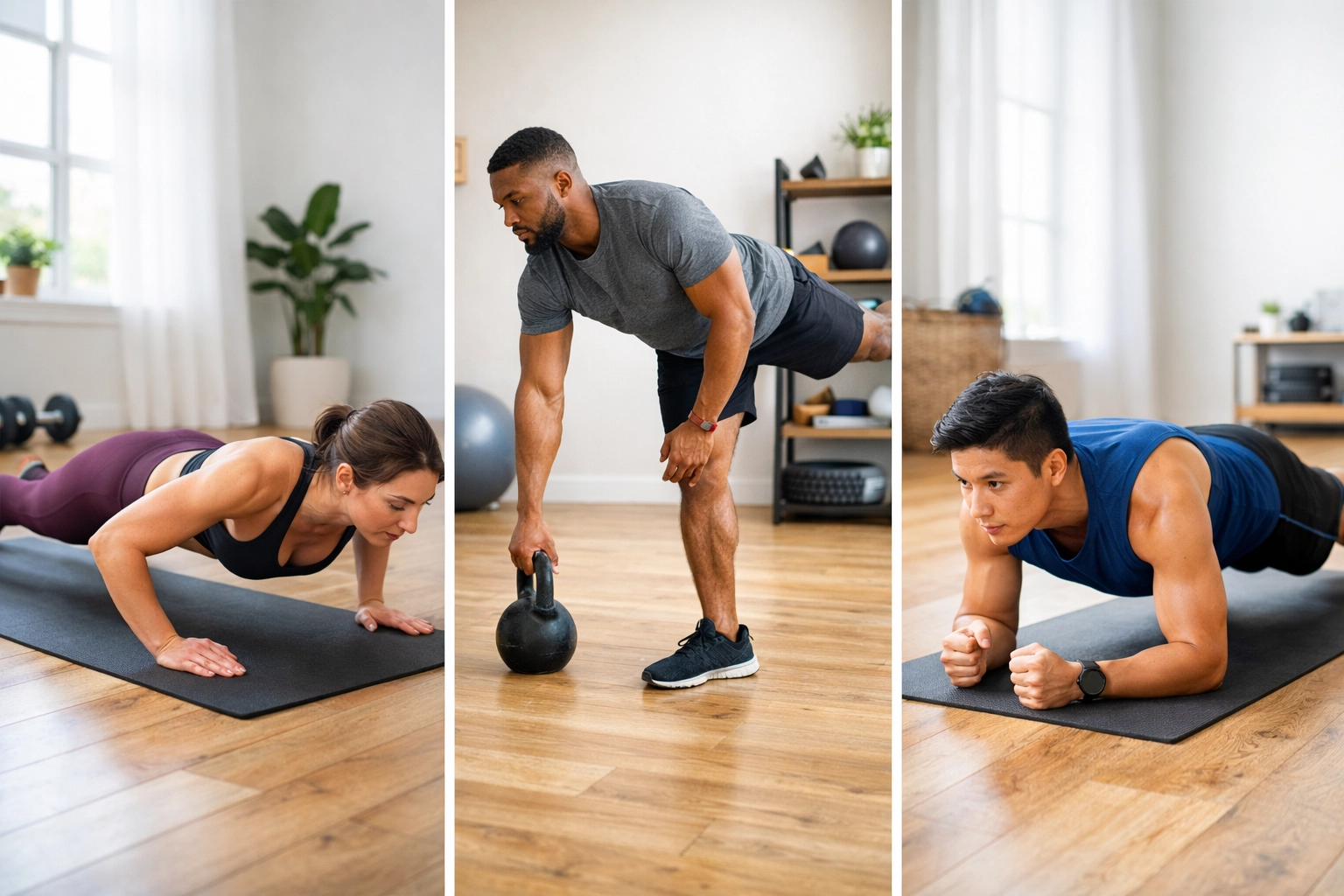
This movement builds balance, posterior chain strength, and unilateral stability. Stand with feet hip-width apart. Shift your weight onto your right foot and slightly bend that knee. Hinge forward at the hips, keeping your back flat as you lift your left leg behind you. Your torso and lifted leg should form a straight line, like a "T" shape.
Lower until your torso is nearly parallel to the floor, then drive through your planted foot to return to standing. This isn't about touching the floor: it's about controlling the movement and feeling the work in your hamstrings and glutes.
Target: 3 sets of 8-10 reps per leg
Lateral Lunge
Step one foot out to the side, about twice your shoulder width. Bend that knee while keeping your other leg straight, pushing your hips back like you're sitting into the bent leg. Your foot should stay flat on the ground with your knee tracking over your middle toes. Press through that foot to return to standing.
This trains your legs in the frontal plane: a movement pattern most people neglect but that's crucial for athletic performance and injury prevention.
Target: 3 sets of 10-12 reps per side
Upper Body and Core Power
Push-Up
The ultimate upper body builder. Start in a high plank with hands directly below your shoulders, body forming a straight line from head to heels. Your core and glutes should be engaged: no sagging hips or piked-up butts.
Bend your elbows to lower your chest until it's about an inch above the ground. Your elbows should be at about a 45-degree angle from your body, not flared straight out to the sides. Press back up with control.
Can't do a full push-up yet? Drop your knees to the ground or elevate your hands on a sturdy surface. Progressively lower the elevation as you get stronger.
Target: 3 sets of 12-15 reps
Plank
The plank builds anti-extension core strength: your ability to resist unwanted movement. Start in a high plank position with hands under shoulders and feet hip-width apart. Your body should form a straight line. Squeeze your glutes, engage your core, and imagine pulling your elbows toward your toes (without actually moving them).
Breathe normally. Don't hold your breath. If your hips start sagging or hiking up, you're done: rest and reset.
Target: 3 sets of 30-60 seconds
Superman
Lie face-down with arms extended overhead. Engage your core and slightly tuck your pelvis (imagine tilting the top of your pelvis toward your ribs). Simultaneously lift your arms, chest, and legs a few inches off the floor. Hold for two seconds, then lower with control.
This strengthens your entire posterior chain: your back, glutes, and hamstrings: in a way that's nearly impossible to replicate with other bodyweight movements.
Target: 3 sets of 10-12 reps
Dead Bug
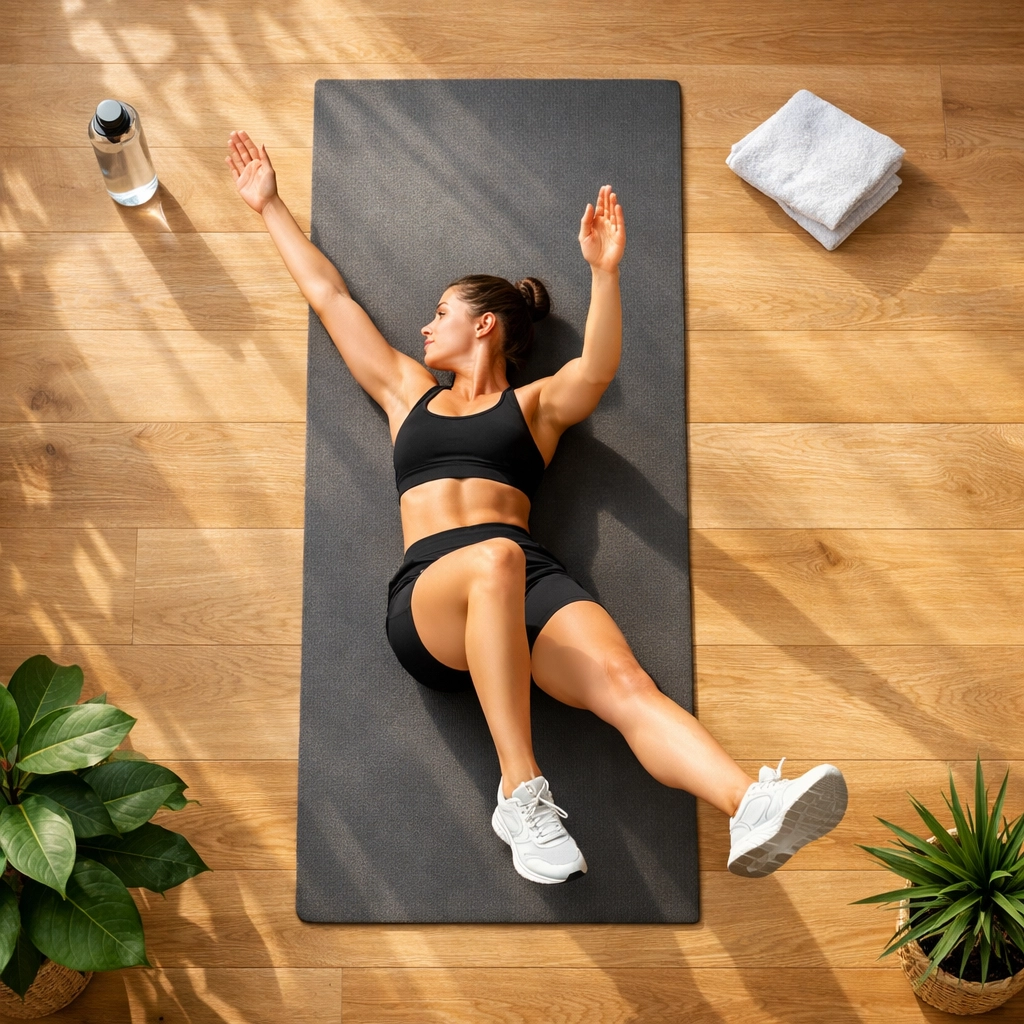
Lie on your back in a tabletop position: knees bent at 90 degrees, shins parallel to the floor, arms reaching straight toward the ceiling. Press your lower back gently into the floor by engaging your core.
Simultaneously extend your right arm behind your head and your left leg away from your body, both hovering an inch above the floor. Return to the starting position and repeat on the opposite side. Move slowly and with control: this is about core stability, not speed.
Target: 3 sets of 10 reps per side
How to Structure Your Bodyweight Training Workouts
Having exercises is one thing. Putting them together into an effective workout is another. Here's how to structure your training for maximum results:
The Beginner Protocol
Frequency: Train 2-3 times per week with at least one day of rest between sessions. Your muscles grow during recovery, not during the workout itself.
Format: Circuit-style training works brilliantly for beginners. Perform one set of each exercise back-to-back with minimal rest, then take 2-3 minutes before starting the next round.
Work Intervals: Aim for 45 seconds of work followed by 15 seconds of rest. This keeps your heart rate elevated while giving you brief recovery periods.
Total Volume: Complete 2-3 rounds of your circuit. As you progress, add a fourth round or increase the work interval to 50 seconds.
Sample Beginner Workout
Round 1-3:
- Bodyweight Squats (45 seconds)
- Rest (15 seconds)
- Push-Ups (45 seconds)
- Rest (15 seconds)
- Glute Bridges (45 seconds)
- Rest (15 seconds)
- Plank (45 seconds)
- Rest (15 seconds)
- Lateral Lunges (45 seconds)
- Rest (15 seconds)
- Dead Bugs (45 seconds)
- Rest (2-3 minutes between rounds)
Total workout time: About 20-25 minutes
This hits every major muscle group, builds cardiovascular endurance, and requires zero equipment. Do this consistently for 4-6 weeks, and you'll see legitimate changes in your strength and physique.
The Form Fundamentals That Make or Break Your Results
Poor form doesn't just limit your results: it sets you up for injury. Here are the non-negotiables:
Core Engagement: Your core should be braced in virtually every exercise. Think about pulling your belly button toward your spine without sucking in your stomach. This creates stability and protects your lower back.
Neutral Spine: Whether you're in a plank, squat, or bridge, maintain the natural curves of your spine. Don't let your lower back hyperextend or round excessively. Imagine a straight line from your head through your spine to your tailbone.
Knee Alignment: During any lower body movement, your knees should track over your middle toes. If they cave inward, you're putting unnecessary stress on your knee joints and missing out on glute activation.
Full Range of Motion: Don't shortchange your reps. Lower all the way down in your squats. Touch your chest to the ground in your push-ups (or as close as you can with good form). Partial reps build partial strength.
Controlled Tempo: Rushing through exercises is the fastest way to plateau. Take 2-3 seconds to lower yourself in each rep, pause briefly at the bottom, then press back up with power. This time under tension is where the magic happens.
If an exercise feels too challenging, modify it. Can't do a full push-up? Elevate your hands on a sturdy surface. Can't hold a plank for 30 seconds? Hold for 15 and work your way up. Progressive overload means gradually increasing the difficulty over time: not destroying yourself on day one.

How to Progress Beyond the Basics
Here's where bodyweight training gets exciting. Once you've mastered the fundamentals, you can progress in several ways:
Increase Volume: Add more sets or reps to your existing exercises.
Decrease Rest: Shorten your rest periods between exercises to increase intensity.
Change Leverage: Make exercises harder by changing angles. Decline push-ups, single-leg squats, and pike push-ups all increase difficulty without adding weight.
Add Isometric Holds: Pause at the most challenging part of an exercise for 2-5 seconds.
Introduce Advanced Movements: Work toward skills like pull-ups, handstand push-ups, pistol squats, and muscle-ups.
This last point is where many people hit a wall with pure bodyweight training. Pull-ups, muscle-ups, and certain advanced gymnastic movements require equipment: specifically, something to hang from or pull against.
That's where a system like the Resistance Rail becomes invaluable. It's a floor-to-ceiling gym setup that installs without drilling holes or damaging walls, giving you access to pulling movements, suspension training, and resistance band work that complements your bodyweight routine perfectly. For serious calisthenics practitioners, gymnasts, or anyone training for ninja warrior competitions, having a pull-up bar alternative that doesn't require wall mounting expands your training options exponentially.
Programming for Long-Term Success
The biggest mistake beginners make is jumping between programs every week, chasing the latest workout trend on social media. Here's the truth: consistency beats novelty every single time.
Stick with a basic program for at least 4-6 weeks. Track your reps, sets, and how the exercises feel. Aim to beat your previous numbers each week: even if it's just one additional rep.
After 6 weeks, reassess. Are the exercises feeling easier? Can you complete all sets with good form? Time to increase the difficulty. Add an extra set, shorten your rest periods, or progress to more challenging variations.
Your body adapts to the stress you place on it. But adaptation takes time. Give your program time to work before changing everything up.
The Bottom Line
You don't need a fully equipped gym to build serious strength. Bodyweight training at home provides everything you need to develop functional, athletic strength that transfers to real-world performance.
Start with the fundamentals outlined in this guide. Focus obsessively on form. Train consistently 2-3 times per week. Progress gradually by increasing volume, decreasing rest, or advancing to more challenging variations.
As you progress, consider expanding your capabilities with versatile equipment that doesn't compromise your space. Check out our shop for equipment designed specifically for serious home training without the wall damage or permanent installation.
Your body is your gym. Now get to work and prove what you're capable of building with nothing but gravity, determination, and the right approach.
