
Let's cut the BS: most people training at home are doing it wrong. Not "slightly off" wrong: completely, gains-destroying, time-wasting wrong.
You've got the motivation. You've cleared space in your living room. Maybe you've even invested in some decent home gym equipment. But despite showing up consistently, your strength gains have flatlined. Your pull-ups aren't improving. Your muscle definition isn't popping. And you're starting to wonder if home training actually works.
Here's the truth: home training absolutely works: when you stop making these seven brutal mistakes that are quietly sabotaging your progress. These aren't minor technical details. These are fundamental errors that are keeping you weak, leaving gains on the table, and potentially setting you up for injury.
Whether you're a CrossFit athlete converting your garage, an MMA fighter supplementing gym sessions, or a calisthenics practitioner building a versatile home gym, these mistakes will kill your progress faster than anything else.
Let's fix them.
Mistake #1: Treating Your Warm-Up Like a Suggestion
The Brutal Truth: You wouldn't redline your car engine when it's cold, so why are you jumping straight into heavy resistance training with frozen muscles?
Skipping warm-ups isn't just risky: it's stupid. Cold muscles have reduced elasticity, limited range of motion, and are significantly more prone to tears and strains. You're literally programming yourself for injury while simultaneously limiting your performance capacity.
When your joints aren't properly lubricated and your nervous system isn't primed, you can't generate maximum force. You're leaving 10-15% of your strength on the table before you even start your first working set.

The Fix: Implement a non-negotiable 8-10 minute dynamic warm-up before every session. Not static stretching: that's for after training. We're talking movement-based preparation:
- Bodyweight squats (15-20 reps)
- Spider lunges with rotation (10 each side)
- Inchworms (8-10 reps)
- Arm circles and shoulder dislocations
- Jump rope or high knees (2-3 minutes)
For serious athletes doing advanced bodyweight training at home, add exercise-specific warm-up sets. Planning muscle-ups? Do some dead hangs, then scapular pulls, then assisted pull-ups, then chest-to-bar pull-ups. Progressively load the movement pattern.
Your warm-up isn't wasted time: it's an investment in performance and injury prevention. Miss it, and you'll pay the price.
Mistake #2: Half-Repping Your Way to Nowhere
The Brutal Truth: Partial reps are for partial results. If you're not taking exercises through a full range of motion, you're building partial strength and leaving massive gains untapped.
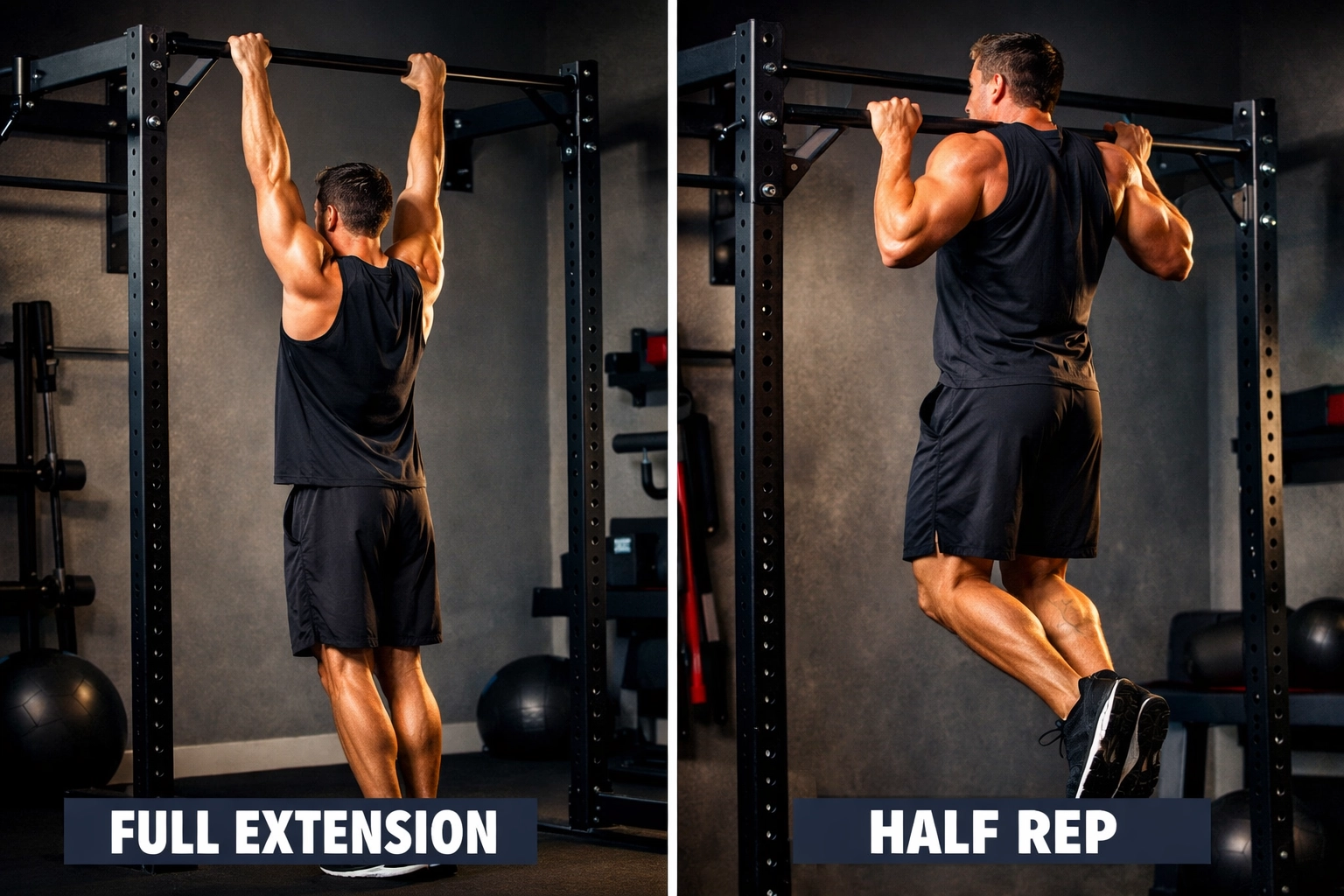
Most home trainers develop terrible habits because there's no coach watching. They do quarter-squats instead of ass-to-grass squats. They stop pull-ups at chin level instead of getting chest to bar. They press dumbbells three-quarters of the way instead of achieving full lockout.
This isn't just inefficient: it's creating strength gaps and dysfunction. Your muscles only get strong through the ranges you train them. Skip the bottom half of your squat, and you'll be weak as hell in that bottom position. That's how injuries happen.
The Fix: Master full range of motion before adding load. Every rep should move through the complete anatomical range of the exercise:
- Pull-ups: Dead hang to chest touching the bar
- Dips: Shoulders below elbows to full lockout
- Squats: Hip crease below knee level to full extension
- Push-ups: Chest to floor to complete arm extension
Film yourself. Most people think they're hitting depth when they're nowhere close. The camera doesn't lie.
When you're doing resistance training with proper ROM, you might need to decrease weight or assistance. Do it. Your ego will survive, and your strength gains will explode.
Mistake #3: Playing Russian Roulette With Load Selection
The Brutal Truth: Using the wrong resistance is sabotaging you from both directions. Too heavy, and you're grinding through garbage reps with terrible form. Too light, and you're doing cardio disguised as strength training.
This is where many home trainers completely lose the plot. Without the structured progression of a gym environment, they either ego-lift with excessive resistance or stay in their comfort zone forever with weights that stopped challenging them months ago.
The Fix: Apply intelligent load selection based on your goals and honest self-assessment:
For full body workout at home sessions focused on strength: You should reach technical failure (form breakdown) between 4-8 reps. If you can easily knock out 10 perfect reps, increase the load.
For hypertrophy and muscle building: Target 8-12 reps where the last 2-3 are legitimately challenging. You should feel like you have maybe 1-2 reps left in the tank.
For muscular endurance: 15-20 reps with moderate resistance, maintaining perfect form throughout.
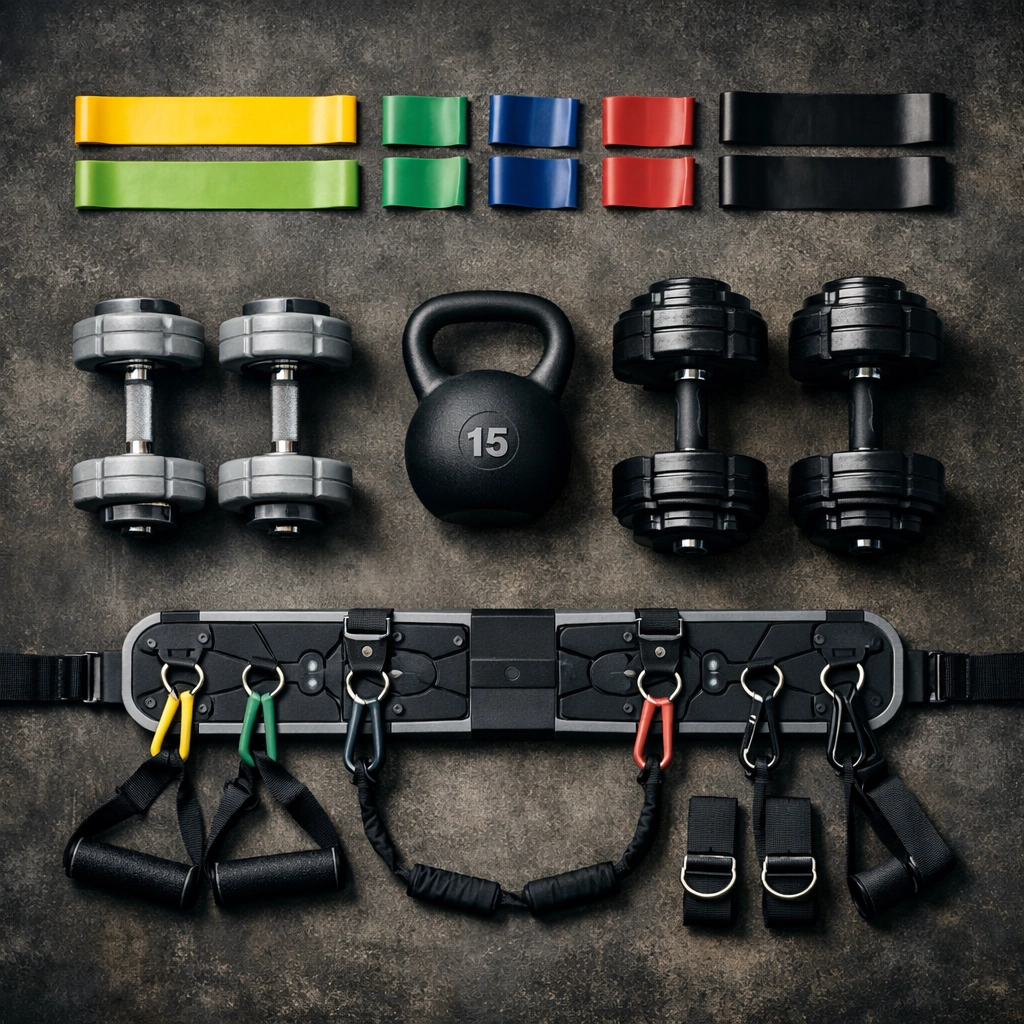
The beauty of systems like the Resistance Rail from Bold Body Fitness is the infinite adjustability. You can micro-adjust resistance by changing band tension or body angle, making it perfect for progressive overload without buying 47 different dumbbells.
Test yourself weekly. Track your numbers. If you're not gradually increasing load, volume, or difficulty over time, you're not progressing: you're maintaining.
Mistake #4: Training to Failure Like a Madman
The Brutal Truth: The "no pain, no gain" crowd has poisoned your brain. Training every set to complete muscular failure isn't hardcore: it's counterproductive.
When you grind every set until your muscles quit, you accumulate massive fatigue without proportional gains. You fry your central nervous system. You increase injury risk exponentially. And research shows you actually make WORSE strength gains than stopping just short of failure.
A 2016 study in the Journal of Sports Medicine found that non-failure training produces superior results for both strength and hypertrophy compared to training to failure. The reason? You maintain higher quality volume across your entire workout instead of destroying yourself on set one.
The Fix: Leave 1-2 reps in the tank on most working sets. This is called "RIR" (Reps In Reserve), and it's how smart athletes train for long-term progress.
Use this approach:
- Warm-up sets: Nowhere near failure (3-5 RIR)
- Working sets 1-2: Challenging but controlled (2-3 RIR)
- Final working set: Push closer to limits (0-1 RIR)
- Occasional max effort: Once every 2-3 weeks, test true failure
For serious calisthenics equipment for home work like muscle-ups or one-arm pull-up progressions, training to failure is especially dangerous. These high-skill movements require pristine technique. Grind them into the ground, and you're practicing bad movement patterns while fatigued.
Progressive overload doesn't mean destroying yourself: it means consistently doing slightly more quality work over time.
Mistake #5: Treating Recovery Like a Weakness
The Brutal Truth: You don't get stronger in the gym: you get stronger during recovery. Training breaks muscles down. Rest builds them back up. Skip recovery, and you're just repeatedly damaging yourself without adaptation.
The "more is better" mentality destroys more home trainers than any other mistake. Without the forced rest periods of scheduled gym classes, people hammer themselves daily. Seven days a week. Sometimes twice a day. All intensity, no recovery.
Your muscles don't care about your dedication. They care about having time to repair, adapt, and grow stronger. Deny them that, and you'll end up weaker, more injury-prone, and perpetually exhausted.
The Fix: Program intelligent recovery into your training week. Here's how serious athletes do it:
Option 1 - Full Body Split:
- Train full body Monday/Wednesday/Friday
- Active recovery or off Tuesday/Thursday/Saturday/Sunday
Option 2 - Upper/Lower Split:
- Upper body Monday/Thursday
- Lower body Tuesday/Friday
- Active recovery Wednesday/Saturday
- Complete rest Sunday
Option 3 - Push/Pull Split:
- Pushing movements (dips, push-ups, overhead press) Monday/Thursday
- Pulling movements (pull-ups, rows, face pulls) Tuesday/Friday
- Legs Wednesday/Saturday
- Rest Sunday
For athletes training with a CrossFit home gym setup at Bold Body Fitness, this might mean alternating between strength-focused days and conditioning-focused days, ensuring muscle groups get 48-72 hours between heavy loading.
Active recovery matters too: walking, yoga, light swimming, foam rolling. Movement without intensity helps flush metabolic waste and accelerates recovery.
Sleep is non-negotiable. If you're getting less than 7-8 hours, you're capping your gains regardless of training quality. Muscles literally repair and grow during deep sleep cycles.
Mistake #6: Program-Hopping Like It's a Dating App
The Brutal Truth: You've tried German Volume Training, then switched to 5/3/1, then jumped to some YouTuber's program, then saw an Instagram ad for another system. You've been "training" for two years but you've never actually completed a program.
Program hopping is training ADHD, and it's killing your progress. Every program works: if you stick with it long enough to actually see results. But you're chasing novelty instead of results, constantly starting over at square one.
Research shows that the longest training interventions (those lasting 53+ weeks) produce the best results, with subjects continuing to improve as long as they maintained consistency. You can't evaluate a program in three weeks. You need months to see what it can do.
The Fix: Choose one intelligent program and commit for at least 12-16 weeks. Not sort-of commit. Actually commit.
For home training with no wall damage workout system equipment like the Resistance Rail, a simple linear progression works beautifully:
Weeks 1-4: Adaptation phase (moderate volume, perfect technique)
Weeks 5-8: Volume phase (increase sets and reps)
Weeks 9-12: Intensity phase (increase resistance, decrease volume)
Weeks 13-16: Peak and deload
Track everything. Compare week 16 to week 1. That's how you measure program effectiveness: not by how sore you feel or how "hard" the workouts seem.
The program doesn't need to be perfect. It needs to be good enough and followed consistently. A mediocre program executed flawlessly beats a perfect program executed half-heartedly every single time.
Mistake #7: Flying Blind Without Progress Tracking
The Brutal Truth: If you're not tracking your workouts, you're just showing up and hoping for the best. Hope is not a strategy. Data is.
Most home trainers have no idea if they're actually getting stronger. They "think" they are. They "feel" like they are. But they have zero objective evidence. Then they wonder why their strength has plateaued for six months.
Without tracking, you can't progressively overload. You can't identify weak points. You can't celebrate wins. You're just randomly exercising and praying that adaptation magically happens.
The Fix: Maintain a detailed training log. Not complicated: just comprehensive. Record:
- Date and time
- Exercises performed
- Sets and reps completed
- Resistance used (band color, weight, body angle)
- Rest periods
- Subjective difficulty (1-10 scale)
- Notes on form, energy, any issues
Review weekly. Are your numbers going up? Even slightly? If you're not setting small PRs (personal records) every 2-3 weeks, something needs to change.
For pull up bar alternative training using a versatile system, track variations: strict pull-ups, weighted pull-ups, L-sit pull-ups, archer pull-ups. Master each progression before moving to the next.
Your log becomes your competition. Every workout is a chance to beat your previous best. Add one rep. Add five pounds. Decrease rest by ten seconds. Improve time under tension.
Small, tracked improvements compound into massive strength gains over months and years.
The Bottom Line: Stop Sabotaging Yourself
These seven mistakes are silent progress killers. They're not dramatic. They're not obvious. But they're absolutely devastating to your long-term strength development.
Here's what changes today:
- Warm up properly - No exceptions, no shortcuts
- Use full range of motion - Film yourself to verify
- Choose appropriate resistance - Challenge yourself honestly
- Stop short of failure - Train smart, not just hard
- Prioritize recovery - Growth happens during rest
- Commit to one program - See it through completely
- Track everything - Data drives progress
Set up your home gym equipment right, eliminate these mistakes, and watch your strength explode. The gains were always there; you were just blocking them with self-sabotage.
Your move.
