

You've been staring at your spare room, garage, or basement thinking the same thing: How do I turn this space into a legit training zone without destroying it?
If you're serious about bodyweight training at home: whether you're grinding through calisthenics progressions, prepping for a Ninja Warrior course, or supplementing your CrossFit WODs: you've probably narrowed it down to two main options: a traditional pull up bar or a floor to ceiling gym system.
Both will get you off the ground. But only one will unlock a true full body workout at home.
Let's break it down, no fluff, no filler. Just the facts you need to make the right call for your training goals.
The Traditional Pull Up Bar: Old Faithful
Pull up bars have been around forever. Door-mounted, wall-mounted, ceiling-mounted: pick your poison. They're simple, relatively affordable, and they work.
What you get with a standard pull up bar:
- Pull ups and chin ups (obviously)
- Hanging leg raises
- Some bar hang variations
- Limited gymnastic movements
For a lot of people, that's enough. If all you want is to bang out sets of pull ups and call it a day, a basic bar will do the job.
But here's the reality check: a pull up bar is a one-trick pony.

The Limitations Nobody Talks About
Sure, ceiling-mounted pull up bars can handle impressive loads: some up to 200 kg: and give you enough clearance for full range of motion. Wall-mounted versions offer even more stability.
But they come with serious trade-offs:
Permanent installation. You're drilling holes. Into your ceiling. Or your walls. That's fine if you own your place and plan to stay forever. Not so fine if you're renting, renovating, or just don't want to deal with the damage.
Limited exercise variety. Pull ups, chin ups, leg raises... and then what? You're stuck doing the same handful of movements. For serious athletes training calisthenics equipment for home use, that's a ceiling you'll hit fast (pun intended).
Zero resistance training options. Want to add bands? Cables? Suspension trainers? You'll need additional anchor points, more drilling, more equipment scattered around your space.
No push movements. A pull up bar only handles half the equation. What about dips? Push ups with elevation? Horizontal pressing? You're left buying more gear to fill the gaps.
For casual fitness? A pull up bar is fine. For anyone chasing real performance: ninja warriors, MMA fighters, gymnasts, CrossFit athletes: it's a starting point, not a destination.
The Floor to Ceiling Gym: The Complete Package
Here's where things get interesting.
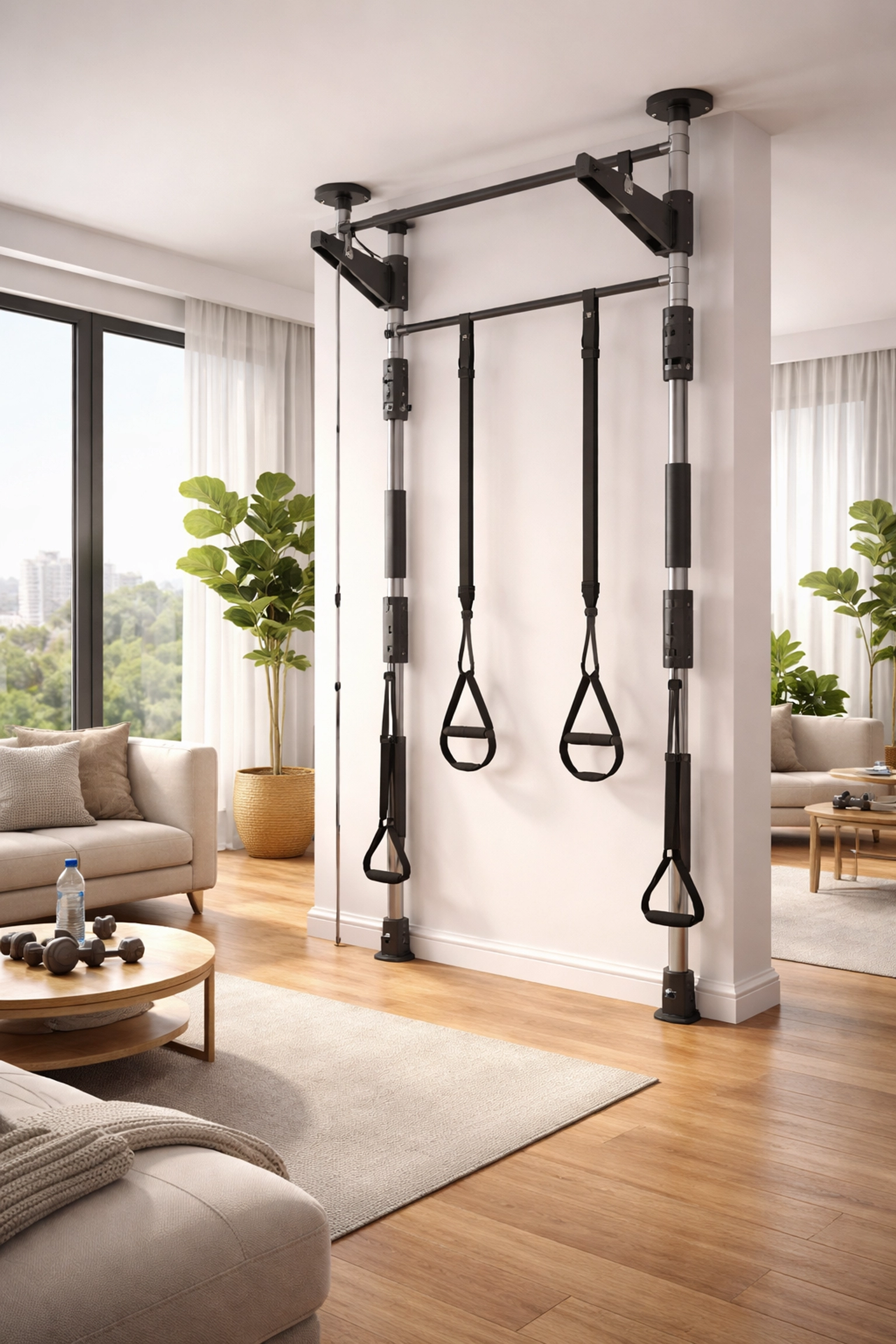
A floor to ceiling gym isn't just a pull up bar with fancy marketing. It's a fully integrated versatile home gym system that transforms any room into a complete training station.
The concept is simple: instead of drilling into walls, you use a tension-based system that locks securely between your floor and ceiling. No damage. No permanent installation. Full functionality.
What Makes It Different
True full body capability. We're talking pull ups, dips, rows, push ups, suspension training, resistance band work, cable exercises, hanging core work: all from one system. That's not hype. That's math. More attachment points equals more exercises equals better results.
No wall damage workout system. This is massive for renters, homeowners who don't want holes everywhere, and anyone who might need to move their gym setup. You install it, you train on it, you take it down without leaving a trace.
Scalable resistance training. Floor to ceiling systems like the Resistance Rail Deluxe are designed to work with bands, cables, and attachments. That means you can progress from bodyweight basics to loaded movements without buying a rack full of equipment.
Space efficiency on another level. A pull up bar uses overhead space. A floor to ceiling gym uses the entire vertical column of your room. Same footprint, exponentially more training options.
Head-to-Head: Pull Up Bar vs Floor to Ceiling Gym
Let's get specific. Here's how these two options stack up across the metrics that actually matter for your home gym equipment decision.
Exercise Variety
Pull Up Bar: Limited to pulling movements and hanging exercises. You can get creative with grip variations, but you're still working the same movement patterns. Front levers and back levers are possible on quality bars, but that's about where it ends.
Floor to Ceiling Gym: Full spectrum training. Upper body pulls, upper body pushes, core work, lower body assistance exercises, suspension training, band-resisted movements. One system, dozens of exercises.
Winner: Floor to ceiling gym, and it's not close.

Installation and Portability
Pull Up Bar: Permanent. You're committing to those holes in your structure. Moving? You're either leaving it behind or patching drywall.
Floor to Ceiling Gym: Tension-based setup means no drilling required. Set it up in minutes, take it down when needed, reinstall somewhere else. Perfect for the no wall damage workout system crowd.
Winner: Floor to ceiling gym.
Durability and Load Capacity
Pull Up Bar: High-quality ceiling and wall-mounted bars can handle 200-250 kg. Solid for static holds and controlled movements.
Floor to Ceiling Gym: Comparable load capacity with proper installation, plus the added benefit of multiple anchor points distributing force. Systems like the Resistance Rail are built for dynamic, explosive training: not just slow, controlled reps.
Winner: Tie, assuming you buy quality in either category.
Cost-Per-Exercise Value
Pull Up Bar: Cheaper upfront, but you'll spend more over time adding equipment to fill the gaps. Dip station, suspension trainer, resistance bands, anchor points... it adds up.
Floor to Ceiling Gym: Higher initial investment, but you're getting a versatile home gym that replaces multiple pieces of equipment. Long-term, it's the smarter spend.
Winner: Floor to ceiling gym for serious trainers.
Who Should Choose What?
Let's keep it real. The right choice depends on who you are and how you train.
Stick With a Pull Up Bar If:
- You only care about pull ups and basic hanging work
- You're on a tight budget with no plans to expand
- You own your space and don't mind permanent installation
- You're supplementing a commercial gym membership, not replacing it
Go Floor to Ceiling Gym If:
- You want a legit crossfit home gym or calisthenics setup
- You're a ninja warrior, gymnast, MMA fighter, or serious athlete
- You need a pull up bar alternative that does way more
- You rent or don't want to damage your walls
- You want one system that handles resistance training and bodyweight work
- You're building a full body workout at home without cluttering your space
The Bold Body Fitness Approach
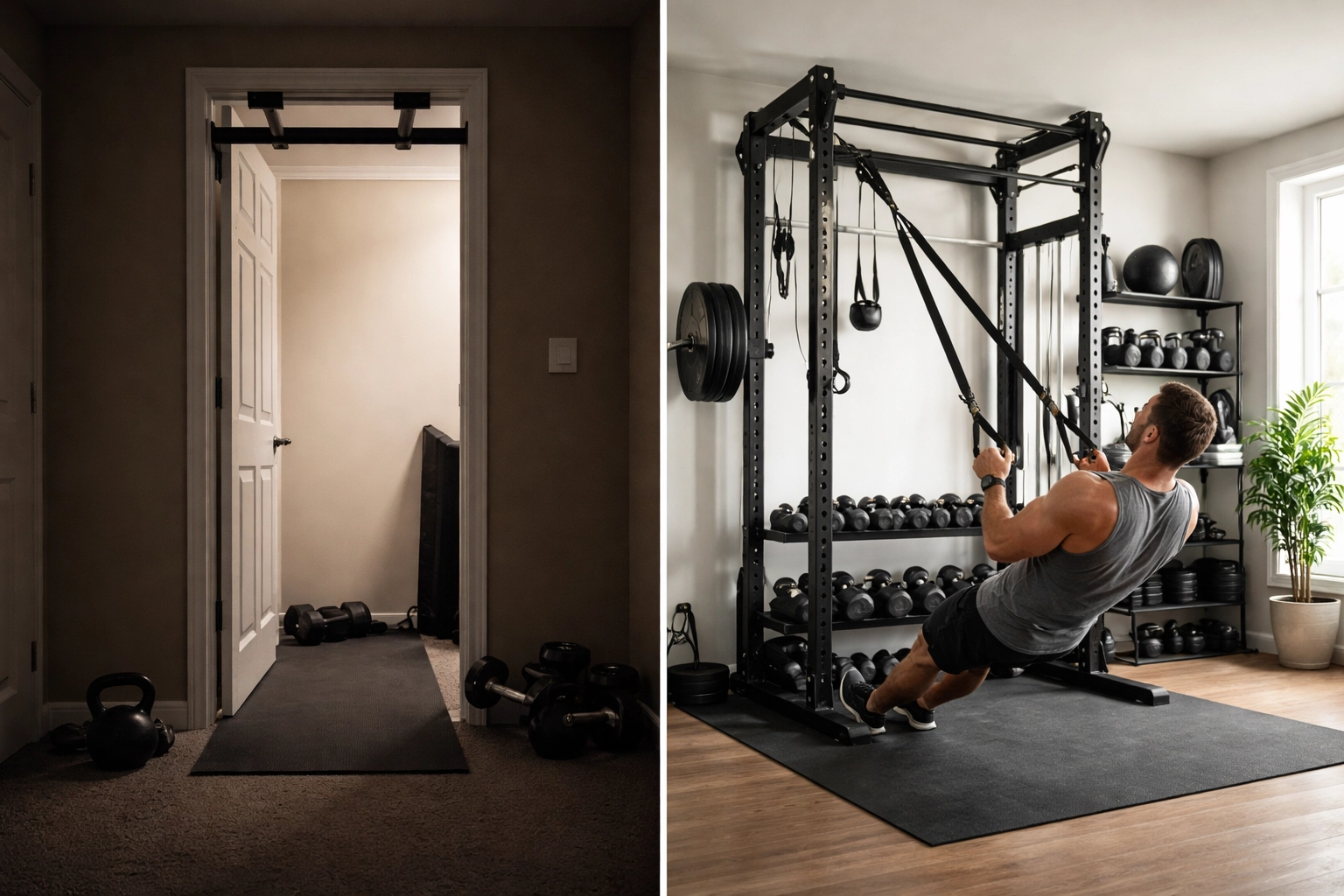
At Bold Body Fitness, we built our equipment for athletes who refuse to compromise. The Resistance Rail system is engineered specifically as the ultimate calisthenics equipment for home use: delivering gym-level training capability without the gym-level footprint or wall destruction.
Whether you're working muscle ups for your next Ninja Warrior qualifier, drilling guard passes for MMA, or chasing that first strict handstand push up, the Resistance Rail Deluxe gives you the tools to get there.
No excuses. No limitations. No holes in your walls.
Check out our full lineup in the Bold Body Fitness Shop and see what's possible when your home gym equipment actually matches your ambition.
The Bottom Line
A pull up bar is a tool. A floor to ceiling gym is a training system.
If you're just dabbling in fitness, the pull up bar will serve you fine. But if you're serious about bodyweight training at home: if you want to progress, to challenge yourself, to train like the athlete you're becoming: you need equipment that grows with you.
The floor to ceiling gym isn't just better. It's the difference between working out and actually training.
Make the bold choice.
